-

The interior of the infrastructure becomes a flexible, reprogrammable space for present and future
-
The park’s radical structure reclaims former wastewater plant land and creates a new leisure park
-
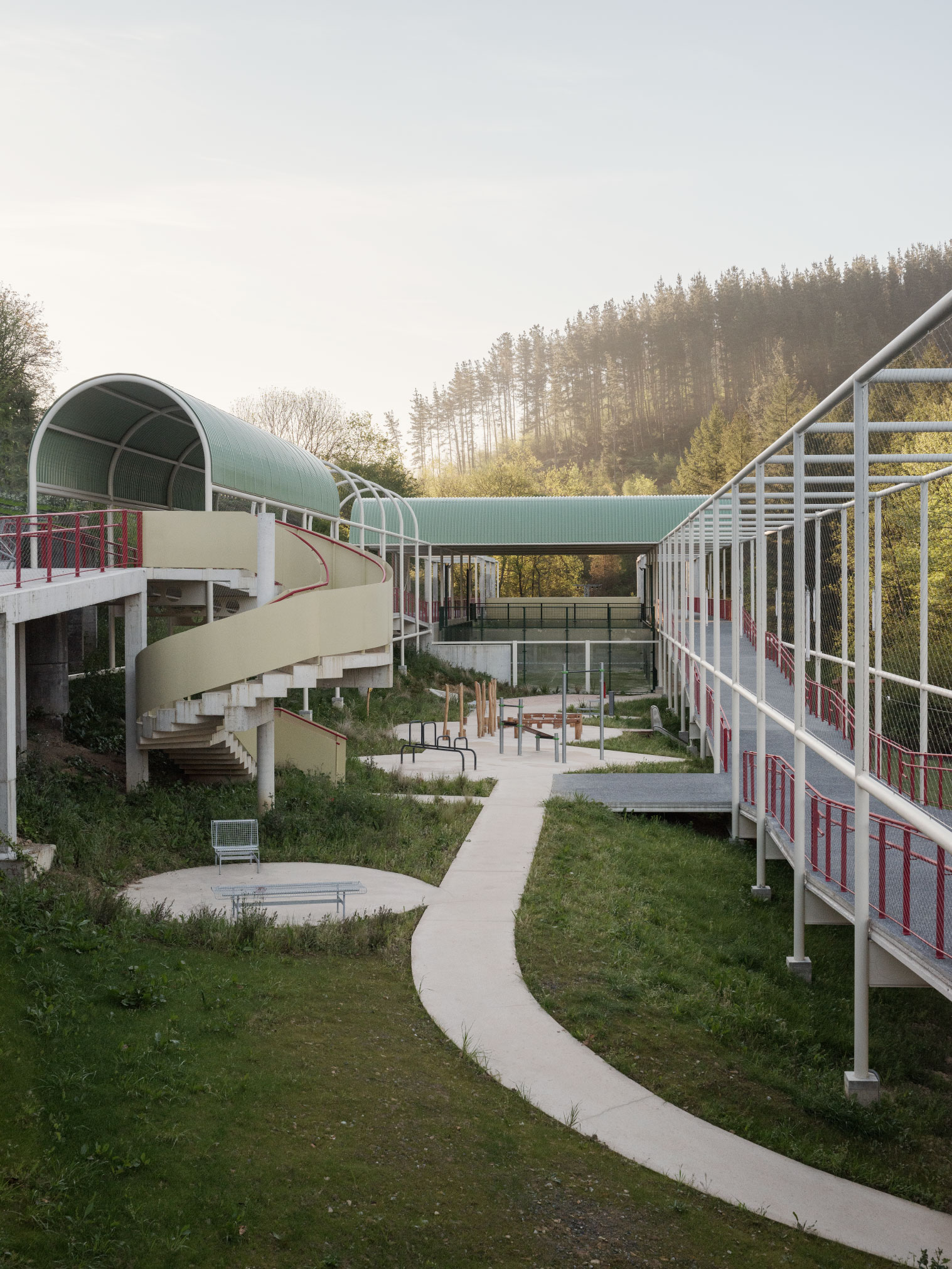
Vaulted roof providing a covered space for outdoor activities.
-
Circular walkway anchors the linear structure and creates a new landscape route.
-
Urban connection: the sculptural staircase creates a direct formal and symbolic link with the town.
-
Aerial view of the linear structure restoring the town–nature edge
-
Set of sections of walkways and terrain
-
Set of sections showing cuts and fills to balance the earthworks without removing soil from the site
-
Working model
-
Walkway construction detail in section and elevation
-
Axonometric view of the overall project
-
Site plan
Zubitegi Park
Bear Architects. Mallabia, Spain
-
Name of work in English
Zubitegi Park
-
Name of work in original language
Zubitegi Parkea
Prize year
EUmies Awards 2026
-
Work Location
Mallabia, Spain
-
Studio
Bear Architects
EUmies Awards 2026 Nominees


Collaborators
Program
Landscape
-
Labels
Gardens & Parks · Regeneration · Structure · Facilities
Site area
12005 m²
-
Client
Ayuntamiento de Mallabia
Total gross floor
3731 m²
Cost
320 €/m²
Located on the southern edge of Mallabia (Basque Country), the project transforms a degraded riverbank once occupied by a wastewater treatment plant into a public sports and leisure park. Instead of a conventional building, it proposes a linear open-air infrastructure composed of ramps, walkways and a lightweight vaulted canopy that adapts to the terrain. The project restores the Zubitegi river landscape and connects the town with its natural surroundings, creating a new civic topography that enables free and inclusive use throughout the year.
The project operates on a harsh, artificial site: a former wastewater treatment plant trapped between industrial warehouses that sealed the southern edge of Mallabia and broke its relationship with the landscape. This was not natural land to protect but a damaged industrial void to reclaim as common ground. Rather than adding another architectural object, the strategy is to renaturalise and re-open the site to collective use through infrastructure. A 19-metre slope is negotiated by a radical system of ramps and walkways that extend the axis of the town’s main street and stitch the fragmented topography. Their geometry frees a linear accessible platform at mid-level: a public ground where to walk, meet, train, watch and be watched. Conceived as an anti-building, the project assumes the industrial memory of the place, transforming it into a civic framework. It resists enclosure and privatisation, asserting public space as a shared territorial right.
The site’s structural strategy responds to the poor geotechnical condition of the site with unstable sludge layers. To avoid deep foundations, the project is assembled from the upper edge of the slope using a progressive system of prefabricated steel porticos. Precast slabs span between frames and are backfilled to consolidate a linear topography. Boyd beams carry visible services, reinforcing the industrial clarity of the system and simplifying maintenance. Material austerity and serial assembly reduce cost, time and impact. The colour strategy critically reinterprets the industrial past: soft pastel tones add irony, transforming productive language into civic infrastructure. No synthetic protective pavements are used. Instead, permeable layers and planted embankments stabilise the terrain and restore hydrological continuity along the Zubitegi riverbank. The result is engineered wilderness: a robust structure gradually absorbed by vegetation. Construction as civic land recovery.