-

Zone 0 : nuclear island
-
1 situation
-
2 the protocol
-
3 radioactive cartographies
-
4 protocol cronogram I
-
5 protocol cronogram II
-
6 protocol cronogram III
-
Zone 0 : nuclear island panel
-
Zone 0 : nuclear island
María Escudero García. Madrid, Spain
-
Name of work in English
Zone 0 : nuclear island
-
Name of work in original language
Dismantling and closing CIEMAT. Thoughts about radioactivity and time
Prize year
Young Talent 2020
-
Work Location
Madrid, Spain
-
Author/s
María Escudero García
-
School
Madrid School of Architecture - Polytechnic University of Madrid.
Madrid, Spain
Young Talent 2020 YT Nominees


Zone 0 : nuclear island
Dismantling and closing CIEMAT. Thoughts about radioactivity and time
Program
Mixed use - Infrastructure & Urban
-
Labels
Aggregation · Master plan · Energy · Regeneration · Treatment
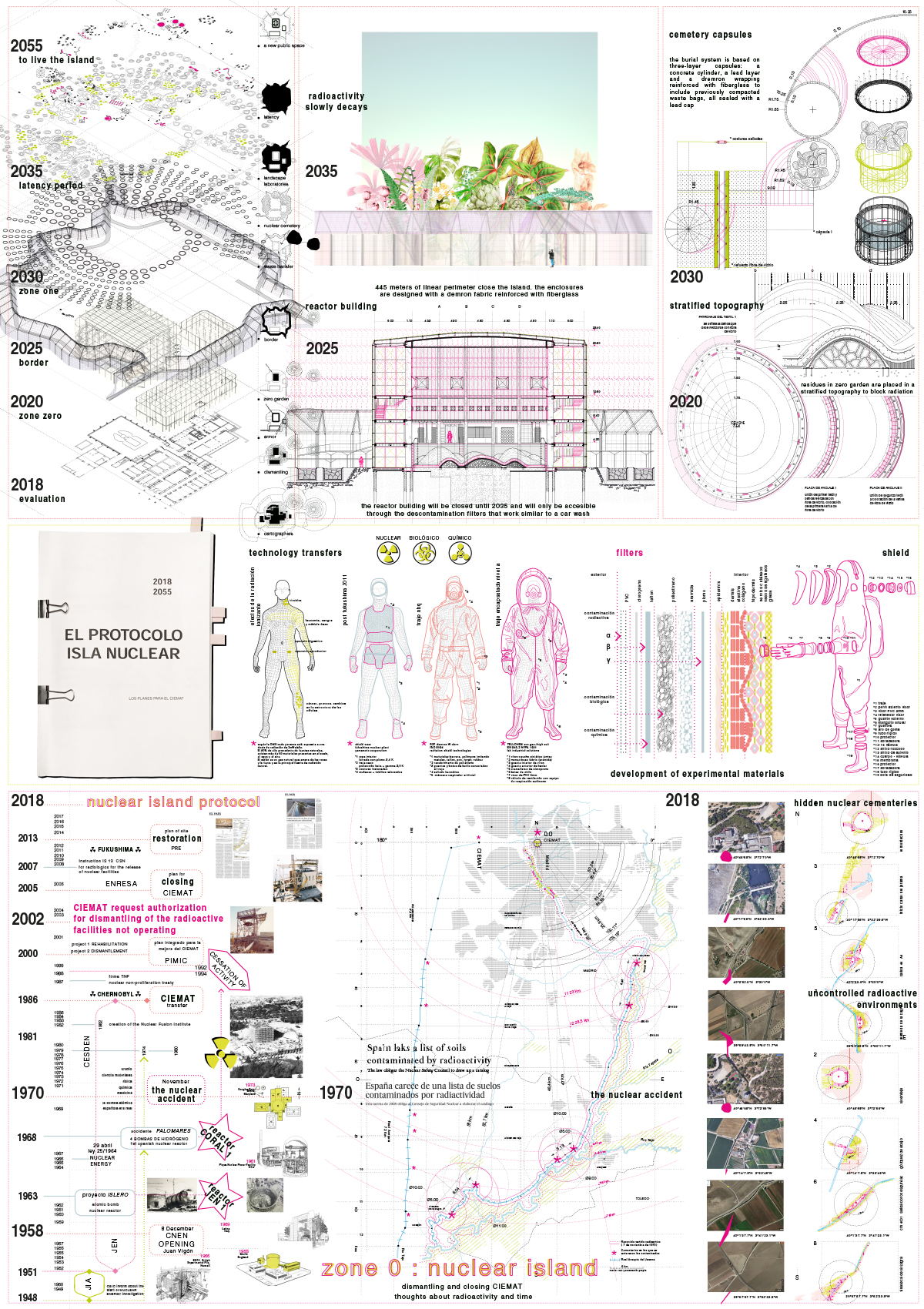
Zone 0 : nuclear island, is an architectural project that must be understood as a process, a means of research to demonstrate that with architecture we can articulate strategies and protocols to solve contemporary challenges of enormous technological complexity.
In Madrid, we can find the most radioactive point in Spain and we are not even aware of it. In 1958 Franco founded the Nuclear Energy Board, which had the first Spanish experimental reactor. In 1970 a leak left radioactive coolant that ends in the Manzanares river. This is actually the largest nuclear accident in Spain. The dictatorship carried out Operation Tajo, in which the waste generated by the accident was buried in 8 secret points, two of them in the Nuclear Energy Board, currently CIEMAT. Since 1994, calls have been made for the closure of this facilities, but none of the plans have been implemented. I found in this situation the opportunity for the architecture project, the possibility of creating a safe nuclear island, decontaminate the place and propose a future use, giving back to the public a recovered space of the city. This final thesis project started the day the investigation began. I had to build the context to frame the proposal between research and practice. It was necessary to generate new tools of work taken from other disciplines that would help me design my proposal and with all that I had learned, in 2018 I drafted the Nuclear Island Protocol, a sequence of events, actions over time to record the transformation process of a contaminated site. Based on three parameters: wind, soil and wrapping, I designed a project that was measured in radioactivity, distance and time. The implementation of the Protocol takes 37 years and is divided into 6 phases theoretically described and develop along the project. The aim is to propose a methodology that brings together the previously investigated techniques and the experimental ones proposed and designed by me. These are technological transfers such as anti-radiation suits turned into facades, botanical studies on plants that absorb radiation, transformed into landscape laboratories or engineering techniques with which to build my nuclear cemetery. The nuclear island is a living project, a process, and an investigation to reflect on a conflicting reality: how to build livable radioactive environments.