-

THE PROJECT
-
A CITY DIVIDED IN TWO
-
A HISTORICAL COMPARISON
-
THE PORT AND THE SEA
-
MORE THAN ONE OPTION
-
A LIFT BRIDGE
-
ONE BRIDGE - TWO WAYS OF CROSSING
-
THE PANEL
-
When Crossing Becomes an Experience
Laurent Bongen. Ostend, Belgium
-
Name of work in English
When Crossing Becomes an Experience
-
Name of work in original language
A study on how to cross the port of Ostend
Prize year
Young Talent 2023
-
Work Location
Ostend, Belgium
-
Author/s
Laurent Bongen
-
School
Faculty of Architecture, Architectural Engineering and Urban Planning - Catholic University of Louvain-la-Neuve.
Louvain-la-Neuve, Belgium
Young Talent 2023 YT Nominees



When Crossing Becomes an Experience
A study on how to cross the port of Ostend
Program
Mixed use - Infrastructure & Urban
-
Labels
Aggregation · Bridge · Port · Public Space · Structure
The city of Ostend has transformed large parts its former port into a new residential district. In order to connect the emerging area with the city centre, the project explored ways of crossing the harbour on foot and by bike. The final proposal combines technical constraints with a focus on user experience to maximise the added value for the city.
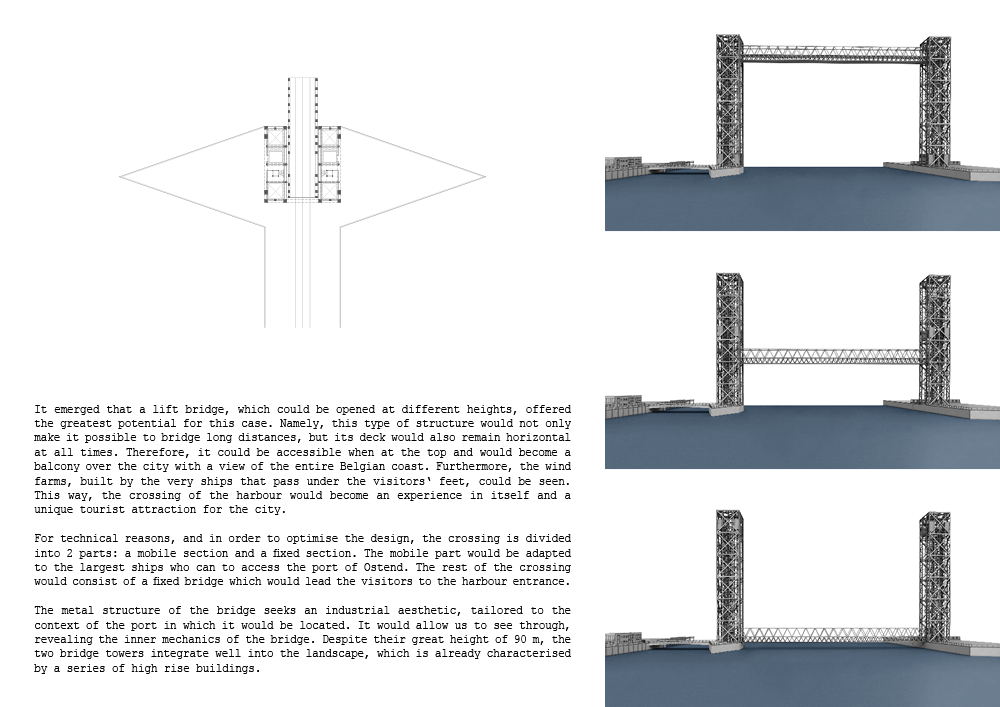
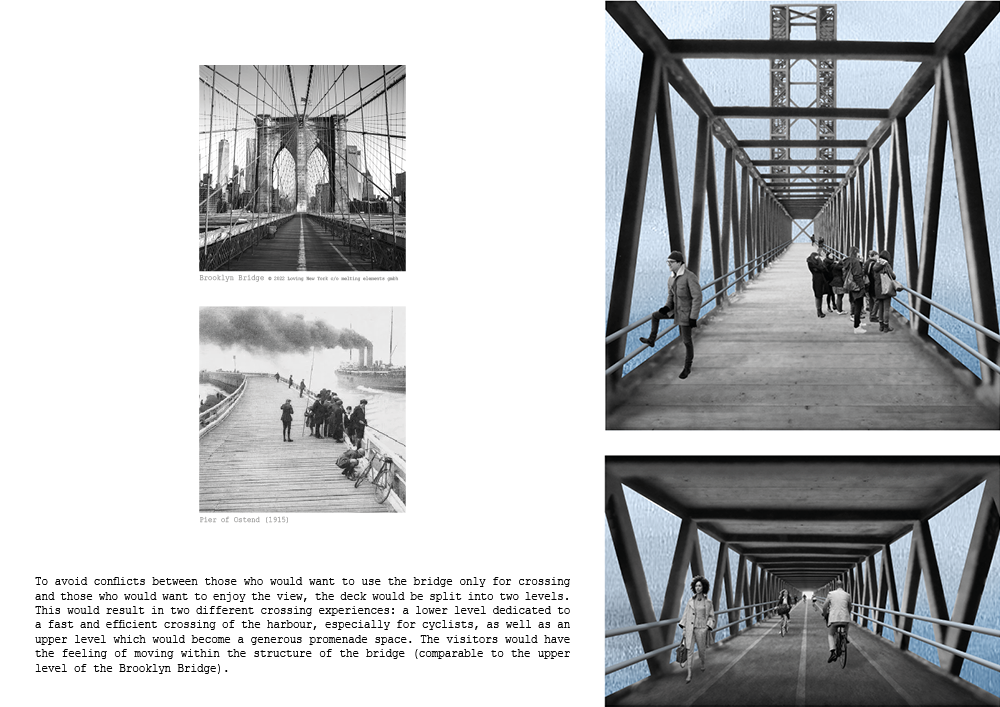
The project is founded on a detailed analysis of the functioning of the port. The characteristics and schedules of the vessels entering the harbour are particularly important. The port of Ostend has changed a lot since the end of the ferry service with England. Nowadays, it specialises in the construction and maintenance of wind turbines in the North Sea. The vessels used for this purpose are the biggest among those entering the harbour and are therefore decisive for the design proposal. Through an urban analysis of the city, three potential crossing points were identified. These then lead to several different crossing options. Each of them had certain advantages as well as disadvantages. Therefore, in developing the project further I did not focus exclusively on the most rational solution, but on the one that could bring most added value to the city. Finally, the design of a lift bridge was studied in greater detail. The proposed type of structure would not only make it possible to bridge long distances but could also be opened at different heights. Furthermore, the bridge deck would always remain horizontal, therefore allowing it to be accessible when at the top. From there, visitors could overlook the entire Belgian coast and even see the wind farms, built by the very ships that pass under their feet. Regardless of the need to let ships through, the bridge could be fully opened at certain times. In this way, the crossing of the harbour would become an experience in itself and a unique tourist attraction of the city. The bridge is designed in a way that crossing is still possible, even when it is open. Both towers feature several lifts and staircases connecting the ground floor to the bridge deck. To avoid conflicts between those who might want to use the bridge only for crossing and those who would want to enjoy the view, the deck would be split in two levels. This would result in two different crossing experiences: a lower level dedicated to a fast and efficient crossing of the harbour, especially for cyclists, and an upper level that would become a generous promenade.