-

Veil
-
Old & New
-
Porosity
-
Urban Parasite
-
Light & Volumes
-
Street Elevation
-
Axonometric
-
Section Perspective
-
Plan Level 1
-
Plan Level 4
-
South Elevation
-
East Elevation
VEIL - Renovation and Extension of Residential Building
Arid. Athina, Greece
-
Name of work in English
VEIL - Renovation and Extension of Residential Building
-
Name of work in original language
VEIL - ανακαίνηση και προσθήκη κτιρίου κατοικιών
Prize year
EUmies Awards 2026
-
Work Location
Athina, Greece
-
Studio
Arid
EUmies Awards 2026 Nominees
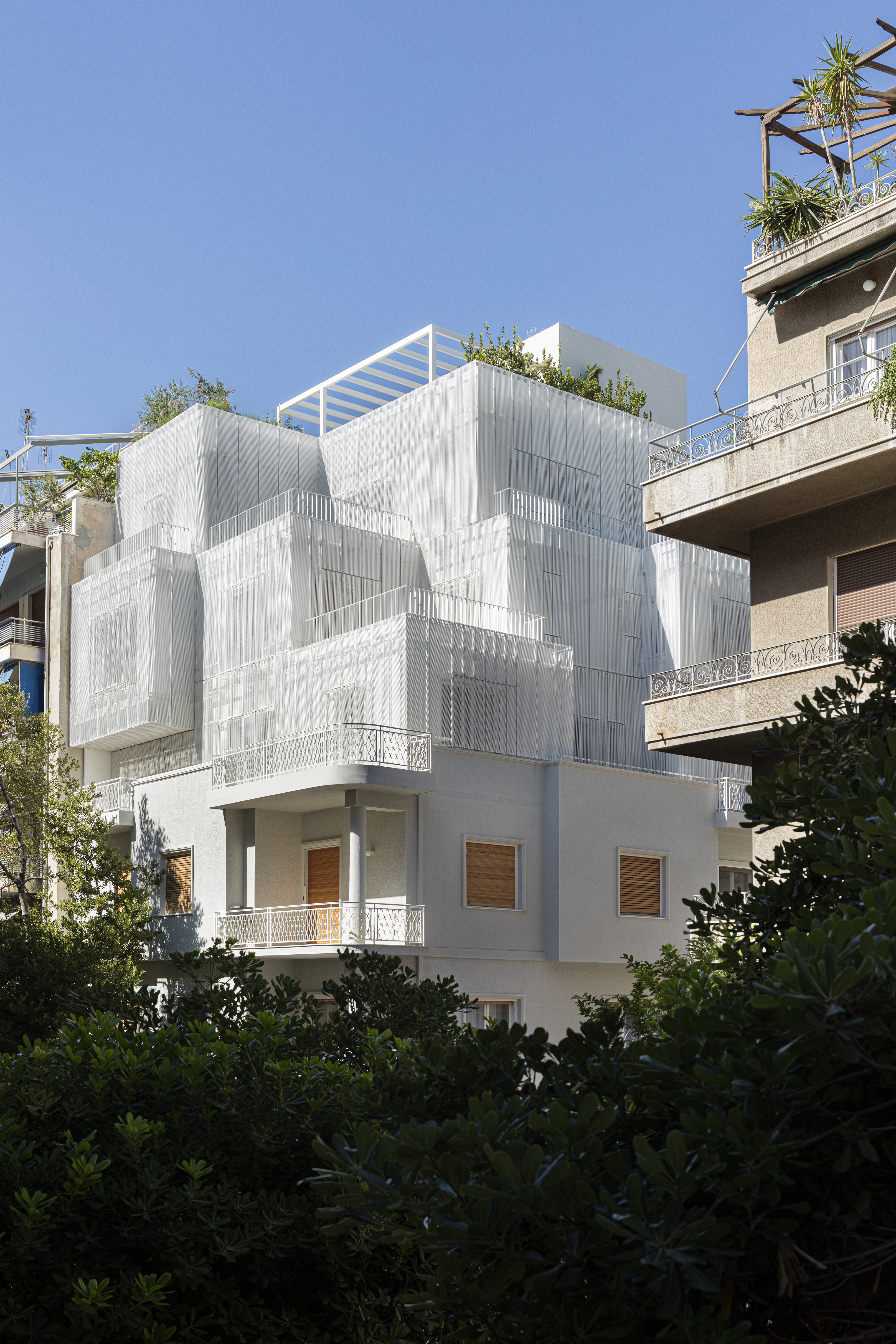


Veil reimagines a 1950s Athenian polykatoikia as a radical act of extension of the city. Wrapped in a perforated aluminum skin,the architectural addition transforms mass into lightness and opacity into openness, creating a dialogue between old and new.
Collaborators
Structure: Dimitris Antonopoulos - Dka; Structure: Andreas Alexandropoulos; Construction management: Andreas Alexandropoulos - Callen ATEE; Lighting: Anastasia Philippopoulou - Anastasia Philippopoulou; Landscape: Thanos Sklavenitis - Scape; Mechanical Study: Vasilis Kolovos - HMeng; Visuals: Andrius Raguotis - Sugar Visuals
Program
Collective housing
-
Labels
Elderly · Social · Student · Youth
Site area
267 m²
-
Client
Urban Links
Total gross floor
845 m²
Cost
1450 €/m²
Veil is a three-level addition above a 1950s structure in the residential urban fabric of Athens that redefines the Athenian polykatoikia as a collective living structure. The new intervention engages in a dialogue with the existing building, preserving its identity. A perforated aluminum shell envelopes the additional volumes creating a sense of dematerialization. Balancing presence and transparency, Veil achieves integration with the urban fabric through setbacks and reestablishes a connection among its residents and the city.
Veil confronted three intertwined challenges. The conceptual challenge was to convince the client that restraint in buildable square meters could create more value than complete exploitation, proposing a building that gains generosity through light, openness, and spatial clarity. The structural challenge involved inserting a new independent concrete frame through the existing shell, supported on its own foundation while preserving the identity of the old. The contextual challenge arose from its setting in a dense residential neighborhood that had seen no new construction for decades. To ensure acceptance, we approached the project as an act of regeneration rather than imposition, using dialogue to build trust. Together these layers shaped an architecture of historic transparency hinting at how the Athenian city can evolve.
Veil explores the contrast between the solid weight of the existing base and the light character of the addition. The project has two coordinated structures, the original and a new independent frame with its own foundations supporting the vertical addition. The restored stucco façade retains the depth of the artificiel tradition, while the upper levels, enclosed by a perforated aluminum skin, transform mass into movement. The double-skin facade acts as a passive environmental system, filters sunlight, enables natural ventilation, and stabilizes temperature through a buffer zone that limits heat gain and preserves warmth. Reuse of the existing structure lowers embodied energy and preserves the materials that safeguard the identity created through the craftsmanship of the past. Durable materials such as ceramic flooring, aluminum facade, and Pentelic marble ensure longevity and minimal maintenance, aligning sustainability with architectural design.