-

South facade - Boulevard Général Jacques
-
Apartment for resident researchers - 2 bedrooms
-
View of the main hall and the opening of the block onto Avenue de la Couronne
-
Main hall entrance
-
Hempcrete arch with recovered blue stone plinth.
-
New entrance tower giving access to the interior of the block for Rue Juliette Wytsman
-
Plan - 2nd floor
-
Est facade - Avenue de la Couronne
-
West facade - Rue Juliette Wytsman
-
Section Building A
-
South facade - Boulevard Général Jacques
-
North facade - Interior of block
USquare Feder
Callebaut architecten, BC architects & studies, evr-Architecten bvba, VK architects+engineers. Ixelles, Belgium
-
Name of work in English
USquare Feder
-
Work Location
Ixelles, Belgium
-
Studio
Callebaut architecten, BC architects & studies, evr-Architecten bvba, VK architects+engineers
Nominees
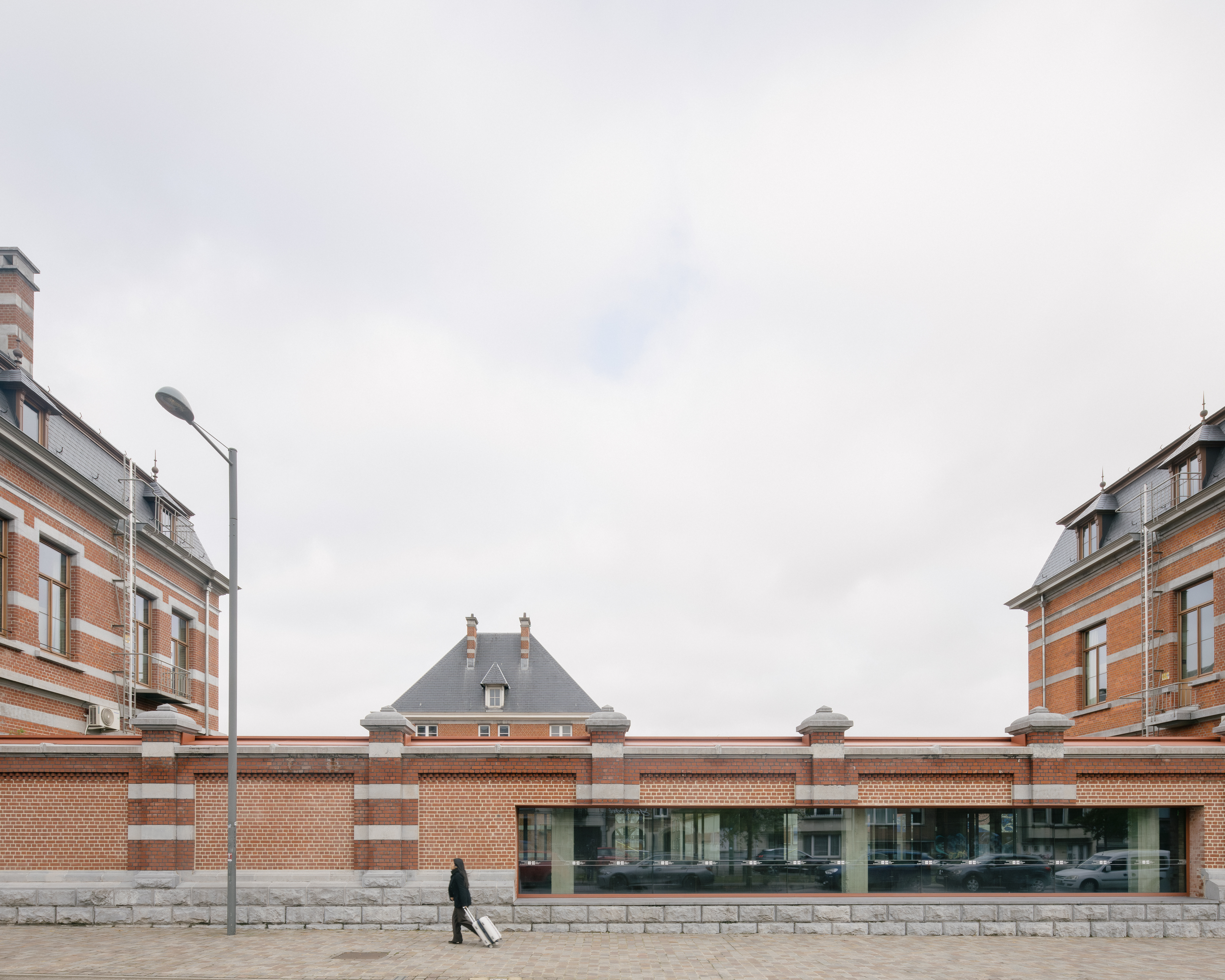


Usquare Feder exemplifies urban mining at the architectural scale. The project valorises existing structures and reclaims on-site resources to create a new research and living environment. Through circular design and bio-based innovation, it redefines how heritage can host contemporary uses.
Collaborators
Acoustic plaster research: BC materials; Acoustic plaster research: Het Leemniscaat; Technical Engineer: Emmanuel Goegebeur - VK architects + engineers; Acoustics: Lieve Van der Spiegel - VK architects + engineers; Structure: Jeroen De Wael - VK architects + engineers; Environmental: Virginie Mertens - VK architects + engineers
Program
Education
-
Labels
Research · University
Site area
4779 m²
-
Client
VUB, ULB, SAU / MSI
Total gross floor
9035 m²
Cost
1847 €/m²
Located in Ixelles, Brussels, Usquare Feder is the inaugural phase in converting the former gendarmerie barracks into a mixed-use university (ULB/VUB) district. It establishes an international research center within six renovated buildings, opening the historically closed site to the city. The project's materiality is defined by a radical circularity, where salvaged bricks, stone, and glazing are thoughtfully integrated with new bio-based elements like hempcrete and locally sourced clay plasters, respecting the site's rich heritage.
The project tackles the complex transition from a closed, mono-functional site to a porous and adaptive urban campus. Rather than erasing the past, the design capitalises on the latent spatial and material intelligence of the existing fabric. By connecting three early 20th-century buildings into one cohesive structure, the project enhances continuity and spatial generosity. Circularity is treated as an architectural driver: the dismantling of neighbouring buildings became an act of urban mining, generating a catalogue of reusable components. Programmes were tailored to existing volumes to minimise intervention, like structural interventions, while reversible infill systems allow future transformation. The project thus operates as a laboratory for sustainable renovation, coupling heritage preservation with contemporary environmental ethics.
Usquare’s construction strategy redefines material practice through reuse and local sourcing. Approximately 130 m³ of recovered bricks, 120 glazing panels, and fragments of marble were reintegrated, each tested for structural performance and durability. The pre-existing masonry was complemented by modular timber structures and demountable plywood partitions fixed with custom clips for disassembly. Bio-based materials, including hempcrete walls and clay plasters made from Brussels soils, ensure acoustic and hygrothermal comfort. Reused marble fragments were embedded in terrazzo floors, transforming remnants into ornament. This careful stratification of old and new drastically reduced CO₂ emissions while preserving embodied energy. Maintenance is facilitated by reversible and visible systems, allowing components to evolve with future uses.