-

REPRESENTATIVE GRAPHIC DOCUMENT
-
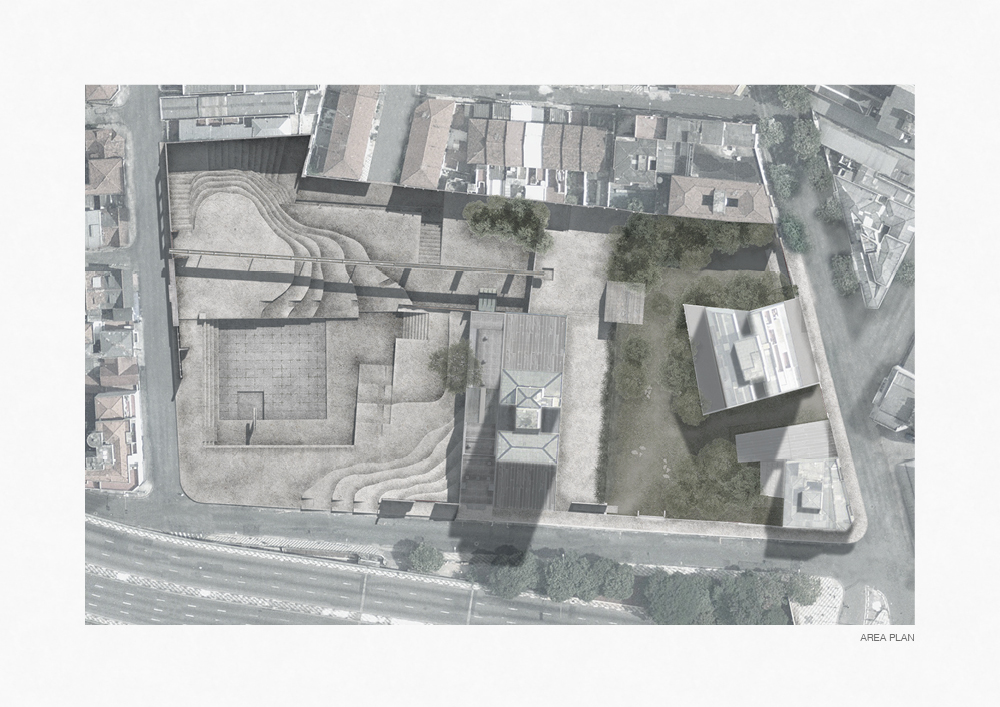
GRAPHIC DOCUMENT//AREA PLAN
-
GRAPHIC DOCUMENT//ELEVATIONS
-
GRAPHIC DOCUMENT//SECTIONS
-
GRAPHIC DOCUMENT//SHAPES
-
GRAPHIC DOCUMENT//PLAN
-
GRAPHIC DOCUMENT//MODELS
-
VERTICAL PANEL
-
-
Urban topography of São Paulo
Marco Busetti, Marta Bazzotti. São Paulo, Brazil
-
Name of work in English
Urban topography of São Paulo
-
Name of work in original language
Project for the area of ??the Teatro Oficina
Prize year
Young Talent 2018
-
Work Location
São Paulo, Brazil
-
Author/s
Marco Busetti, Marta Bazzotti
-
School
Department of Architecture and Arts - IUAV University of Venice.
Venice, Italy
Young Talent 2018 YT Nominees



Urban topography of São Paulo
Project for the area of ??the Teatro Oficina
Program
Culture
-
Labels
Theatre
The project is located in São Paulo, right next to the Teatro Oficina. A theater-street designed by Lina Bo Bardi for a theatrical company, which is a permanent location for experiments and research on new theatrical languages. It is a main cultural center not only for the city of São Paulo, but also for Brazil as a whole.
In the debris - and in their accidental way of depositing - left by this urban transformation, we have tried to identify those signs and those traces that, interpreted, could serve as potential elements to formulate our project. An important property of the place on which our work was based, is the existing topography that has been forming over the years following the accumulations and stratifications of the debris. As Lina Bo Bardi imagined, the Teatro Oficina had to open up to a public square that connected it to the other side of the street, towards the heart of the city. With this in our mind we envisioned our work as a personal re-reading of the topography, remodeling and compacting the ruins in the area. In doing so, we created an open space in the city, which welcomes the urban environment that enters it and, changing identity, is transformed into a landscape and a kind of open theatrical space. For this reason today's ground changes to create an urban landscape characterized by flexibility of uses (representations, rites, parades, popular events, etc.), a place where art, culture, architecture and everyday urban life come together and take shape. Together, they create an educational space where the Theater can transmit its principles and values, where people are called to rediscover their identity. The choice was to create a simple and bare place, which would become a single space for human action in which everything is theatrical. We chose to keep the perimeter walls remaining from the demolitions not only because it is important for us to rediscover the history of the buildings that these ruins represent, but also to keep the memory of the place and the recent history of the country alive, a personal memory that is unintentionally mixed with collective memory. The choice also aimed at keeping the walls as they are today, composing a scenic background that recalls the ordinary, not by denying reality, but making it visible.