-

Outdoor Urban Droneport view
-
New infrastructure network and sphere of action
-
Axonometric of processes and operation
-
Section and elevation
-
Floor plans
-
Structure and construction_modularity_rationality and prefabrication
-
Sustainability and facilities
-
Urban Droneport
-
-
Urban Droneport
Saul Ajuria. Madrid, Spain
-
Name of work in English
Urban Droneport
-
Name of work in original language
Drone Logistics Center + New infrastructure network
Prize year
Young Talent 2018
-
Work Location
Madrid, Spain
-
Author/s
Saul Ajuria
-
School
School of Architecture - University of Alcala.
Alcalá de Henares - Madrid, Spain
Young Talent 2018 YT Nominees


Urban Droneport
Drone Logistics Center + New infrastructure network
Program
Infrastructure
-
Labels
Intermodal · Airport
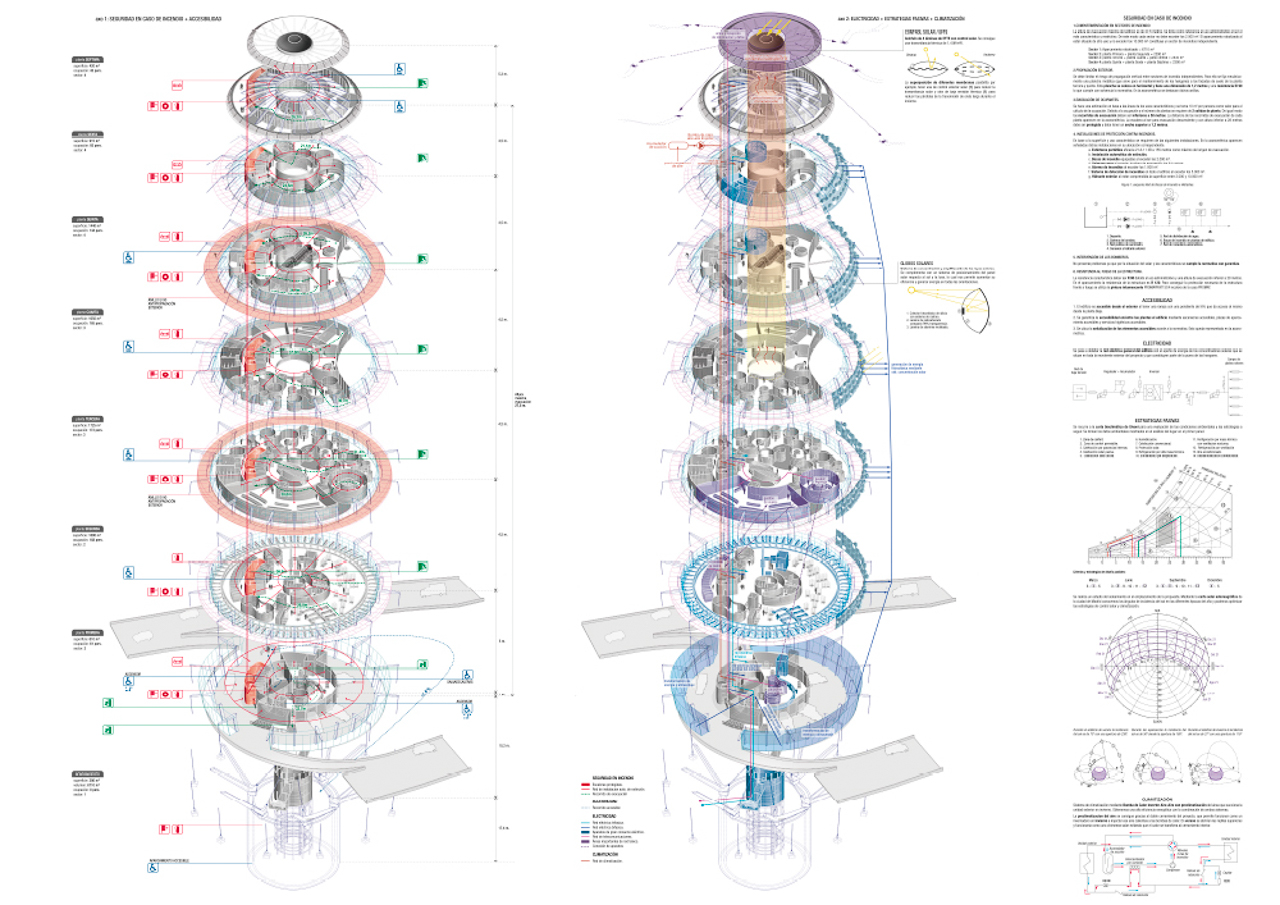
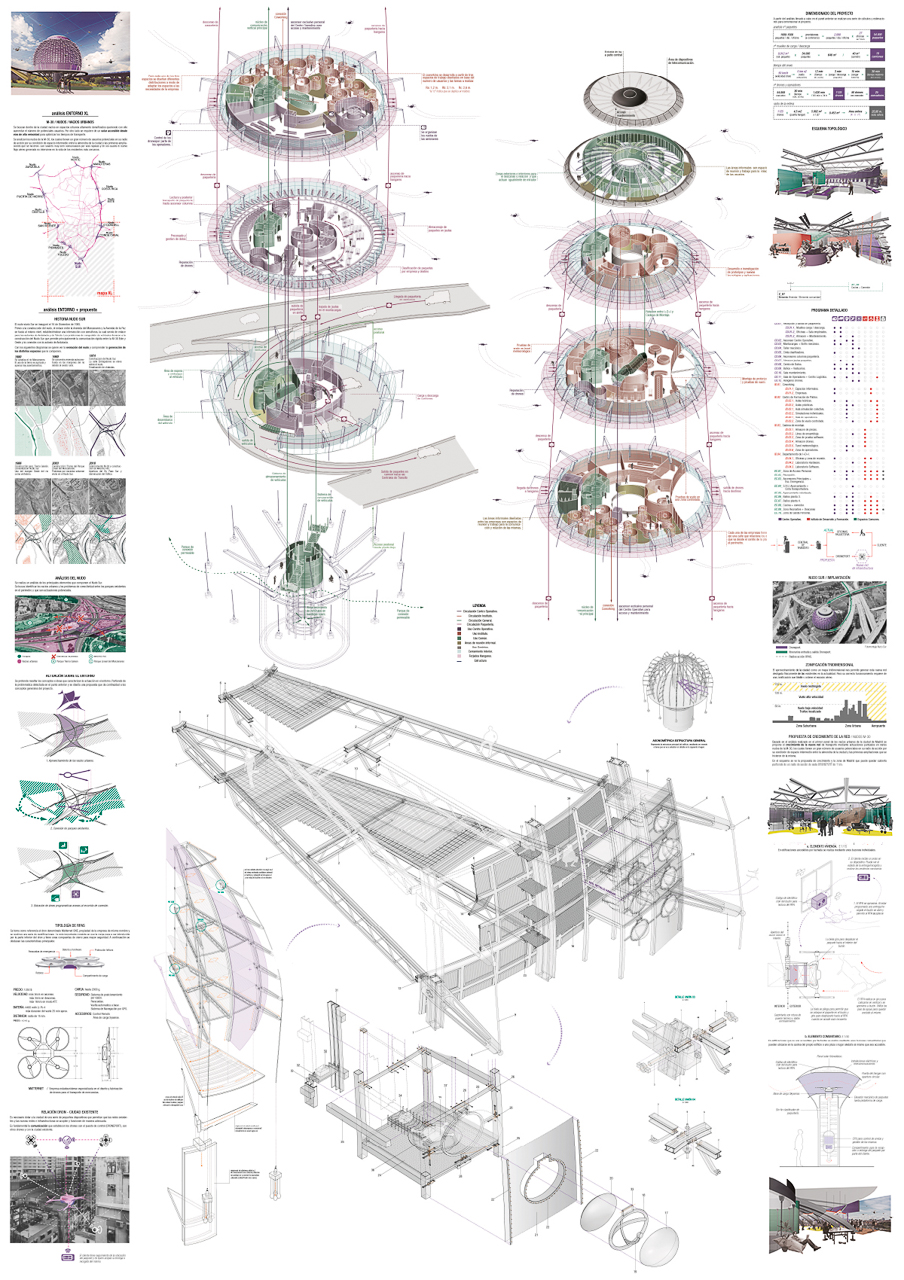
This project aims to enable the transport of goods with Remotely Piloted Aircraft Systems in urban areas. Emphasis is placed on both the design of the necessary architecture and the generation of a new infrastructure network that adapts to the existing city and makes this new delivery system possible.
The Urban Droneport is located in Madrid, within the South Node of the M-30 ring road, characterized by being a disused urban vacuum that has many potential users of the new delivery network in its range of action. The location gives the project a direct communication with the highway, which allows a quick connection with the transit centers of the delivery companies and at the same time, it gives the possibility to replicate the project in the other ring road nodes, allowing to cover the whole city center. The Droneport optimizes the logistic system's and contributes to boost all aspects for the development of the new infrastructure. After analyzing all the processes that will take place in the project, a spherical formalization is chosen. The sphere makes possible a circular development in both plant and section, which favors firstly, the distribution and management of packages and secondly, the flight of the aircraft, avoiding the appearance of turbulences. The main program of the Urban Droneport is a Logistic Center that is located in the lower levels of the sphere, thus ensuring a fast connection with the access roads and favoring the continuity of the parcel distribution chain to the hangars, which are located in the building envelope. The rest of the building allows multiple programs due to the fact that the main structure of the building is placed in the outer envelope, creating a large diaphanous central space that can be subdivided according to the needs of the program. Focusing on the constructive and structural aspects of the building, the principles are: prefabrication, modularity and rationality. The project seeks to minimize the elements and types of joints. Furthermore, it is modulated so that all the details of its construction are solved with only one of its twelve slices. To enable the operation of this new delivery system, a new infrastructure network is designed, which together with the Logistics Center, is adapted to the existing city.