-

URBAN DENSITY
-
CITY - NATURAL SUPPORT
-
GENERAL PLAN. SQUARE
-
HOUSING - TYPOLOGY 1|2
-
HOUSING - TYPOLOGY 3
-
CONSTRUCTION AND DETAIL
-
MODELS
-
SUMMARY PANEL
-
-
Urban density - Between natural and artificial
Margarida Vasconcelos. Lisboa, Portugal
-
Name of work in English
Urban density - Between natural and artificial
-
Name of work in original language
Regarding Rio Seco Urban Park
Prize year
Young Talent 2018
-
Work Location
Lisboa, Portugal
-
Author/s
Margarida Vasconcelos
-
School
Lisbon School of Architecture - University of Lisbon.
Lisboa, Portugal
Young Talent 2018 YT Nominees




Urban density - Between natural and artificial
Regarding Rio Seco Urban Park
Program
Single house
-
Labels
Row · Aggregation
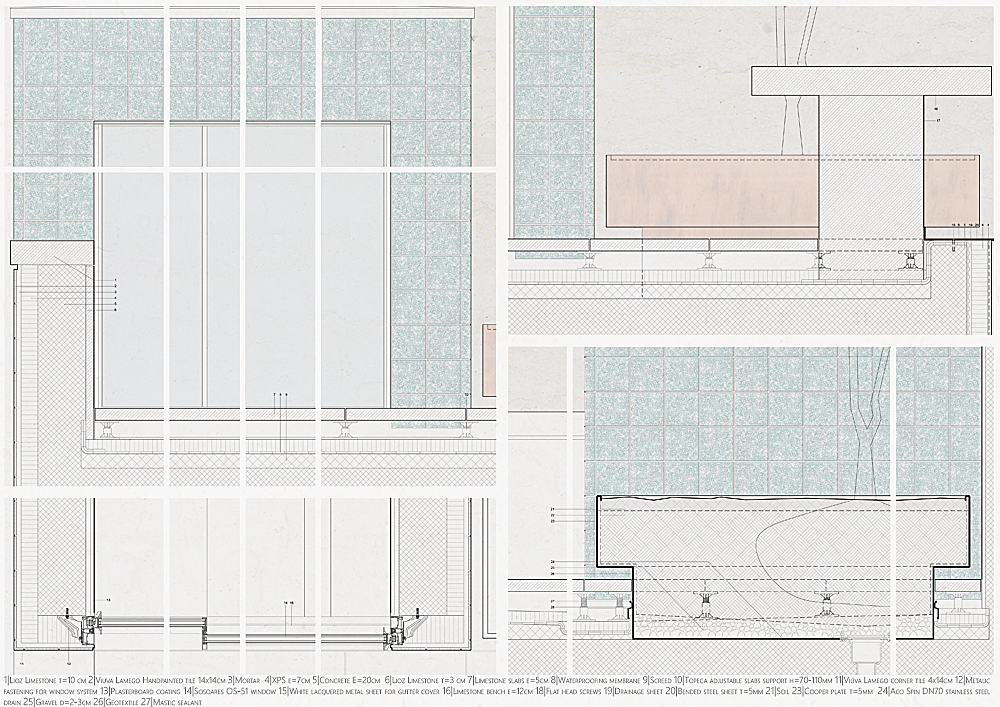
Through the observation of the territory, one discovers a city that lies on an initial support that has suffered a mutation through natural and artificial phenomena. Historical documents, myths and evidence suggest the opportunity to renaturalize a water line, currently buried and piped between Monsanto Forest Park and the Tagus River.
An urban park is proposed for this demeaned valley and comes to light through the unveiling of some of its most permanent features: the topography- it having a complex rocky territory; the geographical boundaries- left by the previous limestone mining activity; the support walls and its fountain. In an effort to consolidate a pre-existing axis – between the two different types of boundaries both natural and artificial - a proposal is formed originating from the complex typology occupation of the space by men. Wary of the different sedimentation phases of Rua do Cruzeiro, we can spot courtyards, bystreets, an archway and an urban void. Proposing the square as the regeneration of a very characteristic unnocupied lot. A certain analogy regarding the archway also comes up; the consolidation of the buildings which encompass the square and centrally the housing proposal. Three single-family typologies in a pre-existing record. Motivated by some location derived circumstances that explore: the total occupation of the lots suggested by the current clandestine model; the exploitation of the topology which suggests spaces and volumes which constantly intercept each other, and finally, the narrative between the house and its patio and between that same patio and the "almost-houses" which adhere to it. The materiality: the stone and the tile with the concrete, the steel and the copper.