-

Train station location and platforms
-
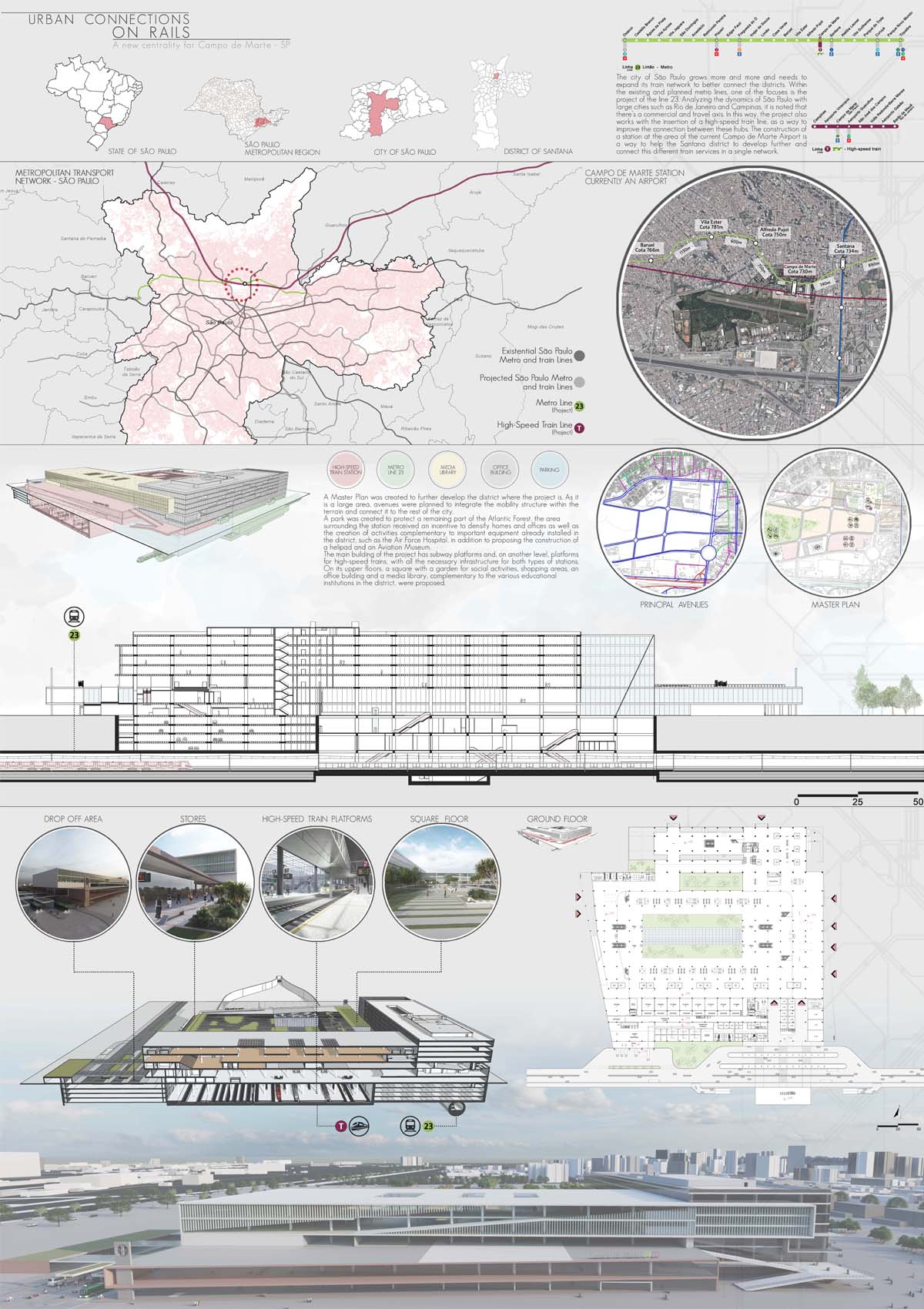
Existing and planned railway transport network and the project location in the city
-
Current situation and the master plan
-
Program and Ground Floor
-
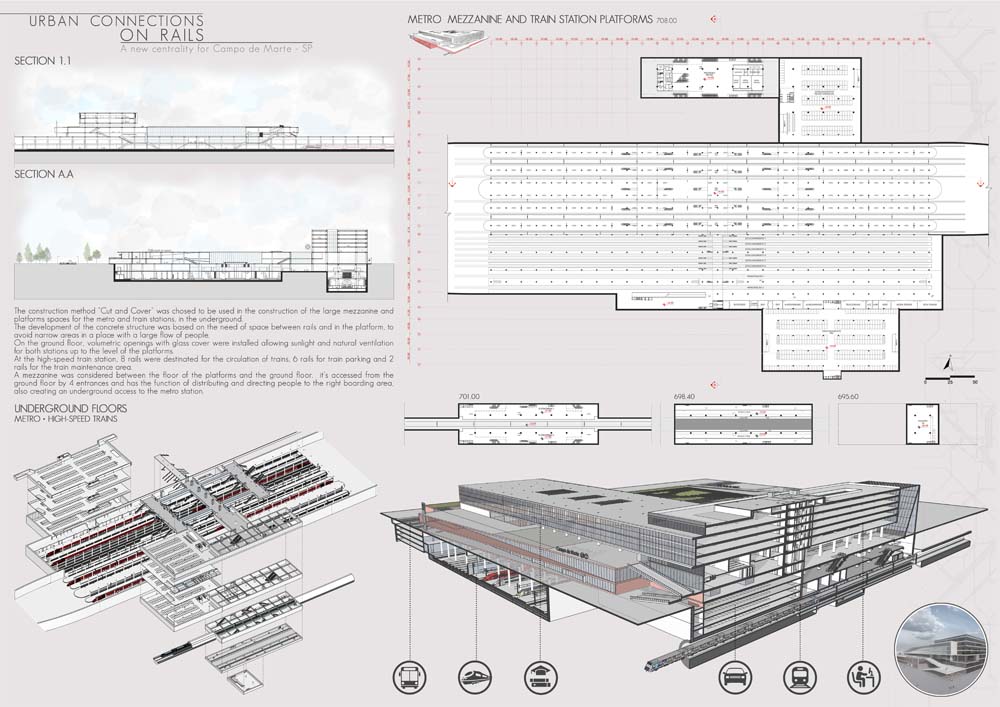
Train station mezzanine and Technical Details
-
Construction method - underground levels
-
Square, media library and office building levels
-
Project summary
-
URBAN CONNECTIONS ON RAILS
Daniel Colmanette Umino. São Paulo, Brazil
-
Name of work in English
URBAN CONNECTIONS ON RAILS
-
Name of work in original language
A new Centrality for Campo de Marte - São Paulo
Prize year
Young Talent 2020
-
Work Location
São Paulo, Brazil
-
Author/s
Daniel Colmanette Umino
-
School
Architecture and Urbanism School - Mackenzie Presbiterian University.
São Paulo, Brazil
Young Talent 2020 YT Open Nominees



URBAN CONNECTIONS ON RAILS
A new Centrality for Campo de Marte - São Paulo
Program
Mixed use - Infrastructure & Urban
-
Labels
Compact · Aggregation · Subway · Train
This study aims to understand the current dynamics within and between large urban centers, such as the city of São Paulo, where transporting people requires a large infrastructure for urban mobility. The project of a train station as a public transport knot, inside of a network, contributes to the physical and social formation of the district and the city.
An analysis of the current dynamics of the city of São Paulo and its relationship with Rio de Janeiro and Campinas, a populous cities with a high concentration of commercial activities and services, showed that the axis between these three cities is marked by a large flow of displacements. High demand has brought an overload of airport and highway services. Thus, the project works with the insertion of a high-speed train line, a mode of transport that does not yet exist in the country, as a way to intensify and improve the connection between these hubs. Thinking about local scale, the city of São Paulo grows more and more and needs to expand its train network, an efficient and high capacity transport. Within the existing and planned metro lines, one of the focuses is the project of the line 23. The construction of a station as a way to interconnect the local metro transport service to the regional high-speed train service is the main object of the project. The location chosen is the current Campo de Marte Airport in the district of Santana, São Paulo. To create a Master Plan to further develop the area, an analysis was made of the current conditions, deficiencies and potentialities of the district where the project is. As it is a large area, avenues were created to integrate the mobility structure within the terrain. A park was created to protect an area of the Atlantic Forest, the area surrounding the station received an incentive to densify homes and offices as well as the creation of activities complementary to important equipment already installed in the district. In order to support the airport that would be disabled, knowing that the main activity is generated by the helicopters, a helipad was proposed, as well as an Aviation Museum. The main building of the project has metro platforms and, on another level, platforms for high-speed trains, with all the necessary infrastructure for both types of stations. On its upper floors, a square with a garden for social activities, shopping areas, an office building and a media library, complementary to the various educational institutions in the district, were proposed.