-

Entrance view, office block
-
West night view
-
West view
-
South, night view
-
East view
-
Gathering area, interior
-
Situation plan
-
Floor plan
-
Section
-
East elevation
-
South elevation
TZ RK- Parents’ House Tuzla
no LAB / normal laboratorija. Tuzla, Bosnia-Herzegovina
-
Name of work in English
TZ RK- Parents’ House Tuzla
-
Name of work in original language
Roditeljska kuća Tuzla
Prize year
EUmies Awards 2026
-
Work Location
Tuzla, Bosnia-Herzegovina
-
Studio
no LAB / normal laboratorija
EUmies Awards 2026 Nominees
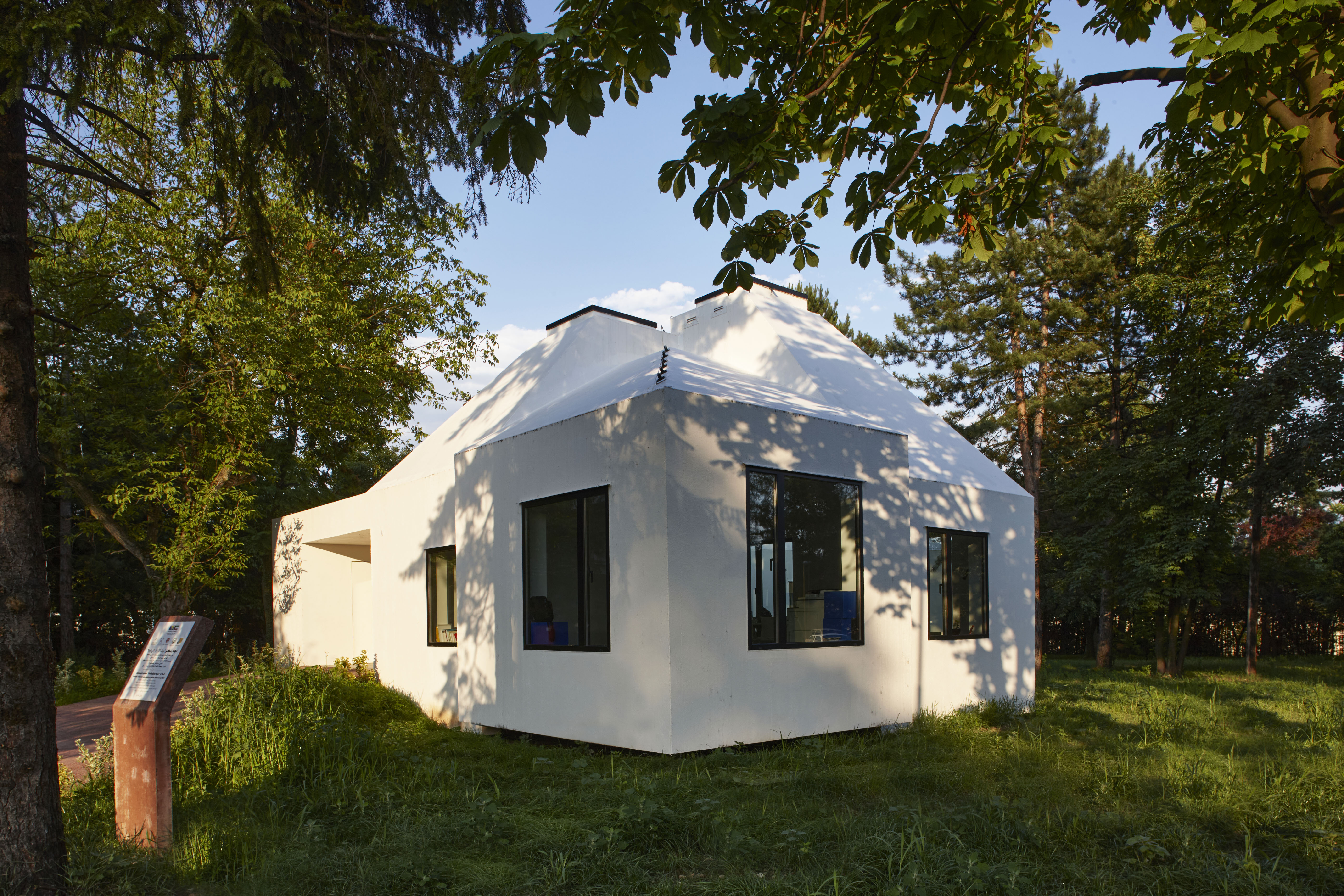


Roditeljska Kuća (Parents’ House) Tuzla is a facility designed to accommodate children with cancer and their families during treatment at the University Clinical Center Tuzla. The design prioritizes daylight, warmth, and psychological comfort in which architecture is a quiet support in the most vulnerable moments of life.
Collaborators
Collaborator (office): Dino Eminagić - normal; Collaborator (office): Mirza Čavčić - normal; Collaborator (office): Zerina Alić - normal; Collaborator (office): Asmir Voljevica - Maketarium; Collaborator (office): Harun Čerkez - Maketarium; Structure: Fetah Džaferović - Studio Part; Installations: Miroslav Pantner - ei invest; Installations: Nedim Zonić - Deling; Lighting: Vladimir Konjević - SSA
Program
Health
-
Labels
Children & Youth
Site area
1060 m²
-
Client
NGO Srce za djecu
Total gross floor
356 m²
Cost
1700 €/m²
Located near the University Clinical Center Tuzla, the Parents’ House provides temporary accommodation for children with cancer and their families during treatment. Elevated on slender steel columns above natural terrain, it preserves existing vegetation and evokes the Bosnian sojenica. Comprising five family units, shared kitchen, dining, and play spaces, it balances privacy and community. Natural materials, soft daylight, and calm proportions create a warm, dignified refuge where architecture becomes silent support in moments of vulnerability.
The project emerged from a deeply human challenge: to create dignified, non-institutional accommodation for families of children undergoing cancer treatment. Working within strict financial and spatial limits, the strategy focused on empathy, simplicity, and emotional comfort. The design reinterprets the archetype of “home” through four house-like volumes joined beneath hipped roofs, forming a unified yet intimate whole. Raised on steel columns, the building preserves the landscape and revives the local typology of sojenica, reconnecting architecture with cultural memory. Southeast orientation and generous openings invite daylight, warmth, and views of nature, transforming care into spatial experience. Modest yet meaningful, the house demonstrates how architecture can restore hope through form, light, and restraint.
The building employs a hybrid structure of reinforced concrete cores with insulated masonry infill, supported by a precise grid of steel columns. This elevated framework minimizes ground impact, protects vegetation, and allows natural drainage. The ventilated façade and green roof optimize energy performance, while generous openings enable daylight and natural cross-ventilation. The material palette—concrete, steel, plaster, and timber detailing—balances durability with tactile warmth. Construction emphasizes cost-efficiency, ease of maintenance, and longevity. Routine façade inspection, roof waterproofing renewal, and ventilation cleaning ensure resilience. By uniting structural clarity, environmental responsibility, and human scale, the project embodies sustainable architecture of care.