-

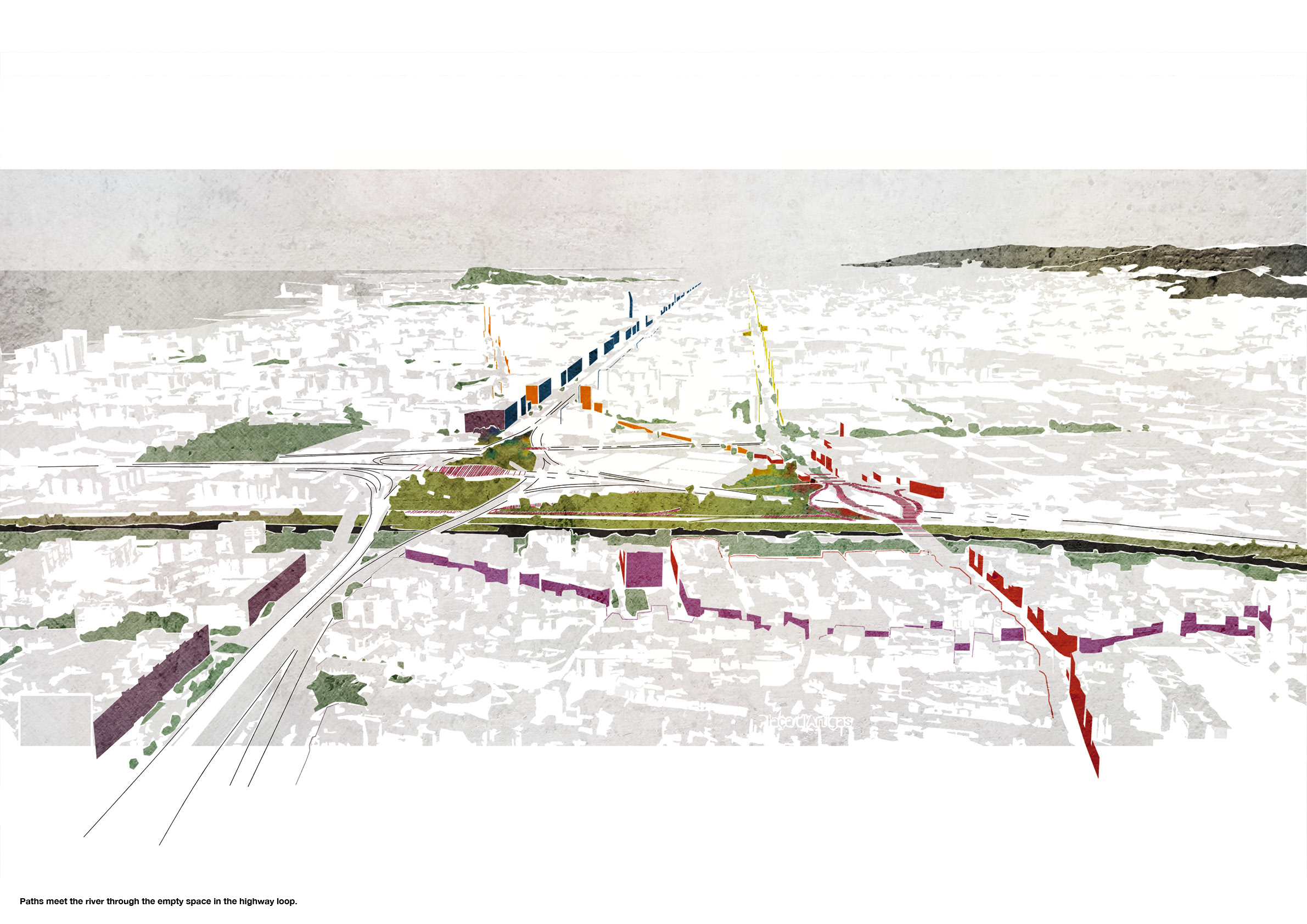
A meeting in the loop
-
Axonometry of the intervention
-
The riverfront
-
Reconstruction of the riparian section
-
The landscape school, hall building
-
Studios and library
-
Model
-
Tuning Infrastructures
-
TUNING INFRASTRUCTURES
MIGUEL HERNANDEZ QUINTANILLA. Barcelona, Spain
-
Name of work in English
TUNING INFRASTRUCTURES
-
Name of work in original language
PARK AND A LANDSCAPE SCHOOL THROUGH A TRAFFIC LOOP BY THE RIVER BESÒS
Prize year
Young Talent 2020
-
Work Location
Barcelona, Spain
-
Author/s
MIGUEL HERNANDEZ QUINTANILLA
-
School
Barcelona School of Architecture - Polytechnic University of Catalonia.
Barcelona, Spain
Young Talent 2020 YT Nominees


TUNING INFRASTRUCTURES
PARK AND A LANDSCAPE SCHOOL THROUGH A TRAFFIC LOOP BY THE RIVER BESÒS
Program
Mixed use - Infrastructure & Urban
-
Labels
Aggregation · Master plan · Gardens & Parks · Regeneration · Road & Highway
The site is a complex and chaotic collection of urban and landscape structures overlaid without harmony. The project explores the possibility of transforming the open spaces in a highway loop into a big park for the dense urban environment and start a narrative that reveals the richness of the place.
Possibilistic and holistic approach. The 3 urban issues explain the major actions, a 4th point explains the detailed architectural intervention: (1) Using the spaces in the traffic loop as park. A redesign of the junction allows to use the empty spaces in the infrastructure to create a park through it. It connects the city instead of splitting it. Tramway and train cross the park and meet in an intermodal station. (2) Break the concrete wall and recreate the floodplain. This is the only place in the city were there are almost no buildings next to the river. It is turned into a floodable park, wetlands are introduced and some pockets are preserved as ecological refuges. Water organizes space and vegetation. (3) Redrawing the Roman path. Small interventions connect the fragments of the historical axis. The Landscape School is placed where the road crosses the river. A new program for the marginal area that can use the park as a testing ground for experiments. (4) Architecture for the river Topography creates a protective slope between the riverbank and the highway. The section of the buildings evolved from studying how to reflect the noise waves from the infrastructure. Their disposition creates paths and public spaces with different degrees of intimacy in the elongated plot. To reduce environmental impact wood is the main material construction, an old tradition preserved in the nearby Pyrenees. Public space and buildings are intertwined spatially and also functionally. Rainwater is canalized in a water way and accumulated in fountains and irrigation pools; solar panels provide electric energy for the buildings and to equilibrate the aquifer; a superficial geothermal device is installed under the floodplain. Old bricks and stones are used to design a park inspired in the shapes of the deltaic plain, the city is ready to meet the river again.