-

Topography of Oblivion - Representative graphic
-
Topography of Oblivion
-
Topography of Oblivion
-
Topography of Oblivion
-
Topography of Oblivion
-
Topography of Oblivion
-
Topography of Oblivion
-
Topography of Oblivion - panel
-
Topography of Oblivion.
Karolina Chodura. Krakow, Poland
-
Name of work in English
Topography of Oblivion.
-
Name of work in original language
Project of museum and memorial park in the Liban quarry in Kraków.
Prize year
Young Talent 2020
-
Work Location
Krakow, Poland
-
Author/s
Karolina Chodura
-
School
Faculty of Architecture - Silesian University of Technology.
Gliwice, Poland
Young Talent 2020 YT Nominees
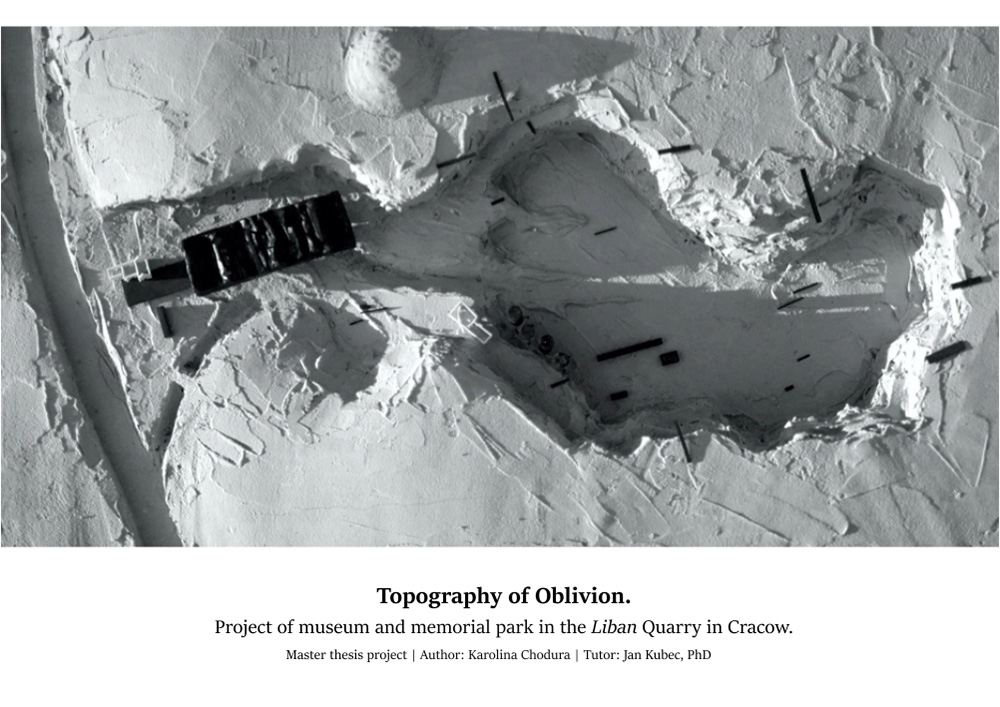


Topography of Oblivion.
Project of museum and memorial park in the Liban quarry in Kraków.
Program
Landscape
-
Labels
Regeneration · Land art
The work touches upon the problem of revitalization of places with traumatic history, which contributed to its exclusion from the city. An example of such space is the Liban quarry in Kraków. The museum and memorial park are dedicated to mass graves hidden in the landscape, called topographies of oblivion.
Emptiness in space is analogous to silence in music - it allows to get the necessary perspective, encourages contemplation, intrigues. It is necessary wherever reflection is needed, especially in places of remembrance. The Liban quarry is a impressive void in the middle of the city. In order not to lose the harsh climate, the emptiness, the designed elements of the memorial park are non-invasive, minimalistic terrain forms. Elements of the park, such as footbridges, site-specific sculptures, furrows in the ground, cuts, depressions, hills, are intended to commemorate the places of mass graves (topographies of oblivion). The terrain forms, sculptures and museum building have their origin in the landscape of the quarry, being made from local soil and rocks. Many of designed interventions depend only on shifting the mass of soil from one place to another. The footbridges scattered across the quarry suddenly end, leaving the visitors in the middle of the trees, at a cliff, above a lake or depression. Some forms of the designed landscape remind of karst caves, mine tunnels and shafts. Like the entire quarry, most objects are influenced by nature, showing the destructive effect of time. Degradation is embedded in their existence. The elements erode, creating a constantly changing landscape. Depressions and furrows in the ground are temporarily flooded, which makes their sharp edges soften. Similarly, artificial hills, originally in an unnatural, rectangular shape, gradually melt in the landscape. \nThe museum, like a massive black cloud,"hangs" over the ravine leading to the quarry. The building skin, made from local soil and rocks, is constantly changing. Along with spring, the elevation comes to life, dies with the onset of winter.\nThe work, in general, draws attention to the often unnoticed aspect of the landscape, its difficult history, but is also focused on restoring a specific space - the Liban quarry, bringing it to the consciousness of residents, and into urban fabric, by creating the museum and park of memory - a place of reflection - in the middle of a vibrant city.