-

Tikkurila Church and Housing
-
Tikkurila Church and Housing
-
Tikkurila Church, entrance from the town square
-
Tikkurila Church Hall
-
Tikkurila Church, Confirmation Ceremony
-
Tikkurila Church and Housing, site plan
-
Tikkurila Church and Housing, Floor plan, 1st floor
-
Tikkurila Church and Housing, floor plan, 2nd floor
-
Tikkurila Church and Housing, section AA
-
Tikkurila Church and Housing, section BB
-
Tikkurila Church and Housing, diagram, scale
-
Tikkurila Church and Housing, diagram, functions
-
Tikkurila Church and Housing, sketch
-
-
FI09 Tikkurila Church and Housing, panel
Tikkurila Church and Housing
OOPEAA Office for Peripheral Architecture. Vantaa, Finland
-
Name of work in English
Tikkurila Church and Housing
-
Name of work in original language
Tikkurilan kirkko ja asuinkerrostalo
Prize year
EUmies Awards 2022
-
Work Location
Vantaa, Finland
-
Studio
OOPEAA Office for Peripheral Architecture
EUmies Awards 2022 Shortlisted
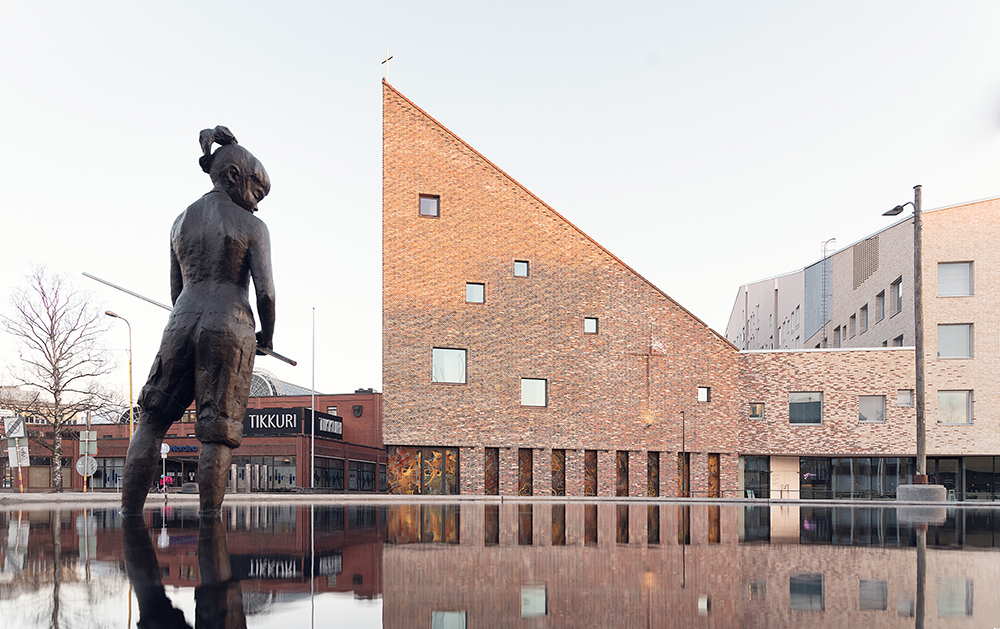


The Tikkurila Church, the Bethania apartments and the student housing form one unity with a diversity of functions. The church contains a cafe and a kids corner open to the public as well as meeting spaces and offices for social services. The rental units and student housing are complemented with shared facilities and retail spaces that enliven the block.
Collaborators
Project architect: Iida Hedberg Project Architect for the Church (OOPEAA), Tuuli Tuohikumpu Project Architect for the Housing; Collaborator (external): Mikko Paakkanen Studio Paakkanen (Furniture for the Altar)
Program
Mixed use - Cultural & Social
-
Labels
Compact · Administration · Church · Collective housing · Community
-
Client
Vantaa Parishes (Church and Bethania Housing) + HOAS, the Foundation for Student Housing in the Helsinki Region
Total gross floor
15482 m²
Completion
2021
Located near the main airport, Tikkurila is a major traffic hub and an important center of business. It is one of the fastest growing and most ethnically diverse areas in the country. Located on the town square, the Tikkurila Church and Housing are part of the densification of the area. With its multicolored brick façade and sculptural shape, the church forms an identifying landmark for the neighborhood. The church building houses a range of adaptable spaces to accommodate a variety of uses. The church hall seats an audience of 450, and it is possible to divide it to allow for multiple simultaneous activities. The building provides workspace for 140 people and offers meeting spaces of various sizes. There are 244 apartments in the complex, 162 for students and 62 for affordable housing. The interior courtyard unites the housing and the church forming a pleasant space for gatherings.
Integrated in a city block, the Tikkurila Church and the adjoining housing are designed as one complex. With the personal experience of people as an essential starting point for the architecture, human scale, accessibility, and life cycle sustainability have been key guiding principles in the design. The shape and volume of the block are at once compact and variable. The church has been deliberately placed in the corner of the block where it takes on a strong presence. The steeply angled pitched roofs with glazed burnt brick form an important part of the character of the block and give the church an autonomous identity. Around the entrances, the scale is lower and more moderate, making them inviting and approachable. It grows taller in the part containing the main church hall, reaching up high towards the light that enters the space in a subtle manner. In the interiors, the atmosphere is cozy and relaxed. Carefully framed views open into the surrounding city scape and to the interior courtyard as well as over the green roofs of the office wing of the church. The sloping roof also makes it possible to create variability to the apartments allowing for duplex units on the upper floors.
Social sustainability was an important concern in the design. The block provides a multicultural meeting point for all generations. The adaptable spaces of the church can be adjusted as the needs of the community change. With apartments ranging from studios to duplexes for families, the housing offers generous shared spaces. The deliberate simplicity of the design of the apartment building supports the position of the church as the focal point of the block. The large glass walls of the church lobby open onto the courtyard and visually link the various functions. The courtyard allows light into the interior of the block. In the choice of materials, longevity is key. Taking a que from the surrounding buildings, brick is the main material used in the exterior. The shifting colours of the fairfaced brick help unite the varied functions and soften the scale of the complex. The clay brick roofs are complemented with red felt cladded roofs, and the green roofs and roof gardens provide a sense of greenery for spaces overlooking them. In the interiors of the church, concrete and wood create a strong dynamic. The chosen materials will endure well and acquire a beautiful patina over time.