-

Cover image.jpg
-
Survey chimneys.jpg
-
Turbine hall.1.jpg
-
Turbine hall.2.jpg
-
Physical and formal connections.jpg
-
Urban dimension.jpg
-
Relations and perceptions.jpg
-
The porch.jpg
-
The station.jpg
-
The sport field.jpg
-
The dock.jpg
-
Views.jpg
-
View of Pine forest.jpg
-
Turbine hall recovery.jpg
-
Turbine hall recovery.1.jpg
-
Turbine hall recovery.2.jpg
-
Turbine hall recovery.3.jpg
-
Turbine hall recovery.4.jpg
-
Views of Turbine hall.jpg
-
View from workspace.jpg
Three Chimneys Archipelago
Valentina Ciancaglini, Giulio Giannico. Barcelona, Spain
-
Name of work in English
Three Chimneys Archipelago
-
Name of work in original language
Arcipelago delle Tre Ciminiere - Un nuovo piano di rigenerazione per l'area delle tre Ciminiere di Sant Adrià de Besòs
Prize year
Young Talent 2025
-
Work Location
Barcelona, Spain
-
Author/s
Valentina Ciancaglini, Giulio Giannico
-
School
Department of Architecture and Arts - IUAV University of Venice.
Venice, Italy
Young Talent 2025 YT Finalists


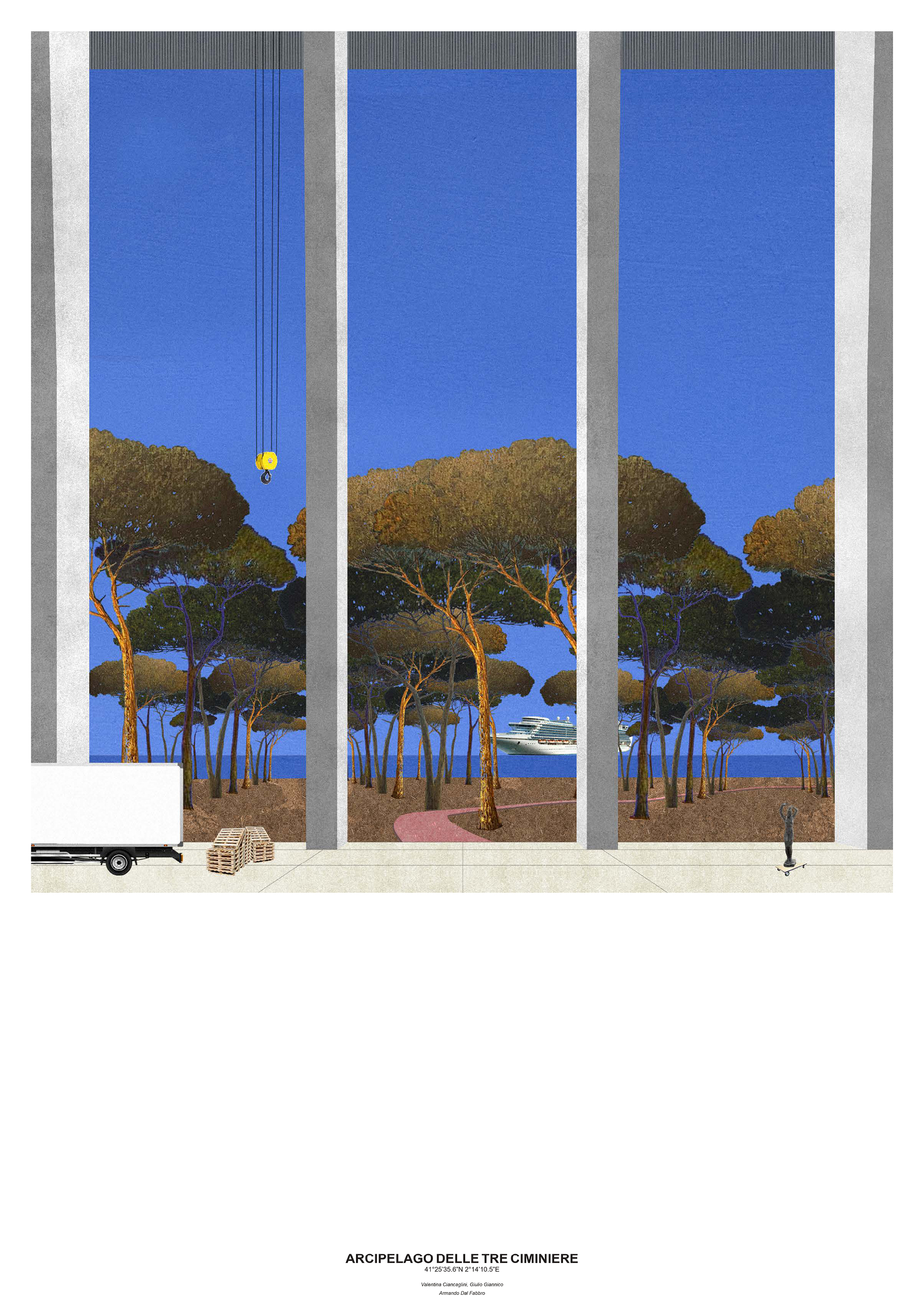
Three Chimneys Archipelago
A New Regeneration Plan for the Three Chimneys Area of Sant Adrià de Besòs
Program
Mixed use - Cultural & Social
-
Labels
Aggregation · Art · Art Gallery · Civic Centre · Exhibition · FABLAB · Nature · School · Stadium · Facilities
This thesis focuses on the regeneration of industrial heritage, specifically examining Les Tres Xemeneies in Sant Adrià de Besòs. It investigates the urban void left by the deindustrialization process and suggests reuse strategies to preserve its historical and social value. Given its peripheral location relative to Barcelona, the project aims to integrate the site into the urban landscape, redefining its role while maintaining its architectural identity. The study emphasizes the importance of balancing preservation with innovation for a meaningful transformation of the area.
This thesis explores industrial archaeology as a cultural asset and a key component of place identity. The site bears marks of industrialization in its architecture, daily life, and culture. To prevent abandonment, reuse and conservation strategies must ensure new meaning and function, transforming these structures into active parts of urban life. The analysis of Les Tres Xemeneies in Sant Adrià de Besòs highlights the issue of urban voids left by demolished industrial complexes. These empty spaces disrupt the urban fabric and limit development. This thesis examines how urban voids can redefine the area’s future, fostering new activities and engagement. Situated on Barcelona’s periphery, the site’s physical and formal relationships shape the project’s character. The aim is to preserve the past while integrating it into a modern urban system, ensuring an active community role. The challenge lies in balancing history with contemporary needs, allowing the site to evolve while respecting its identity. The project envisions an "archipelago" of interventions to reactivate the area, including a new station, pier, sports field, and a portico crossing the railway into the park. These elements enhance connectivity, encourage movement, and foster social interaction. A pine forest acts as a visual and conceptual connector, strengthening ties between the site and the landscape while reinforcing sustainability. The adaptive reuse approach ensures the site is not merely preserved but transformed into a dynamic environment for future generations. Public spaces, cultural hubs, and recreational areas contribute to a renewed urban identity, supporting both residents and visitors. This project demonstrates how industrial heritage can serve as a catalyst for urban regeneration.