-

W2M
-
TERRITORY.The Zone of Disassembly_North Sea
-
TERRITORY. Spatial Organization_(e)Waste unveiling Apparatus
-
(e)WASTE TERMINAL. Territorial Switch unveiling (e)Flows_German Bight
-
(e)WASTE TERMINAL. Absolute infrastructure
-
(e)WASTE PLANT. Threshold between manual and automated_Hamburg
-
(e)WASTE PLANT. Catalyst for physical metamorphosis of Waste to Matter
-
The Zone of Disassembly. Unveiling the hidden Flows of (e)Waste
-
The Zone of Disassembly
Martin Kolev. Hamburg, Germany
-
Name of work in English
The Zone of Disassembly
-
Name of work in original language
Unveiling the hidden flows of e-waste
Prize year
Young Talent 2020
-
Work Location
Hamburg, Germany
-
Author/s
Martin Kolev
-
School
Faculty of Architecture and the Built Environment - Delft University of Technology.
Delft, The Netherlands
Young Talent 2020 YT Nominees


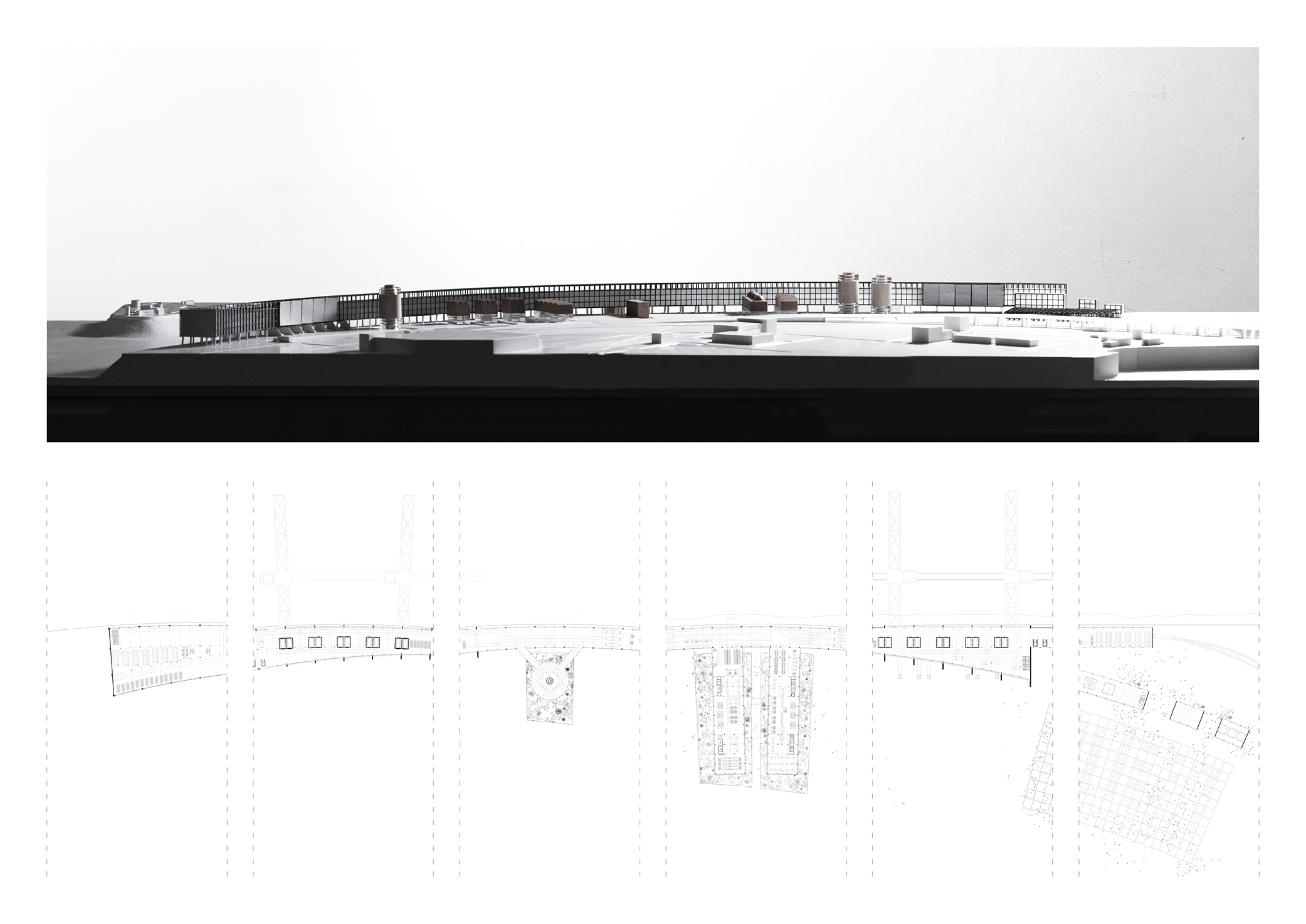


The Zone of Disassembly
Unveiling the hidden flows of e-waste
Program
Infrastructure
-
Labels
Treatment · Port
Neither utopian nor dystopian, the project acts as a ‘transparent’ infrastructure that agitates the position of the public and exposes the sensibility of the e-waste polemic. ‘The Zone of Disassembly’ is a surreal endeavor, which challenges our perception of e-waste and points towards the manifold possibilities veiled under the act of ignorance.
The North Sea is no longer just an extra-territorial space and a limit to the land, but rather an epicenter of political, environmental, economic and societal tension. As transparent infrastructure enabling a potent network of flows, it is a key actor and accelerator within the e-waste dynamics. \n‘The Zone of Disassembly’ derives from the question of territory and formulates a spatial intervention which has the potential to unveil the North Sea hidden e-flows. It is articulated via two interconnected spatial agencies, which establish an infrastructural threshold: the waste archipelago and the waste plant. \nThe waste archipelago resembles a spatial switch whose aim is to reshuffle the existing network of flows within the North Sea and unveiled the hidden such. This artificial set of islands aims to navigate between the territorial waste and material flows. This part of the proposal resembles a spatial set of units, fostered by the undefined spatial density of the sea, formulated by two archetypes: offshore terminal and e-waste storage units. This multipliable spatial syntax allows for its spatial translation in various contexts. \nThe on-shore part of the project emphasizes the physical metamorphosis of waste into matter. Its formalistic approach reacts upon the demand of its functional layers and establishes a symbiosis of flows constantly shifting between manual and automated labor force. The high degree of visual permeability embedded into the building’s skin exposes the hidden flows. Hence, the disassembly plant performs as a spatial medium embedded within the sensitive urban context. It is as a spatial medium; a threshold between global and local, human and machine, manual and automated. \nThe project challenges the disassembly process’ territorial scope, as one could easily ‘deconstruct’ it primary syntax and easily define a new kind of composition. The act of ‘displacement’ fosters the perception of the project and its political integrity as it back-casts the design process by re-informing the research and testing the outcome in the territorial context.