-

Positioned at the heart of the plot, the project generates a public south plaza as the main entrance for the nursery
-
Fortified in the heart of the thousand-year-old citadel of Bonifacio, the Montlaur nursery is part of the military, geological and sedimentary heritage of the city
-
By opening up onto the historic axis of the city, the project promotes pedestrian flows while revealing the urban memory of the city
-
The windmills are testament to powerful winds over the site, the figure of the cloister stands out
-
The cloister typology surrounds an interior garden: the children’s playground
-
In-between wide landscape and indoor garden, the double-sided spaces contribute to the natural ventilation of the building
-
The massing and identity of the project dialogue with the military heritage of the Montlaur district
-
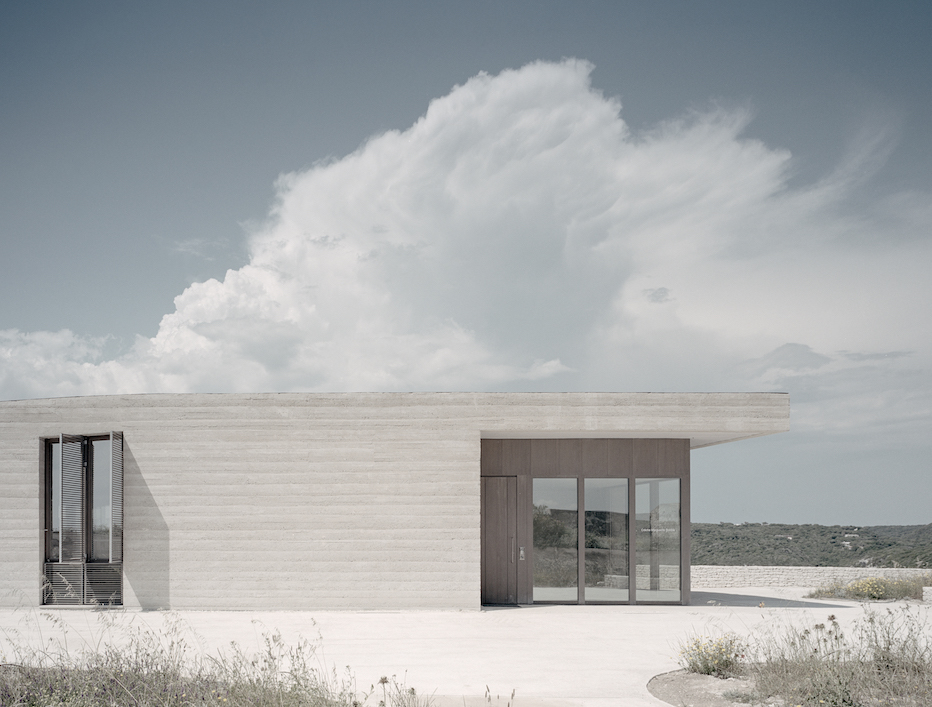
The absence of reinforcement eliminates the risk of concrete oxidation, especially in a sea environment and the use of porous lime insures an effective moisture absorption/release making the walls more breathable and improving the interior thermal comfort
-
The building emerges from the ground and carries proudly the aggregates extracted from the site
-
The tight and artisanal ramming echoes the roughness and horizontal beds of the Genoese stone towers
-
The garden, sheltered from the winds, contributes to the thermal comfort and the quality of the building use
-
The gallery unfolds around the interior garden and distributes all the spaces
-
The oversized glass windows, as an educational tool, participate in the early learning and development of the child
-
-
The Montlaur nursery in Bonifacio
Buzzo Spinelli. Bonifacio, France
-
Name of work in English
The Montlaur nursery in Bonifacio
-
Name of work in original language
Crèche Montlaur Bonifacio
Prize year
EUmies Awards 2024
-
Work Location
Bonifacio, France
-
Studio
Buzzo Spinelli
EUmies Awards 2024 Nominees


Collaborators
Program
Education
-
Labels
Kindergarten
Site area
3341 m²
-
Client
Bonifacio Municipality
Total gross floor
1322 m²
Completion
2023
Cost
2482 €/m²
The 45 crib-nursery constitutes the very first project reconversion of the former Montlaur military district. Close to three limestone windmills, the cloister typology stands out to protect an interior garden bordered by galleries -the safe playground for children. Based on the scientific concept of the first 1000 days which shape the child’s development, the project goal is to offer an educational tool out of the context and location itself. Indeed, considering the space’s dimensions, as much as the views offered on the city and the landscape, or the opportunity for the tiny bodies to engage with nature and the building’s raw materiality; all aspects have been carefully thought of in order to encourage children’s curiosity and early learning.
Imagined as a place where boundaries disappear, there is no longer an interior and an exterior but a set of open and flexible spaces, through which the body and mind can develop and emancipate. Located in the Mediterranean city of Bonifacio, regulating the nursery interior climate and its spatial functioning depends on a manual task. The human becomes the main operator who interacts with the building: opening the windows to capture the sea breeze for instance, or closing the sunshades to protect one’s self from the sun, are daily but necessary actions. They are comforted by proven architectural systems, such as inertia, double-sided spaces and the interior garden. Theoretical and physical support for future users and property management was crucial during the construction site. An experimental laboratory which lasted more than four years, where ancestral techniques implementation coupled with a scientific approach were at the heart of exchanges and debates. The support continues to guide users, making the building function in harmony with its climate. The building is classified passive architecture and wins the « Effinergie + » label.
The structure is designed to allow the building reversibility. Indeed, the lime concrete walls hand-rammed in layers of 14 cm, host a wooden roof frame structure which frees up the interior from any load-bearing point. An experimental material which had required eight months of testing, the lime-concrete echoes the military fortification’s texture and the limestone cliff strata. Like a Roman concrete without cement or reinforcement, the project’s materiality consists of limestone aggregates and a lime binder which are the city’s DNA. The absence of reinforcement eliminates the risk of concrete oxidation, especially in a sea environment, and the use of porous lime insures an effective moisture absorption/release making the walls more breathable and improving the interior thermal comfort. The site's specificities promise therefore to anchor permanently the project in the thousand-year-old citadel, standing the test of time without being outdated. The concrete and even the millwork in endemic Lariciu pine wood from short supply chains, highlight the time-consuming artisanal nature of the construction site, and thus defies the standard economic logic.