-

01 Representative Document.png
-
02.png
-
03.png
-
04.png
-
05.png
-
06.png
-
07.png
-
08.png
The Mont St-Michel bay face of climate change : a history of a territory's habitability
Bilal KHANNAT, Nathan WISTRAND, Nils ZEHNTER. Baie du Mont Saint Michel, France
-
Name of work in English
The Mont St-Michel bay face of climate change : a history of a territory's habitability
-
Name of work in original language
Le Mont Saint-Michel face au changement climatique : une histoire de l'habitabilité d'un territoire
Prize year
Young Talent 2025
-
Work Location
Baie du Mont Saint Michel, France
-
Author/s
Bilal KHANNAT, Nathan WISTRAND, Nils ZEHNTER
-
School
Strasbourg School of Architecture - Strasbourg School of Architecture.
Strasbourg, France
Young Talent 2025 YT Nominees


The Mont St-Michel bay face of climate change : a history of a territory's habitability
Consolidating activities in the Mont St-Michel bay : Consolidating a territory face of climate change
Program
Infrastructure
-
Labels
Energy · Treatment
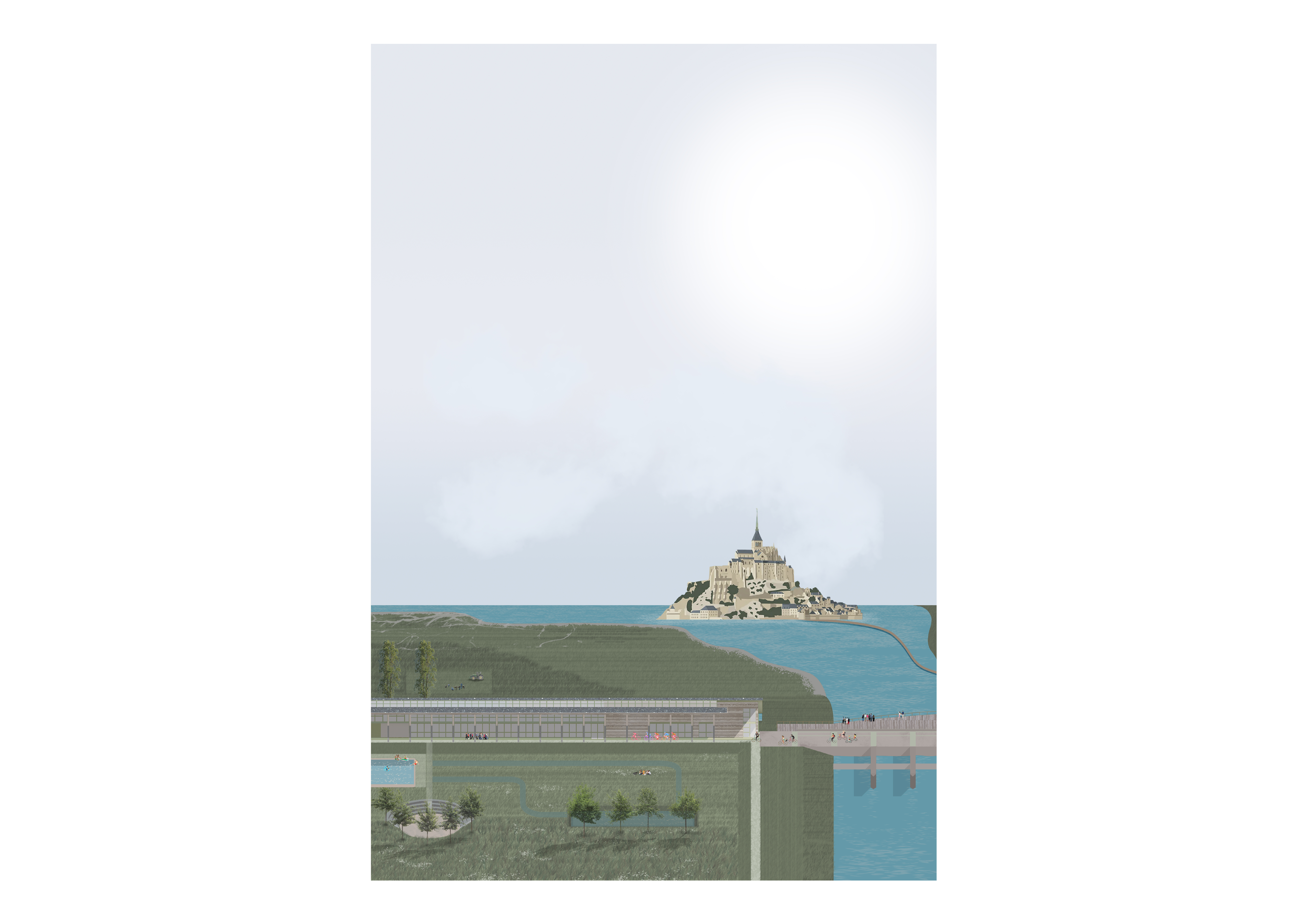
The Mont St-Michel Bay is undergoing constant change. On the one hand, natural phenomena such as marshes, erosion, and coastline progradation. On the other hand, human activities and the overage of agricultural, aquacultural, and touristic productions threaten its balance. Add to this the long-term risk of sea levels rising, we have to anticipate now the risks and organize a strategy that takes social and economic realities into account. Then, could we consolidate the strategic containment of the Mont St-Michel bay, by consolidating its economic activities?
In the first instance, it's a question of territorial architecture. Short, mid, and long term. We organize the different areas of the territory and their specific features. So, far from binary solutions with disastrous social, economic, and environmental effects, we wanted to adopt a measured approach. On the Normandy coast, we are organizing a population retreat to the land available in the hinterland and reinforcing the coastal line with breakwaters, while designing walking paths for pedestrians. In the saltbushes of the western polders, we accept the risk of rising sea level, because it's impossible to fight against it. In this case, it's a project lever, accepting a new way of using the land with salt marshes. Finally, as the hinterland of Dol region is doomed to flooding, we accept the idea of transforming the coastline into a lido with a lake in the hinterland. To activate this strategy, we use production sites as tools. A shellfish concrete production site to make the buildings and dikes around the bay, 3 quackgrass insulation production sites to clean the saltbushes of this plant and produce natural insulation, and 5 mobile sheepfolds to maintain the natural dikes that are the saltbushes and maintain a heritage of ancestral pastoral activity on the Normandy coast. The projects are designed to meet today's needs while adapting to future changes in the area. The sheepfolds can be dismantled according to clear structural principles. The quackgrass production centers adapt to the salt production of the old agricultural west polders and a future checkpoint for Mont St-Michel. Finally, the shellfish concrete center is designed to function as a roof overhang, using an existing structure to accommodate new uses.