-

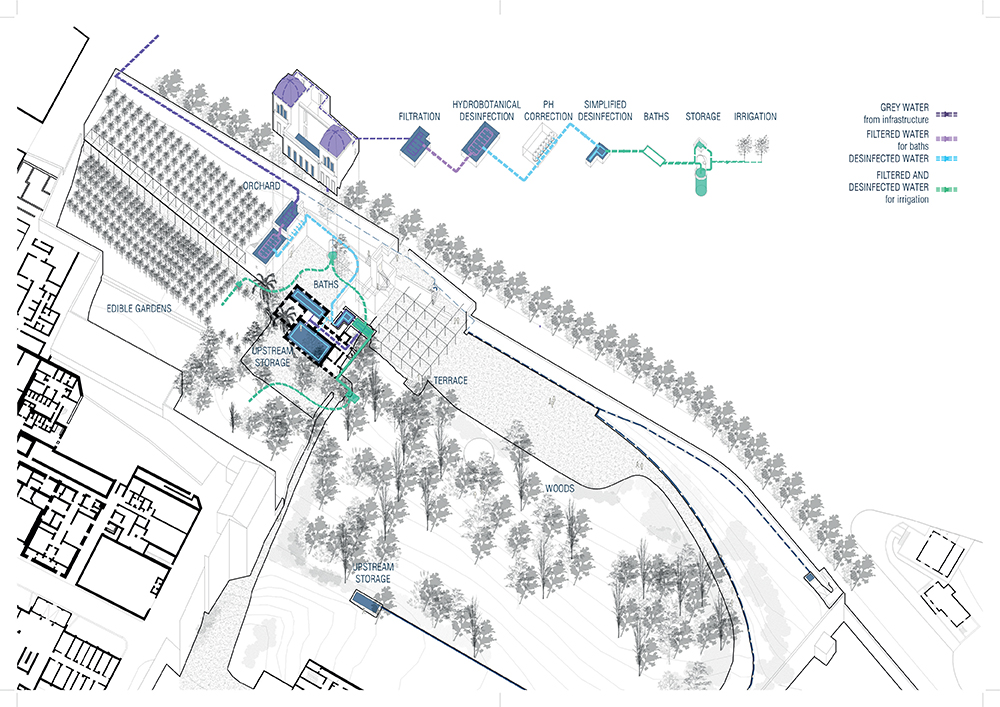
Infrastructural path and water treatment for public baths
-
Flooding risk and pressure on existing unitary sewage system
-
Infrastructural pieces for impermeable and permeable areas
-
Site plan for public baths
-
Lower level of public baths
-
Upper level of public baths
-
Baths and edible gardens
-
Learning from the countryside's virtues in the city
-
The Countryside as Infrastructure
Raquel Batista Pereira. Lisboa, Portugal
-
Name of work in English
The Countryside as Infrastructure
-
Name of work in original language
The water's course and drainage in the design of public space
Prize year
Young Talent 2023
-
Work Location
Lisboa, Portugal
-
Author/s
Raquel Batista Pereira
-
School
ISTA - School of Technology and Architecture - ISCTE - University Institute of Lisbon.
Lisboa, Portugal
Young Talent 2023 YT Shortlisted


The Countryside as Infrastructure
The water's course and drainage in the design of public space
Program
Infrastructure
-
Labels
Treatment
Sewage and drainage systems in Lisbon are facing high pressure because of the increasingly frequent torrential rains. A change from unitary to separative sewage reduces the load downstream and a superficial infrastructure integrates the water cycle in the design of the city, activating public spaces where it is slowed, stored, cleaned and enjoyed.
The project studies the virtues of the countryside – the draining capacity and landscaping potential – and tries to apply them on an urban context. Infrastructures constitute a huge noise in the lives of the city, even though they are continuously being hidden with its own spatial potential is lost. A reverse evolution is proposed: instead of concealing the infrastructure, it can be used to plan the city.\r\nThe rainwater draining system has this potential - not only does the change to a separative sewage system enables a substantial reduction in soil erosion and the loads on the downstream infrastructures, which suffer the most from the direct tidal effect, but it also allows for the use of rainwater, currently wasted, to create leisure and productive infrastructural paths along which the water is slowed, stored, cleaned, serving the irrigation of the broad unused areas of Alcântara’s Alto de Santo Amaro. The water cycle is incorporated in the design and life of the city and its public spaces.\r\nThe proposed infrastructure is a fragmented aqueduct that reveals itself in several formal expressions, both in\r\npermeable and impermeable areas: visible or invisible channels, walls, benches, stairs, sinkholes, all of them with an internal slope. Water travels through the ducts by gravitational action and this potential energy always allows for the permanent pressure on the infrastructure. The new permeable areas and various water storage tanks along the hydraulic system admit the deposition of sediments and its reduction downstream.\r\nTaking advantage of a shortage of such programs, the public baths are proposed, benefiting from the typological permanence of Quinta do Monte do Carmo, both the built typology, its ruin condition and landscape subunits. The baths, at the hinge of the proposed infrastructure, and its tanks are supplied by the system, after filtration and disinfection, which also waters the edible gardens. This garden typology is explored, trying to sow, care and reap the happiness in the city, strengthening the relationship between landscape, infrastructure, men, the touch of his hand and mouth.