-

Web gallery 1.jpg
-
Web gallery 2.jpg
-
Web gallery 3.jpg
-
Web gallery 4.jpg
-
Web gallery 5.jpg
-
Web gallery 6.jpg
-
Web gallery 7.jpg
-
Web gallery 8.jpg
-
Web gallery 9.jpg
-
Web gallery 10.jpg
The Consumption of Landscape: A grand tour for the 21st century
Sam Beckwith Flint, Xhesika Bicaku, Bethany Clarkson, Thomas Dutton. Rome, Italy
-
Name of work in English
The Consumption of Landscape: A grand tour for the 21st century
-
Name of work in original language
The Consumption of Landscape
Prize year
Young Talent 2025
-
Work Location
Rome, Italy
-
Author/s
Sam Beckwith Flint, Xhesika Bicaku, Bethany Clarkson, Thomas Dutton
-
School
Liverpool School of Architecture - University of Liverpool.
Liverpool, United Kingdom
Young Talent 2025 YT Open Nominees


The Consumption of Landscape: A grand tour for the 21st century
A grand tour for the 21st century
Program
Landscape
-
Labels
Regeneration
How do we build the ‘ideal city’ today? Can we learn from the past to shape tomorrow’s architecture? The built environment is dominated by themes like sustainability and innovation, often used superficially. In response, students seek to rediscover architecture’s fundamentals, exploring how historical ideas evolved. Using Rome as a test-bed, students identify research streams and develop a hypothesis and design in response. This year, following a field trip, they reimagined a Grand Tour for the 21st Century, devising a methodology to reinvent landscape for contemporary tourism.
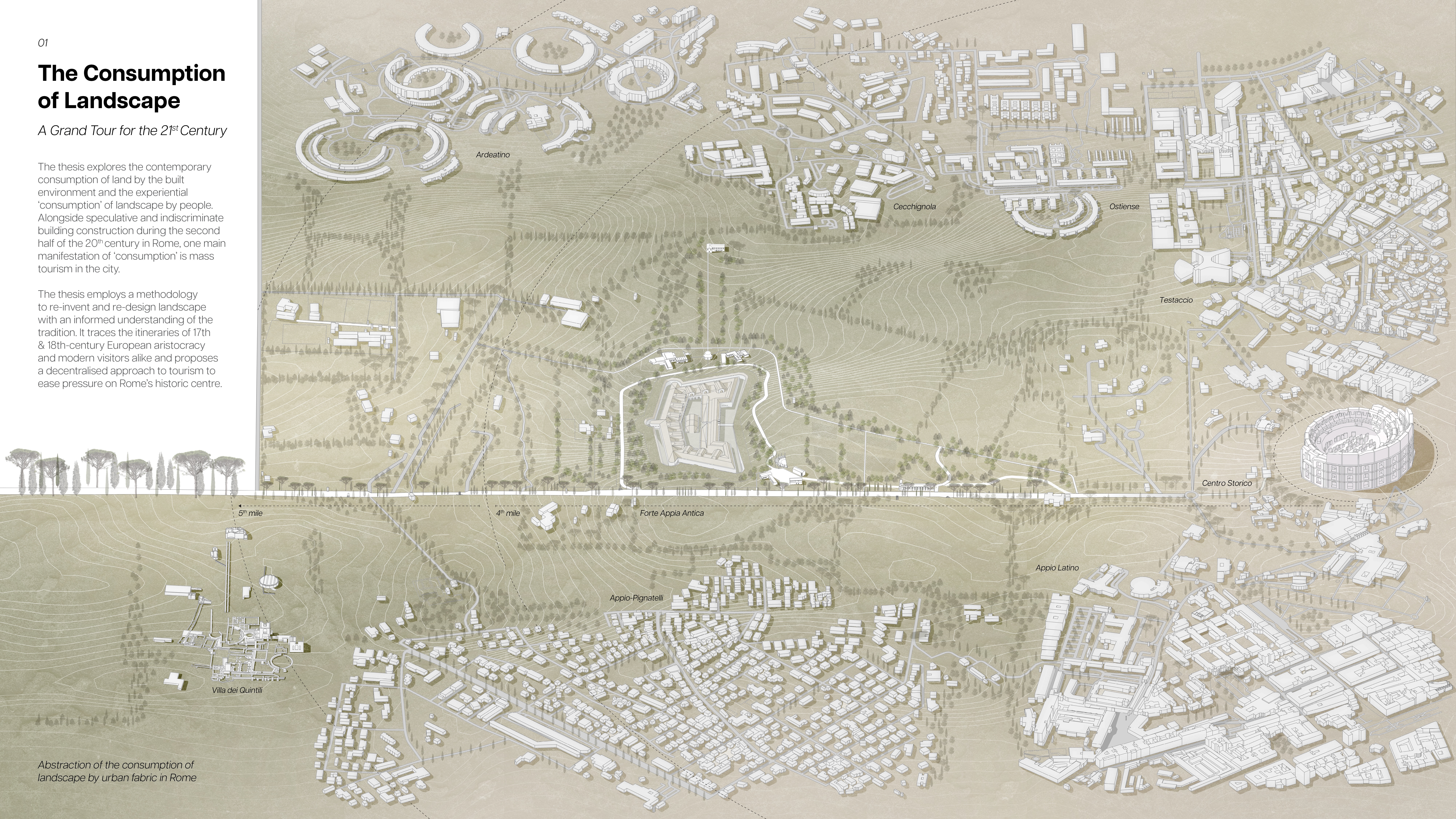
The project reflects on the consumption of landscape: consumption through urban development and consumption through human experience. Focusing on the increasing pressure on Rome from mass tourism and speculative construction, it proposes to re-design a landscape that balances modern tourism needs with historical preservation, re-interpreting the tradition of the Grand Tour. Tracing back the itineraries of 17th & 18th century European aristocracy, and of modern visitors alike, the project proposes a decentralised approach to tourism in order to ease the strain on the city’s historic centre. Rome’s abandoned ‘ring' of 19th-century forts - planned and built after the Eternal City was made capital of Italy in 1871 - is the basis for an alternative strategy imagining a contemporary Grand Tour. The fort on Via Appia Antica and its surroundings are proposed as a new attraction for visitors, blending historical significance with contemporary needs. Drawing from influential historical analysis on landscape design, from the Acropolis to Stowe, the landscape of the site integrates strategies to enhance the visitor experience while safeguarding the existing heritage. The architectural program is inspired by both the place and the needs of contemporary tourism, enhanced through intelligent, adaptive reuse and sustainable agriculture.