-

A representative graphic document
-
City planning analysis
-
Natural environment analysis
-
Project of arrangement of the streets
-
Urban green areas project
-
Project of arrangement of the squares
-
Pavilion project
-
Panel
-
-
The concept of the urban green area of the central part of Gliwice.
Adriana Bary?ewska. Gliwice, Poland
-
Name of work in English
The concept of the urban green area of the central part of Gliwice.
-
Name of work in original language
Gliwice - green habitat
Prize year
Young Talent 2018
-
Work Location
Gliwice, Poland
-
Author/s
Adriana Bary?ewska
-
School
Faculty of Architecture - Tadeusz Kościuszko Kracow University of Technology.
Krakow, Poland
Young Talent 2018 YT Nominees


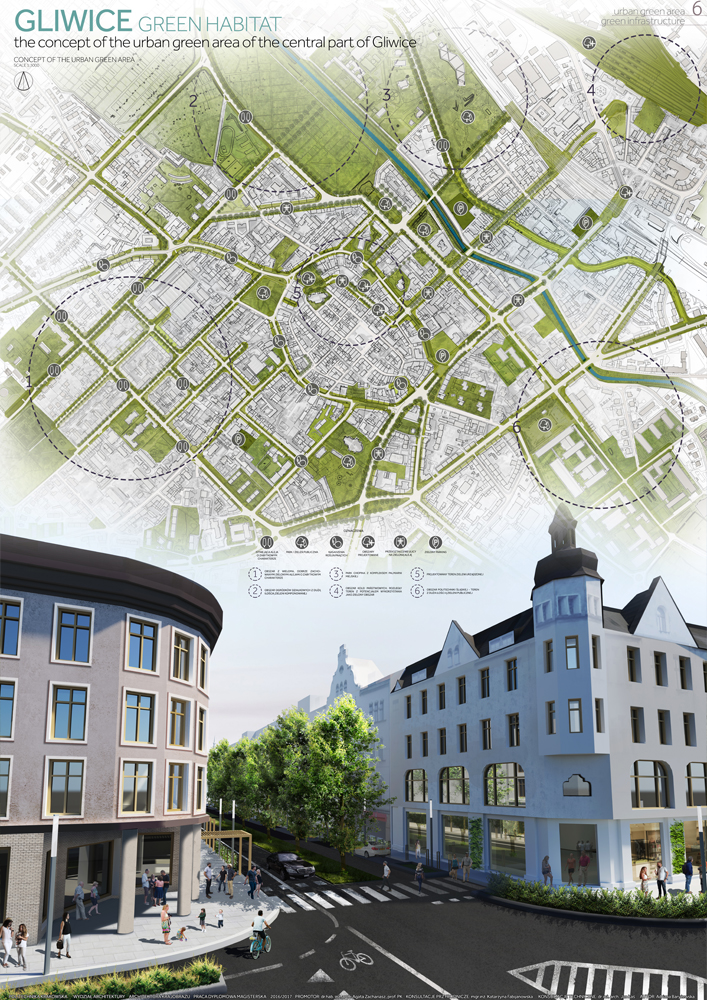


The concept of the urban green area of the central part of Gliwice.
Gliwice - green habitat
Program
Landscape
-
Labels
Regeneration · Green Belt
The thesis presents a homogenous system of the urban greenery related to the current urban environmental conditioning. It is focused on creating new green areas and expanding the already existing ones. A project of implementing a part of the Old Town is developing a green communication network and linking already existing green areas.
The master’s thesis has been completed at the Faculty of Architecture of the Cracow University of Technology. It was developed as the final dissertation of the second cycle study of Landscape Architecture. The thesis concerns the urban green area of the central part of Gliwice, a city located in the western part of the Silesian Metropolis. A coherent, based on detailed research studies of local environmental conditioning, project of the urban greenery is presented in the thesis. Today, in the case of giant metropolis with heavily built up urban space, it is very important to focus on the aspect of nature within the human settlements. The natural tissue of the city should be treated and developed with equal importance as the anthropogenic layers such as buildings and infrastructure. These components should form a coherent, correlative system. The green areas of the city should form a significant combination with the buildings connected by green communication network. Today, this aspect seems not to be considered with sufficient attention while developing a city. However, conscious designing of the urban greenery in the process of planning a city can be traced back as far as the XIXth century. The solutions, took into account by Georgess Haussmann when rebuilding Paris in the years 1852 – 1870 and the project of Frederick Law Olmsted concerning city parks (Emerald Necklace) in Boston, could be good examples of such approach. The thesis presents a homogenous system of the urban greenery related to the current urban environmental conditioning. It is focused on creating new green areas and expanding the already existing ones. A project of implementing a part of the Old Town and developing a green communication network linking already existing green areas both developed and under development is being created. Benefits resulting from green areas within a city reflect in improvement of its natural conditions, decreasing the level of air pollution, enriching the hydrological and microclimatic environment and finally the living conditions of the city dwellers including the spatial order.