-

ENTRANCE TO THE EXHIBITION SPACE
-
EXTERNAL NORTH VIEW
-
MAIN EXHIBITION SPACE
-
VIEW FROM COURT YARD TO STOA
-
VIEW FROM RECEPTION TO OFFICES
-
STEP BALCONY
-
1ST FLOOR PLAN
-
GROUND FLOOR PLAN
-
-
Thalassa Museum (Municipal Cultural Centre)
Sierepeklis Architects. Ayia Napa, Cyprus
-
Name of work in English
Thalassa Museum (Municipal Cultural Centre)
-
Name of work in original language
Thalassa Museum (Municipal Cultural Centre)
Prize year
EUmies Awards 2005
-
Work Location
Ayia Napa, Cyprus
-
Studio
Sierepeklis Architects
EUmies Awards 2005 Nominees


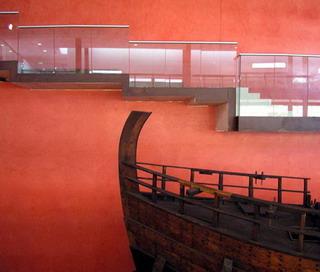


The museum is located at the seaside village of Ayia Napa on the island of Cyprus.
It is the result of a national competition (1st prize) that took place in 1997. The project itself was realized in the period between 2000-2003 and was completed in November 2003. It is a collaboration of the Municipality of Ayia Napa and the Pierides Foundation.
Collaborators
Structural engineering: Andros Achilleos / Hyperstatic Engineering Design; Electrical: George Aletraris / G. Aletraris Associates; Mechanical: George Aletraris / G. Aletraris Associates; Quantity surveyor: Christos Makris / Christoforides Makris Associates
Program
Culture
Completion
2003
The theme of the museum is 'thalassa' (the sea) and it will house artifacts and documentation from different historic periods related to the island's maritime history. The main exhibit item is the ship Kyrenia II, a replica of a widely traveled ship of the 4th century AD, whose wreck and relics were found in the north waters of Cyprus by the diver Kariolou in 1966. In addition to the museum's major exhibition space which covers 4.000 sq.m., the program entailed for a lecture room, a bar and lounge, an educational space for children, an archive, administrative offices (housed in the existing old school -which also had to be incorporated in our design) and extensive outdoor spaces including a small outdoor theatre.
The outdoor spaces are inviting as the project is situated in a lower plateau than the roads that surround it. A generous escalating ramp takes the visitor from the street and leads him to a friendly covered passage, a brave resistance to the intense sun of Cyprus. The main organizational concept is related to the discovery of the ship by the diver, so the visitors of the museum start their tour from the second level and follow a downward spiral route that leads them to the ship in the basement of the museum. This course happens within a three storey space and the kinesthetic experience of the visitors is enhanced with ramps, bridges, stairs and station points. In this way the viewers have the opportunity to perceive the ship first from above and then from different angles thus having a variety of spatial experiences and never loosing contact with the ship.
Light and materials are orchestrated to participate in complementing the trip of discovery. The marble travertine -as if it has been eaten away by the sea, wood -the friendliest material of water, transparent materials &with reference to the reflections of waters, oxidized copper -which transcends through time. Another dominant design feature is the interior red wall which is intended to raise the spirits further. Great attention has been given to detail and all elements are unified together to transverse the sense of a museum for the sea.