-

TERRRA hub integrated into the site’s topography to maintain vegetal continuity
-
Southern terrace opening onto the orchard
-
Partially double-height common space for collective activities
-
Mezzanine stairs crafted from on-site robinia, processed and shaped semi-manually
-
Northern facade opening toward the farming area
-
Northern facade with barn-like shutters at night
-
Ground floor plan
-
Mezzanine plan
-
Plan of the green and accessible roof
-
Section N-S across the site before the building
-
Section across the site showing the role of the building in the ecological enhancement of the site
-
Site’s ecosystem: local resources, energy and circular waste systems, water management, biodiversity
-
Name of work in English
TERRRA
Prize year
EUmies Awards 2026
-
Work Location
Brezoi, Romania
-
Studio
atelier d’architecture autogérée (aaa)
EUmies Awards 2026 Nominees
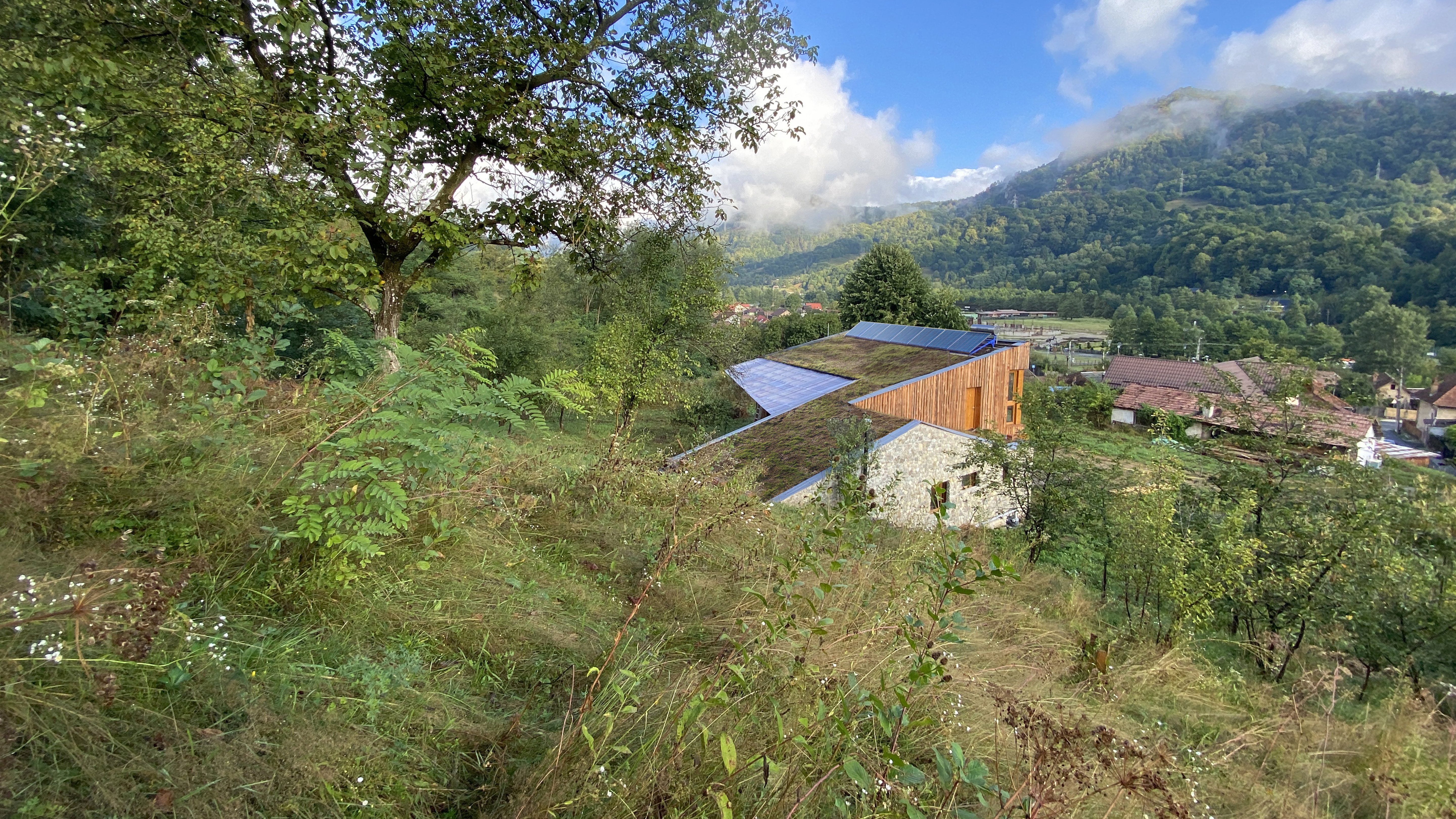


TERRRA Hub in Brezoi, Romania, is a centre for popular ecology offering training in agroecology and eco-design. Blending into the landscape with a green roof and wood terraces, it uses local materials and crafts to reinterpret tradition, testing sustainable eco-prototypes for circular resource use.
Collaborators
Collaborator (office): Silviu Medesan - Architect; Collaborator (office): Manon Marmet - Architect; Installations: Gabriel Deliu - Engineer; carpentry: Florin Ilie - Engineer; Carpentry fittings: Dragos Popescu - Engineer; Building physics: OREGON Engineers; Structure: MIRADEX; Construction management: Stefan Mutu - Engineer
Program
Mixed use - Cultural & Social
-
Labels
Compact · Specialized Centre · Nature
Site area
6000 m²
-
Client
TERRRA
Total gross floor
200 m²
Cost
800 €/m²
Located in Brezoi, a former industrial town in Romania’s mountains, TERRRA Hub fosters regional renewal through agroecology, cultural tourism, and sustainable forestry. It promotes traditional ecological knowledge via research, professional training, and hands-on practice. Spanning 6,000 m², the hub features workshops, meeting spaces, accommodation, and experimental eco-design land. Its 200 m² cultural annex, inspired by local barns and built collaboratively from local materials, reinterprets traditional craftsmanship—blending innovation, community participation, and ecological responsibility.
Brezoi faces significant landscape degradation due to its industrial past and the decline of locally rooted stewardship. Traditional skills and self-build knowledge have diminished, while the town architecture increasingly relies on external specialists, conventional methods, and imported industrial materials—raising CO₂ emissions and aesthetic concerns. TERRRA Hub addresses these issues through both its programme and architecture. As a centre for popular ecology, it promotes landscape preservation and the revival of traditional ecological and construction practices, passing them on to younger professionals. The building embodies this approach, integrating sensitively into its surroundings with a green roof and wooden terraces and using locally sourced materials and traditional techniques executed by local craftsmen. Its design celebrates and reinterprets vernacular methods, creating new aesthetic expressions that merge ecological function, cultural continuity and contemporary design.
The building integrates stone and wood for carbon sequestration, using traditional methods and locally sourced materials. On-site eco-prototypes—dry toilets, water management, and circular waste systems—enable composting, straw reuse, and dry sanitation. Solar-protective shutters ensure thermal comfort while preserving a barn-like aesthetic. Water strategies respond to climate challenges through torrent diversion, ponds, and mini-canals for rain and greywater collection, maintaining 75% site permeability. Local craftsmen and intergenerational workshops foster community participation and skill transmission. A green roof of native plants blends into the terrain, and the layout reflects traditional settlement patterns. Guided by the “reduce, reuse, recycle” R-principles, TERRRA minimizes costs through local resources, embeds maintenance within its training program, and stands as a living model of ecological stewardship and sustainable architecture.