-

The central void defined via tectonics
-
Circulation, inhabitation and invitation
-
A conversation with gravity
-
The light visualisation
-
The open volume in context
-
Layers, Encasement and Differentiation
-
Masterplan
-
Floor plan level +0
-
Floor plan level +1
-
Floor plan level +2
-
Floor plan level +3
-
Section A
TEPAK Paphos - School of Tourism, Hospitality and Management
Eraclis Papachristou Architects. Paphos, Cyprus
-
Name of work in English
TEPAK Paphos - School of Tourism, Hospitality and Management
-
Name of work in original language
Σχολή Διοίκησης Τουρισμού, Φιλοξενίας και Επιχειρηματικότητας, ΤΕΠΑΚ Πάφου
Prize year
EUmies Awards 2026
-
Work Location
Paphos, Cyprus
-
Studio
Eraclis Papachristou Architects
EUmies Awards 2026 Nominees
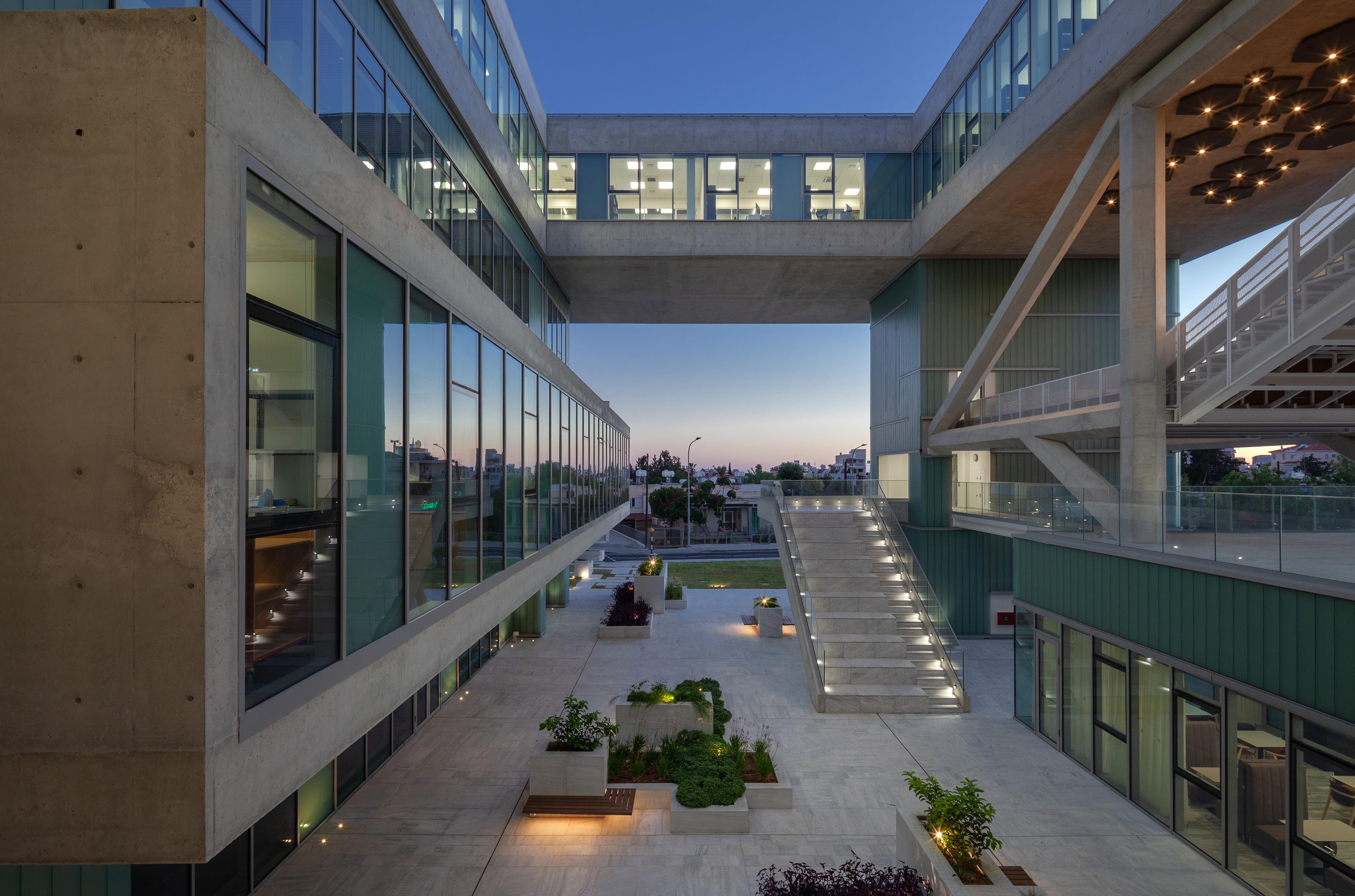


An urban project that focuses on its relationship to the public, to the external space as much as it does to providing a functional and appropriately furnished interior. Located in Paphos it was completed in a furious 20 months, a satisfying design where the finished product strongly resembled the initial sketch.
Collaborators
Structure: ANDREAS ANTONIOU - A.C. Antoniou Civil Engineers LLC; Consulting: KYRIAKOS ZINIERIS - ELIOFOTOU ZINIERIS STASIS MELTEC L.L.C.; Consulting: ANASTASIOS STASIS - ELIOFOTOU ZINIERIS STASIS MELTEC L.L.C.; Consulting: IOANNIS ELIOFOTOU - ELIOFOTOU ZINIERIS STASIS MELTEC L.L.C.; Consulting: STEFANOS ANDREOU - ABC Construction Cost Consultants LLC; Acoustics: PANOS OIKONOMOU - PANACOUSTICS LTD; Fire Safety and Accessibility: SPYROS SPYROU - INTFIRE (CYPRUS) LIMITED; Consulting: MARIOS HADJIOSIF
Program
Education
-
Labels
University
Site area
5406 m²
-
Client
MUNICIPALITY OF PAFOS
Total gross floor
10600 m²
The technical school of hotel management and hospitality is arranged in an ascending hierarchy, with kitchens at ground level, lecture halls, amphitheatres and classrooms over the next two levels and staff facilities at the highest level. These effectively rotate about a central void, a courtyard. Located in an urban context and seen as a public facility the design gathers a great deal of its energy from this space, drawing in the public, acting as an anchor for the school’s facilities. It is a design that wants to communicate, that uses transparency as a tool for conversation and invitation. Materiality and its variations also serve to inform and to intrigue, to enliven the events within.
The driving concept that feeds this particular design is concerned with communication. It develops reduced barriers and filters that allow in light, air and rain. The central courtyard acts as a climatic moderator, taken from the vernacular of the Mediterranean, but it is most significant in that it allows the public into the heart of the space. This is evidenced in the deliberate lack of a perimeter description, the materiality of the public floor evolving to encompass the neighbouring church, while also creating a link to the nearby student residences. Once within the void there are a variety of mechanisms of engagement, from a wide staircase to the suspended amphitheatre, the street furniture to the glass balustrades and the perforated wall of the library. A number of the buildings spaces also open up to the courtyard. Glazing achieves this, providing views into spaces informed by colour and material. A neat contradiction to this is the use of U-Glass, translucent and fascinating when illuminated at night. The design reads as a single object, rendered complex through its exposed interior. Life brought to the surface, offered to the public.
The core of the buildings structure, evolving from the pre-existing basement, is mainly in reinforced concrete. This simple shell is then informed with a variety of materials and finishes. Glazing is made more intriguing through the extensive use of U-Glass. Internal spaces take on materiality and colour, utilising required elements such as sound absorption and seating arrangements. As always, the building comes alive at night as the interior casts its light into the nearby streets. The stage is set. The amphitheatre hovers in the void, a metal structure clad in timber with a perforated mesh balustrade. Further perforated surfaces not only work climatically but also permit filtered view into spaces such as the library. There is a constant unravelling with glass balustrades and external circulation creating a fluid movement, a deep legibility of space. And there is a final contradiction in the language of the pivotal void at the core of the design juxtaposed by the protruding weight of the highest level, which reaches into space, over the complex of events beneath it. The whole offers a series of scales at which to respond to it. It offers intrigue, it offers information.