-

Wind blowing in the textile
-
General view towards the river valley
-
Night time view
-
Detail of anchoring in the riverbed
-
Stepping stones pathway
-
Inside the circle
-
Site plan
-
General Plan
-
Longitudinal section
-
Cross section
Temporary Installation at a Mountain River
Atelier VRAC. Racovița, Romania
-
Name of work in English
Temporary Installation at a Mountain River
-
Name of work in original language
Susur
Prize year
EUmies Awards 2026
-
Work Location
Racovița, Romania
-
Studio
Atelier VRAC
EUmies Awards 2026 Nominees
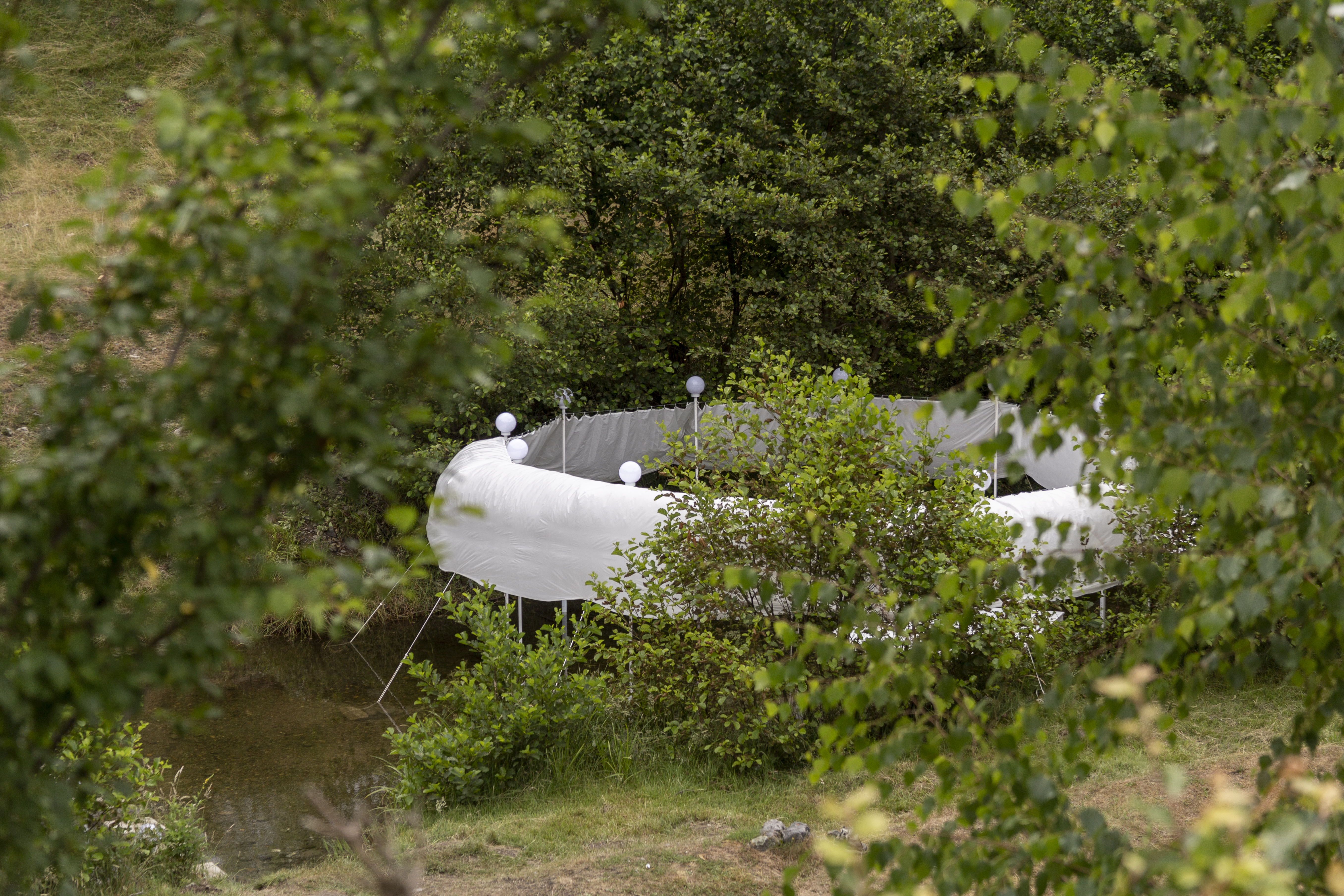
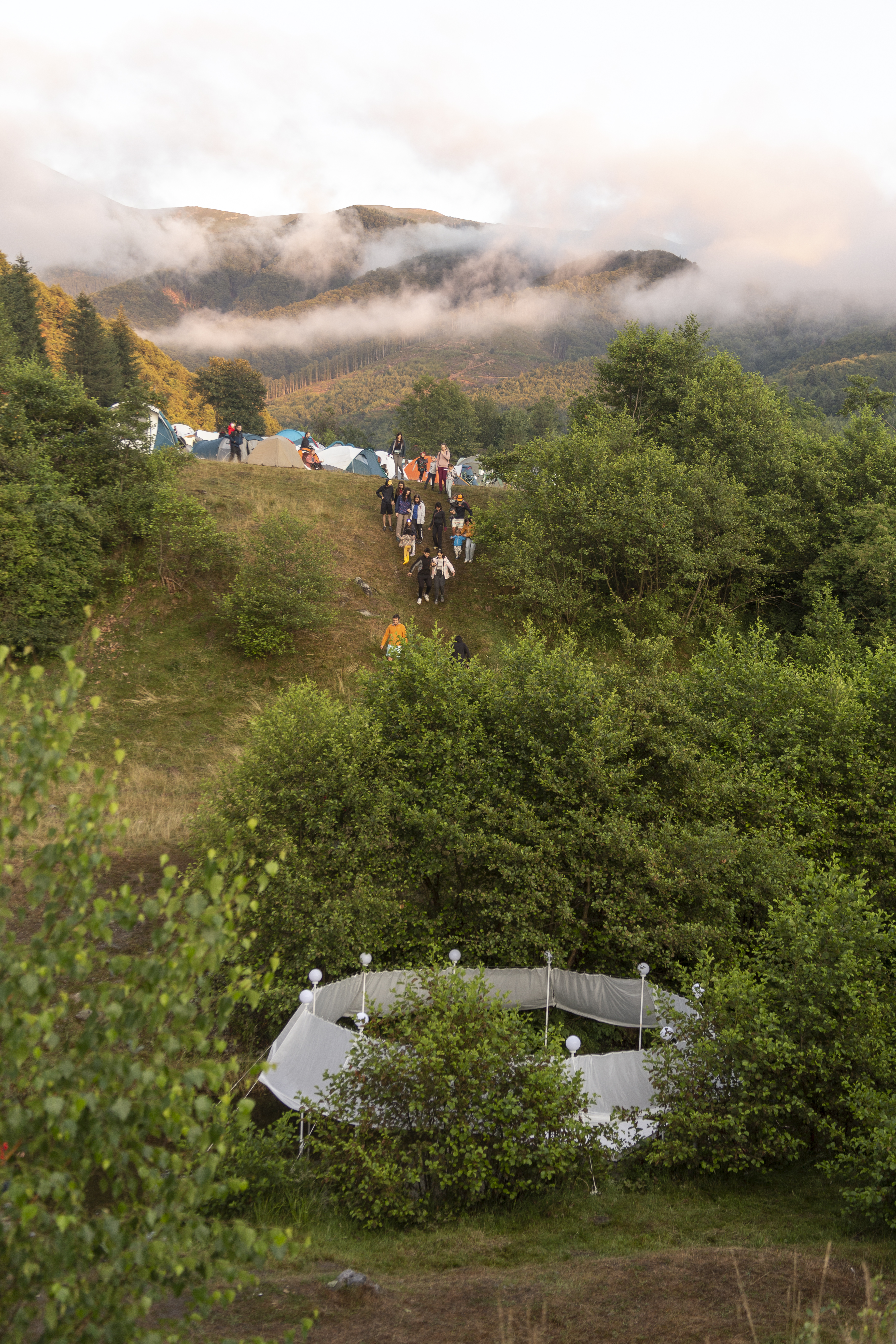


The installation seeks to activate the Moașa Sebeșului River in the Făgăraș Mountains, serving as a central element of Făgăraș Fest. It invites play, encounter, and reflection, raising awareness about the preservation of unaltered mountain environments and the cultural potential of the local community.
Collaborators
Construction & Detailing: Sebastian Big; Construction & Detailing: Oana Big; Construction & Detailing: Hans Scherer
Program
Ephemeral
-
Labels
Pavilion · Installation
Site area
180 m²
-
Client
Foundation Conservation Carpathia
Total gross floor
154 m²
Cost
30 €/m²
The installation emerged from the desire to activate the Moașa Sebeșului River, a tributary of the Sebeș River, which springs from the Făgăraș Mountains. It was created as part of Făgăraș Fest, organised by the Foundation Conservation Carpathia to promote the protection of the area as a national park and to highlight local potential. Set directly over the water, the installation takes the form of a circular outdoor “room” defined by slender vertical elements topped with solar light globes, and a delicate textile surface suspended above the river.
At a time when mountain streams are increasingly subjected to aggressive interventions, such as micro-hydropower plants, invasive constructions, and uncontrolled waste dumping, the preservation of an unaltered landscape becomes an aspiration in itself. In this context, the project proposes a minimal, reversible gesture: a precise geometric form that contrasts with the fluid nature of water. The circle defines a perimeter, an independent gravitational field within the river’s linear course. The textile membrane dislocates visitors from their surroundings, introducing them to a suspended, contemplative space. Children cross beneath the canopy effortlessly, while adults must bend slightly, discovering the interior with a sense of curiosity. The off-centre pontoon, reachable only through the water, turns the act of crossing into a brief pause, where the river seems momentarily contained. The installation thus mediates between protection, play, and awareness, offering a response to the fragility of the environment.
The installation’s geometry is defined by thin vertical metal rods, which were anchored discreetly on both banks and on the riverbed. They support a circular, lightweight textile canopy stretched above the river. The structure allows the water to flow freely beneath, leaving the site untouched. Solar light globes, mounted atop the vertical elements, provide minimal night illumination, ensuring autonomy and low environmental impact. The pontoon, built of timber decking, is positioned asymmetrically within the circle, reinforcing the spatial tension between balance and movement. The stepping stones connecting the river banks were made with prefabricated concrete and used afterwards in other projects. All components were prefabricated, transported manually, and assembled without heavy machinery. After the festival, the installation was entirely dismounted, leaving no trace on the landscape.