-

Axonometric view of the techno-cultural megastructure.
-
Plan of the current situation. Main issues of the territory. Steps of urban regeneration strategy.
-
Urban situation of the district after the regeneration. Axonometric views of the solutions for the main public spaces.
-
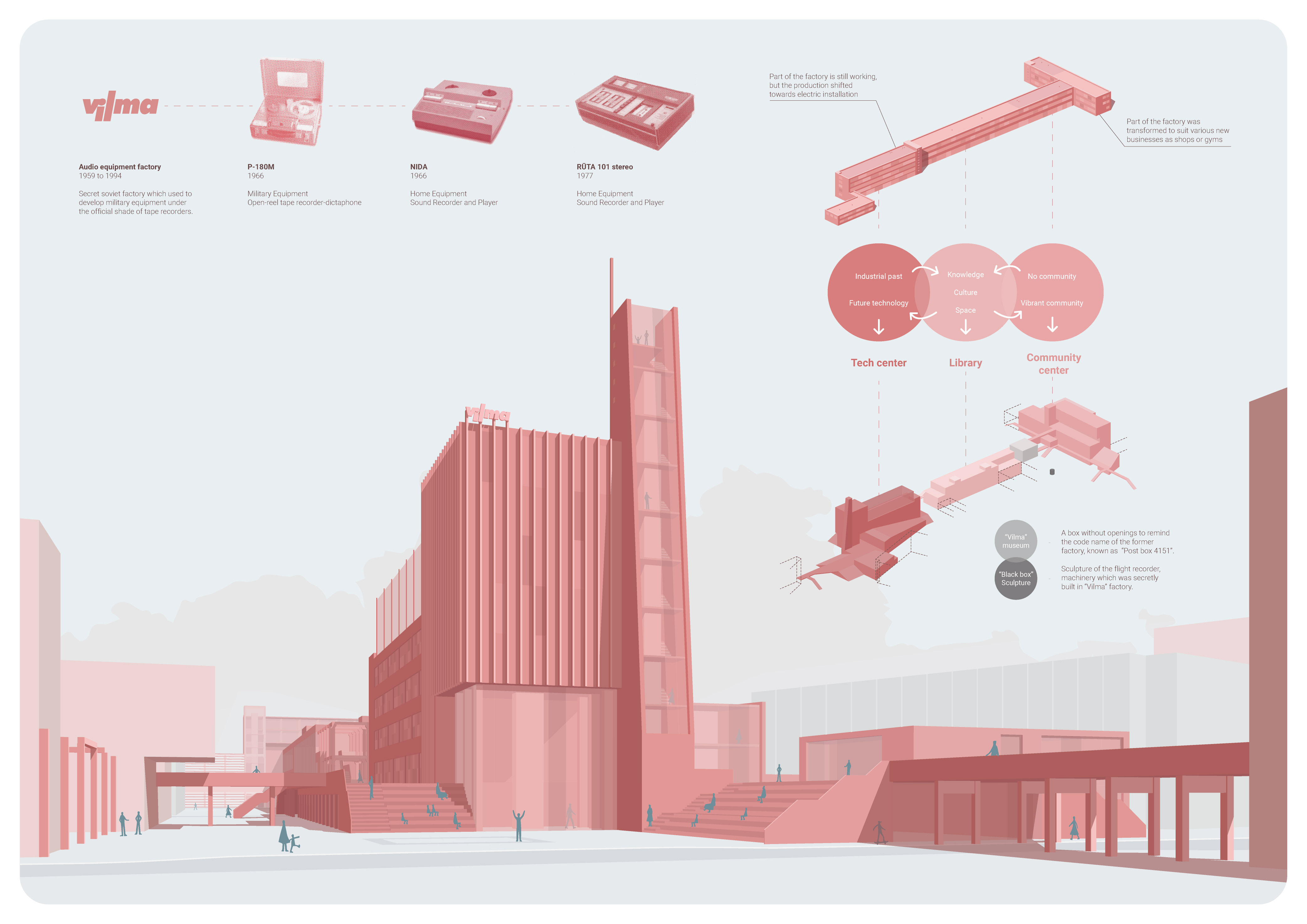
Concept of the detailed part of the project. Short summary of the former factory. View towards the technology centre.
-
Masterplan of the techno-cultural megastructure. Second floor plan.
-
Section of the techno-cultural megastructure. Section of the technology centre.
-
View towards the cultural centre. Axonometric views of the cultural centre parts.
-
Panel
-
Techno-cultural megastructure
Povilas Vincentas Jank?nas. Vilnius, Lithuania
-
Name of work in English
Techno-cultural megastructure
-
Name of work in original language
Urban redevelopment in Šiaur?s miestelis, Vilnius
Prize year
Young Talent 2020
-
Work Location
Vilnius, Lithuania
-
Author/s
Povilas Vincentas Jank?nas
-
School
Faculty of Architecture - Vilnius Gediminas Technical University.
Vilnius, Lithuania
Young Talent 2020 YT Nominees




Techno-cultural megastructure
Urban redevelopment in Šiaur?s miestelis, Vilnius
Program
Urban planning
-
Labels
Redevelopment · Public Space
The bachelor degree project tackles with the problems imposed by a in a post-industrial territory in Vilnius, Lithuania. It proposes both large and small scale urban solutions for the decaying dead-zone located in the urbanised core of the city.
The first problem to be tackled was a closed configuration of the area. The territory was opened and connected to the greater city street network. Major streets were protruded near the outskirts of the district and a tight street grid was developed inside the area. The network of busier and calmer streets was developed to make space for street life to appear and eventually change the cityscape. A lot of small and chaotic buildings had to be demolished for a controlled street grid to appear. Nevertheless, many industrial buildings were considered as important formants of the district and were included into a new mixture of densified and perimetrical built-up. The new systems were strengthened with a network of public spaces. An inner network was established inside the district and various connections were protruded towards the active spaces on the outskirts of the territory. The network was reinforced by the strategic placement of cultural institutions which also tackled the lack of cultural presence in the area. The second part of the project focused on one of the main urban formants of the the district - the former audio equipment factory. The extremely long industrial building was identified as one of the main elements limiting the reach of the territory and was therefore cut into three parts to open up the industrial district. The further plans for the factory were fuelled by the two main aspects of the area - industry and community. One was stuck in the past and the other was split apart and almost nonexistent. In order to solve these problems knowledge, culture and space of a higher quality were each dedicated to the three parts of the former factory. On one end of the structure a technology centre was developed in order to reshape the industrial past into the hub where future technology could be created. On the opposite side of the structure a community centre was developed to nurture the fragile community. A library was developed between the two centres, connecting them with its culture and knowledge into a techno-cultural megastructure.