Tea House in Paço das Infantas
João Mendes Ribeiro Arquitecto Lda. Castelo de Montemor-o-Velho, Portugal
-
Name of work in English
Tea House in Paço das Infantas
-
Name of work in original language
Casa de Chá no Paço das Infantas
Prize year
EUmies Awards 2001
-
Work Location
Castelo de Montemor-o-Velho, Portugal
-
Studio
João Mendes Ribeiro Arquitecto Lda
EUmies Awards 2001 Shortlisted
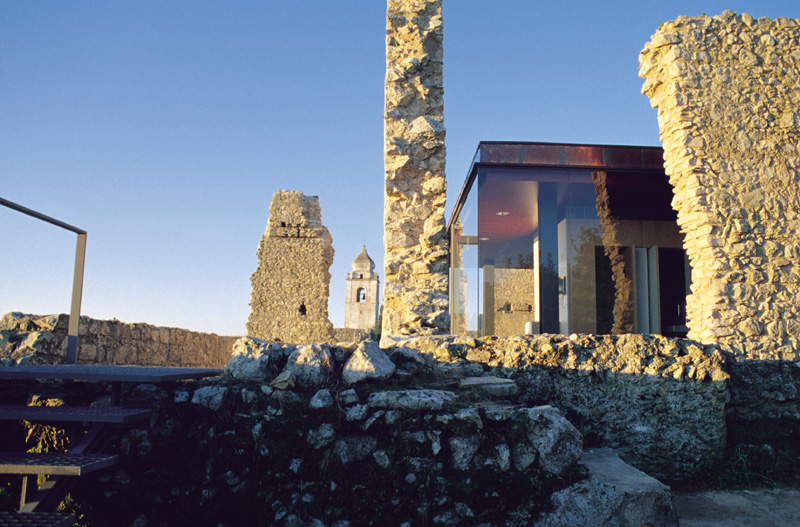


The Tea House in Paço das Infantas is the result of an analysis of the monument, attempting to clarify its historical significance by means of a contemporary use. The inner space of the ruins is occupied by a virtually weightless building, made innocuous by its geometry and the way it stands free from the surrounding ruins.
Collaborators
Collaborator (office): Carlos Antunes, Cid Silva, Desir Pedro, Jos Bandeirinha, Manuela Nogueira, Pedro Grand; Construction company: Not Defined A. Ludgero Castro; Landscape architect: Jo Mendes Ribeiro; Structural engineering: Raimundo Mendes da Silva; Electrical: Marcos Pinguinha; Mechanical: Isabel Sarmento
Program
Food & Accommodation
Completion
2000
The construction consists of a glass box confined by two horizontal planes & a metal roof and a wooden floor - joined together by a volume comprising the service areas. The pavement extends southeast in a platform that doubles as a terrace elevated above ground, thereby detaching the construction from its surroundings. The main purpose of the tea house was to create an autonomous construction, which is valued by a strong geometric and material language, simultaneously ascribing a new and coherent meaning to the existing ruins.
The building is defined by some massive elements, such as: two horizontal plans roof covering and pavement , connected by a chromatically distinct parallelepiped, corresponding to the service areas of the TeaHouse. The vertical surfaces are made in simple glass, modulated and free from framework leads, except for the doors, which are delineated by an iron frame and hoop. The structural elements work independently in the inside. On one hand, in order to keep them away from the ruin, and on the other, so that the dematerialized and abstract image of the glass box may prevail.
The pavement flag and the platform of the esplanade will be slightly erected, thus stressing even more the structure image, which seems to not be linked to anything, not even the soil.In the inside, the distribution of the space is necessarily simplified by minimizing the available areas in the program - 90 square meters. The services body will comprise the acclimatisation substructures systems, as well as the sanitary installations and the pantry for the preparation of cold meals. Joining the service areas in a single body, setback vis-à-vis the surrounding walls, allowed to keep the transparency of the building, thus creating a more abstracting reading level and hence, more suitable to the purposes of clarifying the existing one, while involving a new content.