-

Overal view
-
View on Štvanice island
-
Aerial view
-
Detail
-
Detail
-
Detail
-
Site plan
-
Longitudinal section
-
Cross sections
-
Elevation of the last span and detail of the joint
-
Details of bronze handrail
Štvanice footbridge
Atelier Petr Tej, Blank architekti, Atelier Bridge Structures. Praha, Czechia
-
Name of work in English
Štvanice footbridge
-
Name of work in original language
Štvanická lávka
Prize year
EUmies Awards 2026
-
Work Location
Praha, Czechia
-
Studio
Atelier Petr Tej, Blank architekti, Atelier Bridge Structures
EUmies Awards 2026 Nominees


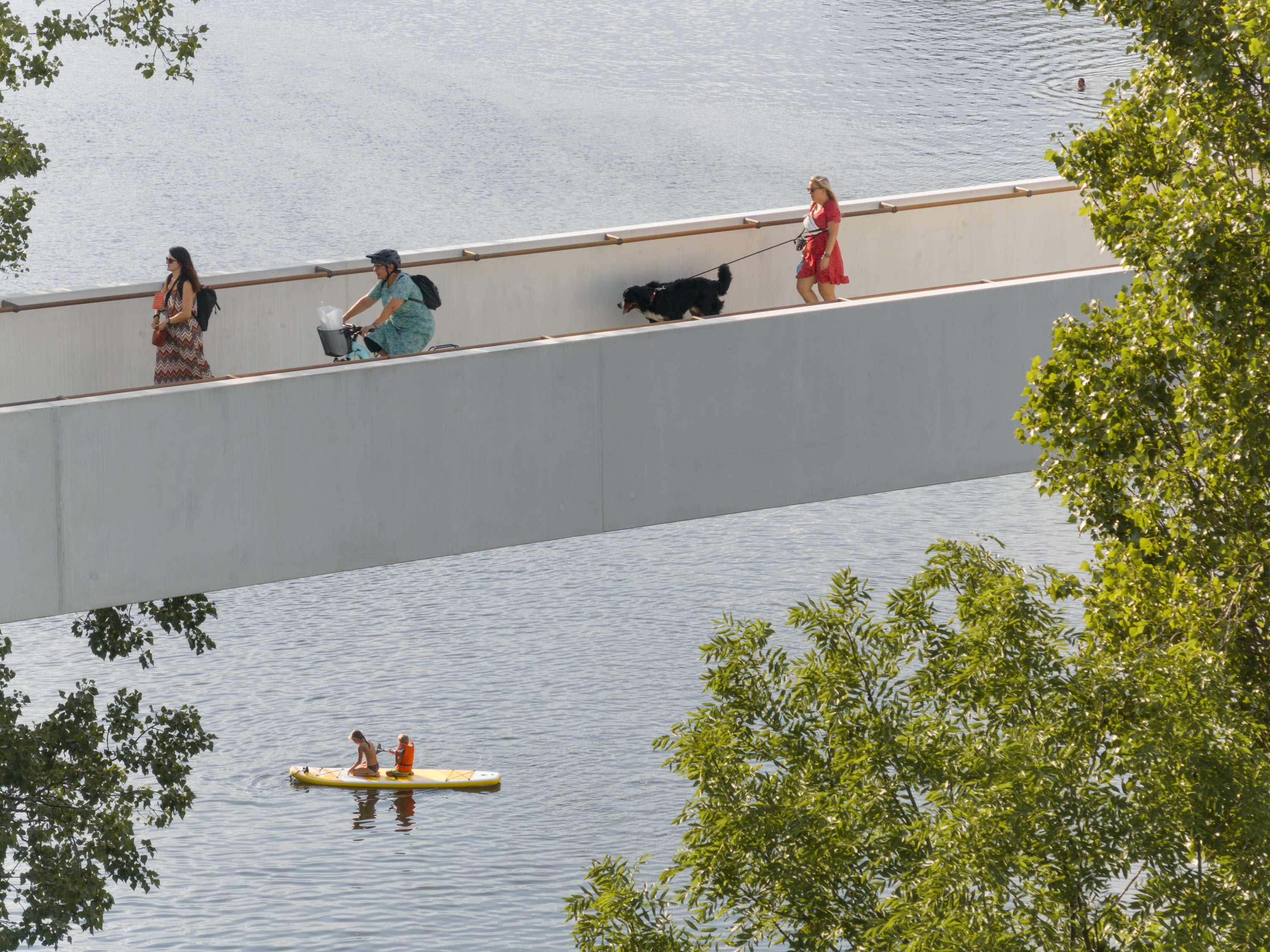


The gentle spatial curve of the footbridge is constructed as a smooth path based on the dynamics of pedestrian and cyclist movement.
Collaborators
Sculptor: Aleš Hvízdal; Sculptor: Jan Hendrych; Structure: Vít Najvárek - TOP CON Servis; Construction management: Michal Kunc - Skanska; Structure: Lukáš Smrt - KŠ Prefa; Consulting: Jiří Kolísko - Klokner Institute CTU in Prague; Structure: Oto Melter - Klokner Institute CTU in Prague
Program
Infrastructure
-
Labels
Bridge
Site area
1820 m²
-
Client
Praha
Total gross floor
1440 m²
Cost
7700 €/m²
The footbridge is realized according to the project of the authors Petr Tej, Marek Blank and Jan Mourek based on an international competition organized by the Institute of Planning and Development of the Capital City of Prague. This gentle spatial curve of the footbridge is constructed as a smooth path based on the dynamics of pedestrian and cyclist movement. The construction of the bridge humbly responds to the panorama of Prague, to the connection to the Holešovice and Karlín banks, as well as to the connection of Štvanice island.
The bridge is supported by two embankment abutments, two piers on the edges of Štvanice island and two piers in the unnavigable arm of the Vltava River. A ramp descends freely towards the island, the plan curve of which copies the curve of the edge of the island. The end span of the footbridge on the Holešovice side descends to connect to the level of the pavement smoothly and barrier-freely on the embankment. The span is designed to be vertically movable at the support point where a hydraulic piston mechanism is located to provide a vertical lift to the flood level Q1000. The structure is designed as a thin white line supported by two parapet beams. The structure has no pylons or suspension cables so as not to disrupt the Prague skyline. Part of the structure is an ornamental bronze handle with figural animal heads at the ends by the sculptor Aleš Hvízdal. The lighting is integrated in the handrail. On the Štvanice island there is a figural sculpture by the sculptor Jan Hendrych.
The bridge is made of high-quality ultra-high performance fibre reinforced concrete (UHPFRC) with a surface similar to shiny white marble. The main supporting structure of the bridge consists of a continuous reinforced concrete beam with longitudinal prestressing and an H-shaped cross-section. These are 2 full-walled side parapet beams with an intermediate deck plate that is supported by transverse ribs. In terms of production and assembly, it is a segmental bridge structure consisting of 57 prefabs. The use of UHPC allows designers to create very subtle and durable structures with minimal maintenance requirements, which is advantageous from a sustainability perspective.