-

Skocjanski zatok_Visitor Centre from Bonifika
-
Skocjanski zatok_Visitor Centre entrance
-
Skocjanski zatok_Observatory from Bonifika
-
Skocjanski zatok_Observatory interior ramp
-
Skocjanski zatok_Small Observatory
-
Skocjanski zatok_Birdhide on brackich area
-
Skocjanski zatok_City Side Entrance
-
Skocjanski zatok_Birdhide on Bonifika
-
Skocjanski zatok_Visitor Centre - competition visualisation
-
Skocjanski zatok_siteplan
-
Skocjanski zatok_Visitor Centre - drawings
-
Skocjanski zatok_Observatory_drawings
-
Skocjanski zatok_Birdhide and Small Observatory_drawings
-
Structures in the Škocjanski Zatok Nature Reserve
Ravnikar Potokar. Koper, Slovenia
-
Name of work in English
Structures in the Škocjanski Zatok Nature Reserve
-
Name of work in original language
Objekti v naravnem rezervatu Škocjanski zatok
Prize year
EUmies Awards 2017
-
Work Location
Koper, Slovenia
-
Studio
Ravnikar Potokar
EUmies Awards 2017 Nominees
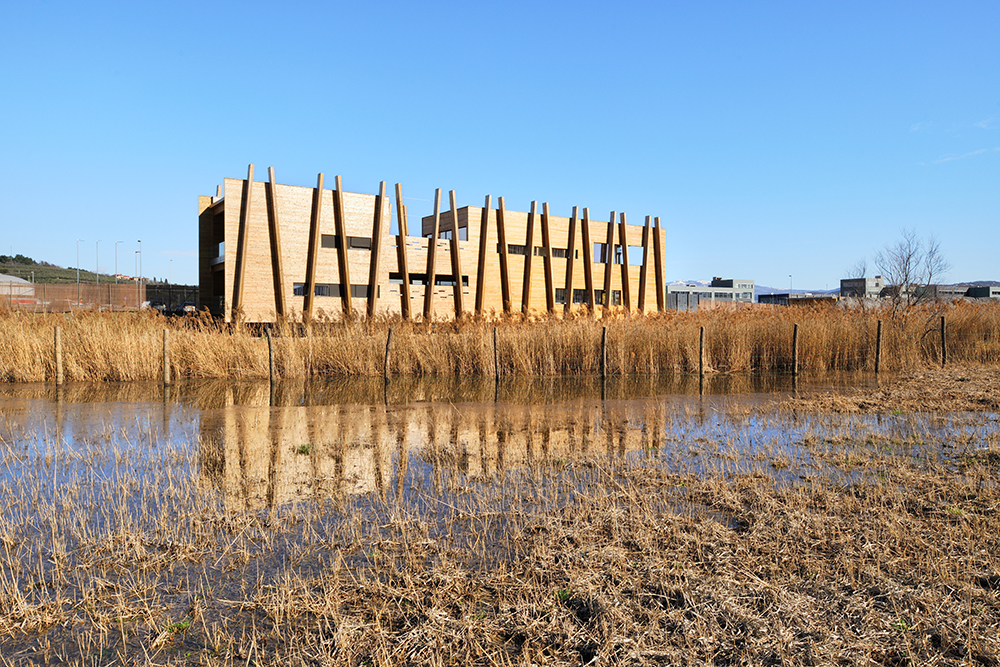


Škocjanski Zatok is the largest brackish wetland nature reserve in Slovenia. It is an island of landscape between the hill of Sermin, the motorway, the railway and the city of Koper. Newly built structures respect the sensitive environment, while offering firsthand experience of nature together with an interesting architectural experience.
Collaborators
Structural engineering: Vilko Šuligoj; Mechanical: Igor Papež; Electrical: David Furlan; Landscape architect: Urša Komac
Program
Landscape
-
Labels
Facilities · Gardens & Parks · Structure
Site area
122 m²
-
Client
Ministry of the Environment and Spatial Planning and DOPPS – BirdLife Slovenia; the operation was co-financed by the European Regional Development Fund
Total gross floor
810 m²
Completion
2016
Cost
2 €/m²
The reserve is functionally divided into two areas with total of 14 built structures. The larger area along the urbanized hinterland of Koper is a brackish wetland. Visitors access to this part is limited to a short path along the road. Observation of the nesting islets, briny puddles and mudflats is possible from newly built bird hides and a small observation tower. Bonifika of Bertoki, the second landscape area is a freshwater swamp with meadows, open water surfaces and reeds. This is the main part of the reserve where entrance, the visitor centre, the stables, the birdhides and observatories are located along the circular educational trail.
The creation of the Škocjanski Zatok is closely linked to the development of the city of Koper when first salt pans and pools for the evaporation of sea water were built in the inlet and salt production flourished. Water barriers and a network of canals are still visible in today's layout of the reserve. After salt productions abandonment area was drastically degraded and used as a city waste area. Yet flora and fauna remained diverse and substantial. Recent landscape renaturation and new interventions were aimed to bring the reserve closer to the wider public. The built structures were designed in line with the sustainable building principles (ecology, economy and sociocultural criteria). They represent auxiliary infrastructure for the educational trails in the natural landscape of the reserve. Structures try to preserve the identity of the place and act as an architectural emphasis. The concept for the visible loadbearing construction closely follows the technical characteristics of the wooden built elements. External vertical elements (pillars) carry the façade and the volume of the structure but also serve as an analogy of a bird nest among the reeds.
Structures are mainly built from sustainable and recyclable materials, equipped with an advanced low-energy, high-efficiency systems. Wood with its technical characteristic, sustainable values, visual appearance, living comfort and symbolic connection with the context has been chosen as predominant material. It is used in construction elements, façades, interior panelling and other architectural elements: stairs, furniture, urban furniture,...to the detail. Visual changes of exposed wooden structure through time are taken as a quality, creating it an inseparable part of the unique natural environment. The symbiosis of the functional design of the objects, the concepts for visible constructions and the choice of materials, colours and textures enables an unimposing positioning of built architecture in the designed natural landscape.