-

View of the multifunctional hall
-
Fragment of the tower`s top
-
Main entry
-
Top terrace
-
General view
-
View of the multifunctional hall from antresol
-
Ground floor plan
-
First floor plan
-
Attic floor plan
-
Section
-
Northern facade
-
Window frame detail
Square Tower of the Lviv Citadel
Symmetry. Lviv, Ukraine
-
Name of work in English
Square Tower of the Lviv Citadel
-
Name of work in original language
Квадратна вежа Львівської Цитаделі
Prize year
EUmies Awards 2026
-
Work Location
Lviv, Ukraine
-
Studio
Symmetry
EUmies Awards 2026 Nominees

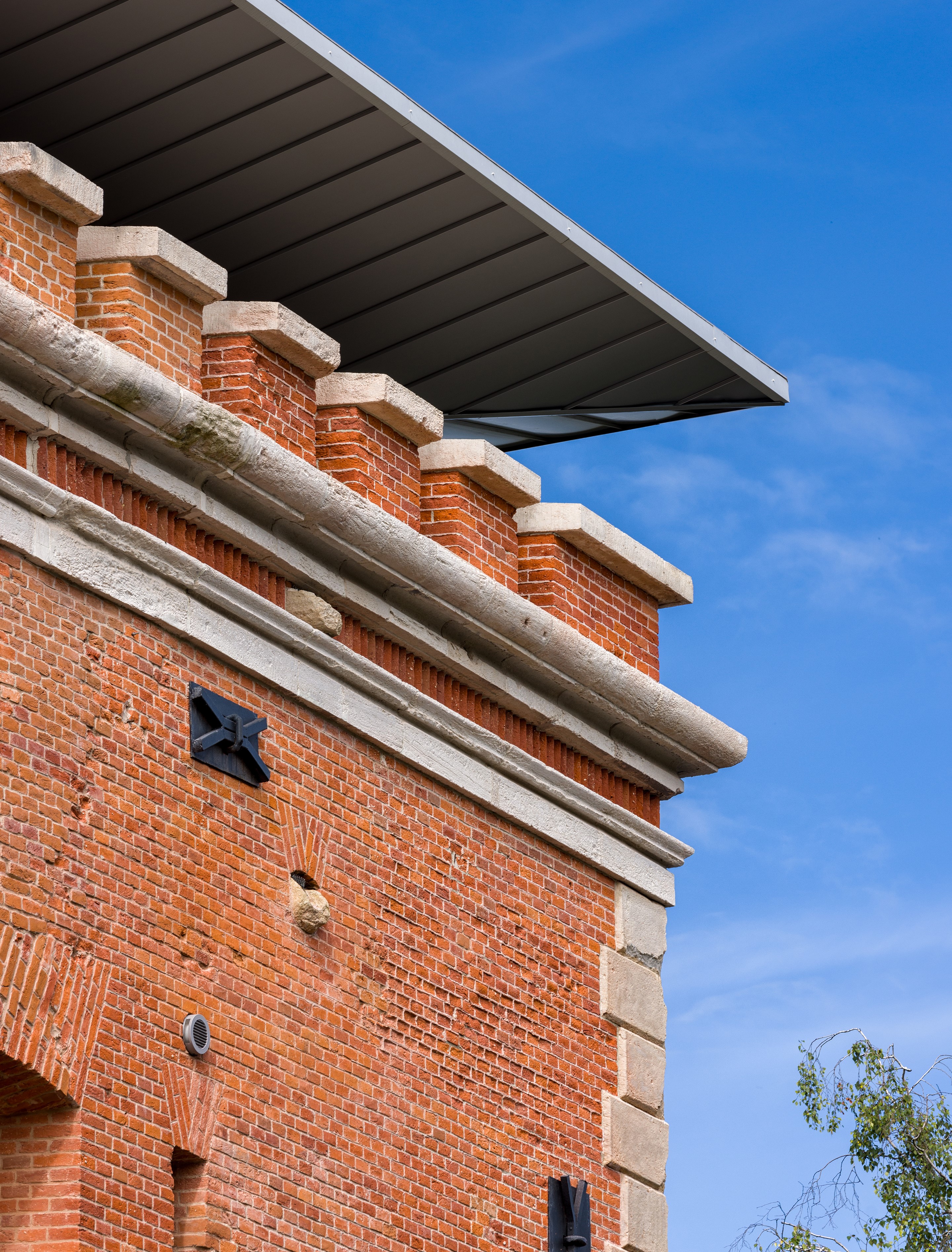


Rethinking the physical and energy potential of the historic building allowed it to be reanimated and adapted to a new purpose. Filled with light and interacting with the natural environment, the renovated attic rises above massive structure in a modern interaction of ancient and gothic traditions.
Collaborators
Structure: Volodymyr Sivers - Symmetry
Program
Mixed use - Commercial & Offices
-
Labels
Compact · Office · Heritage · Café
Site area
1822 m²
-
Client
Ltd Peredzvin
Total gross floor
2560 m²
The Square Tower was built in the 1850s as part of the Citadel complex in Lviv. It has been adapted for public use: offices and a multifunctional hall. The restoration of the architectural monument was carried out without altering the external configuration of the building. A new multifunctional hall has been created in the attic space, encircled by a gallery that follows the line of the merlons and offers wonderful views. Roof windows have been positioned to align with the main viewpoints. Public access has been provided via the restored bridge, and a new elevator connects all floor levels.
Photogrammetric measurements revealed an 18 cm deviation of the northwestern wall from the vertical. As a result, certain sections of the damaged vault were not rebuilt due to the loss of structural geometry but were instead reinforced with metal frames and secured to the reinforced concrete shell using fastening elements. Cracks in the brickwork caused by the deviation of the façade wall were reinforced and filled with new bricks. However, damage to the brick walls resulting from historical bombings was left untouched. A new metal roof was designed and insulated in accordance with the building's energy efficiency requirements. The loopholes and windows were restored, and the locations and shapes of the missing stone frames were indicated with metal sheets. The original round ventilation openings were used to install air recuperators, helping to create a comfortable indoor environment. The earth parapet around the tower was also restored.
Initially, the tower was designed with a flat roof, but to prevent water infiltration, a pitched roof was soon installed. The pillars supporting the roof structure rested directly on the vaults, which led to the formation of cracks. The roof overhangs were insufficient to protect the building’s facades from rainwater. Additionally, the mauerlat beams under the rafters were raised on posts near the merlons, and the space between the mauerlat and the merlons was filled with bricks. This obstructed the merlons and negatively affected their condition. For many decades, the tower was not in use and remained in a neglected state. During restoration, the roof structure was redesigned: the supporting elements were relocated from the vaults to the load-bearing walls, structural components were removed from the merlons, the roof overhang was adjusted to be detached from historical elements, and an internal drainage system was installed.