-

Representative graphic document
-
Graphic documents 1
-
Graphic document 2
-
Graphic documents 3
-
Graphic documents 4
-
Graphic document 5
-
Graphic document 6
-
PANEL
-
Social integration strategies of refugees into foster cities
Marilia Giallourou. Nicosia, Cyprus
-
Name of work in English
Social integration strategies of refugees into foster cities
-
Name of work in original language
The social role of architecture with regards to the integration process of refugees into foster societies aiming in their full participation in all aspects of collective life
Prize year
Young Talent 2018
-
Work Location
Nicosia, Cyprus
-
Author/s
Marilia Giallourou
-
School
School of Engineering - Frederick University.
Nicosia, Cyprus
Young Talent 2018 YT Nominees




Social integration strategies of refugees into foster cities
The social role of architecture with regards to the integration process of refugees into foster societies aiming in their full participation in all aspects of collective life
Program
Collective housing
-
Labels
Social · Complex
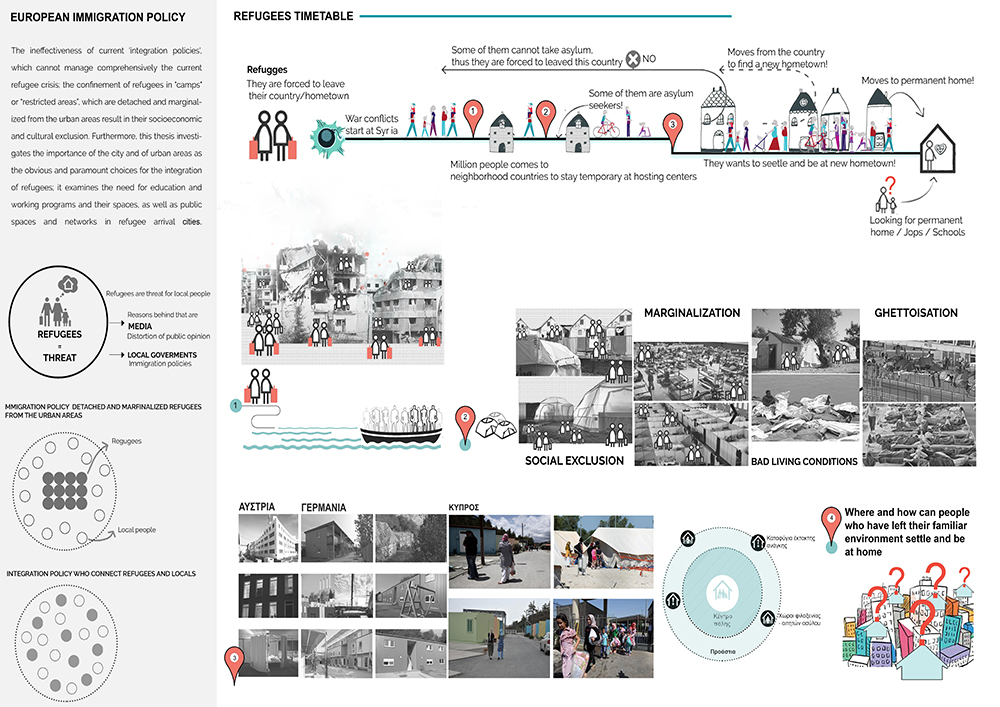
In Syria, people are being forced to live in ongoing violence for the past seven years; losing more than 400k people while 5m left without choice rather chasing a better future away from their home. Which are the social role of Architecture in terms of the integration process of refugees into foster societies?
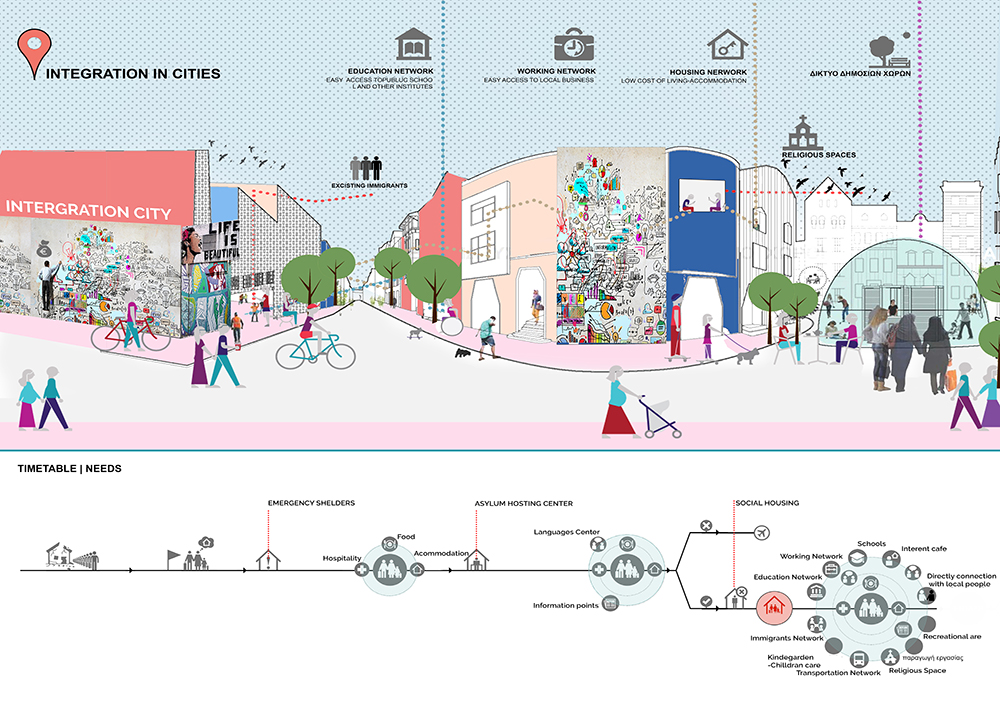
The project explores the social role of architecture with regards to the integration process of refugees into foster societies aiming in their full participation in all aspects of collective life. Initially, What is noted is the ineffectiveness of current 'integration policies', which cannot manage comprehensively the current refugee crisis; the confinement of refugees in "camps" or “restricted areas”, which are detached and marginalized from the urban areas result in their socioeconomic and cultural exclusion. Furthermore, this project investigates the importance of the city and of urban areas as the obvious and paramount choices for the integration of refugees. At the same time, it investigates the need for low-intensity architectural strategies within the urban environment and context, aiming at the integration of refugees in the cultural, economic and social structure of the city. Finally, it investigates the significance of the private space of the home as a social benefit for the refugees. The project is connecting two different but interrelated users; acceptance asylum refugees and local elderly people; in an innovative collective habitation area which operated as social networks, promoting and developing interaction and relations between the users. The project recognizes and examines in detail architectural design strategies that promoting and developing social interaction between refugees and elderly people. These strategies are a focus on “In-Between Spaces”, as a way to developed multiples social relations between spaces and forms with users. The spatial design layout has developed a vision that will improve socialization through dailies activities. In particular, this modular system is composed of three different spaces; public, semi-public and private spaces. Semi-public spaces are designed to improve socialization through simple daily activities such as cooking, ironing, studying, social dialogues and so on.