-

Front view
-
Frot view with corner fountain
-
Side view
-
Interior detail
-
Park view with tower of the SNP Bridge
-
Interior diagonal view
-
Orthophoto
-
Situation
-
Groundfloor plan
-
Sections
-
Axonometrie
-
Program
SJK Pavilion - Café Ferdinand
studeny architekti, Peter Stec Studio, GRAU. Bratislava, Slovakia
-
Name of work in English
SJK Pavilion - Café Ferdinand
-
Name of work in original language
SJK pavilón Bistro Ferdinand
Prize year
EUmies Awards 2026
-
Work Location
Bratislava, Slovakia
-
Studio
studeny architekti, Peter Stec Studio, GRAU
EUmies Awards 2026 Nominees
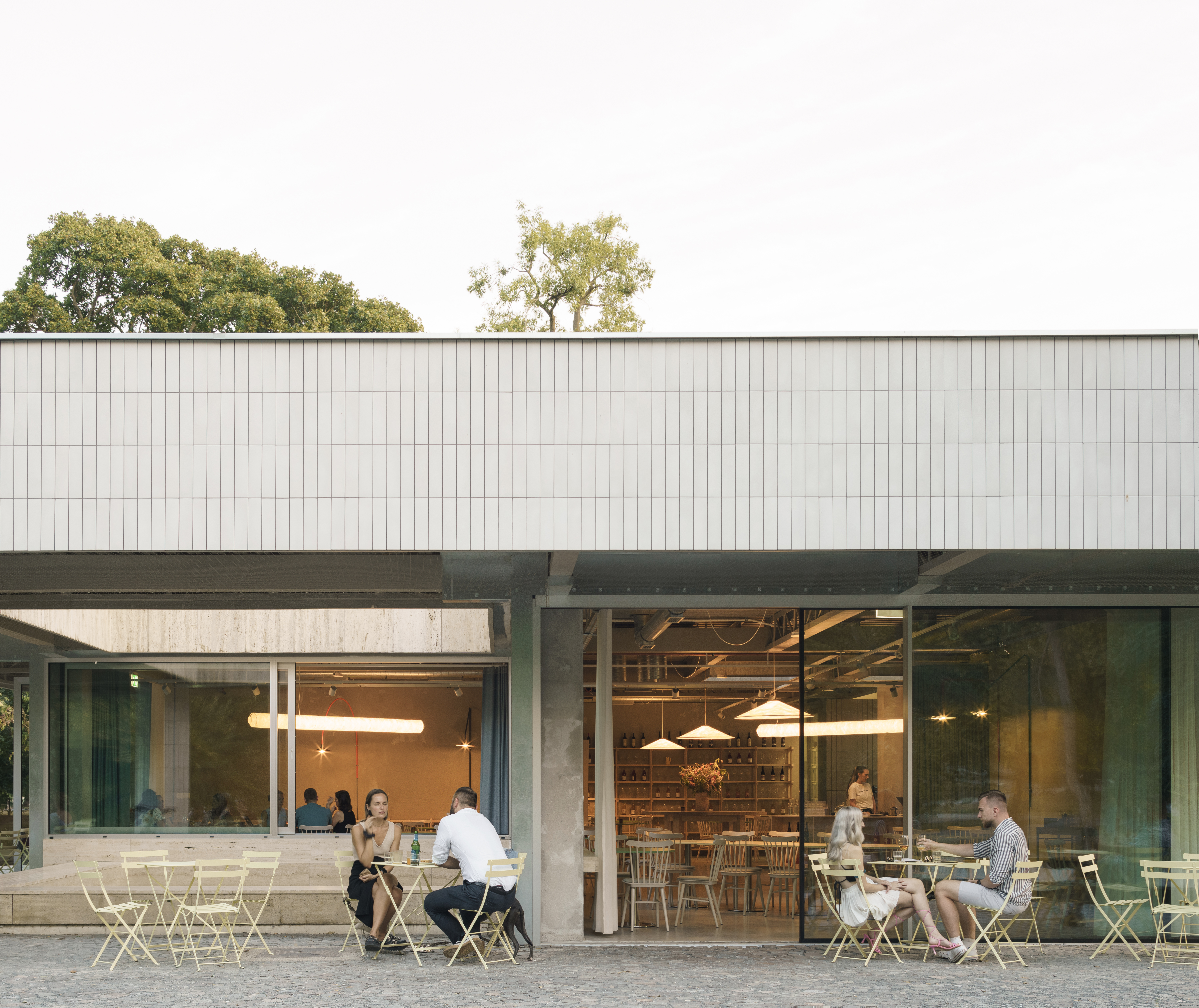


The building, an adaptive reuse of a structure from 1982, was constructed to provide services to one of Central Europe’s oldest public parks. The program restores the originally intended public amenities, including a café, open public restrooms, and a backstage for park events.
Collaborators
Collaborator (office): Maroš Bárora - studeny architects; Collaborator (office): Petra Ďuríšková - studeny architects; Collaborator (office): Nicol Bodnárová - studeny architects; Collaborator (office): Júlia Kolláthová - studeny architects; Structure: Ján Pivarč
Program
Food & Accommodation
-
Labels
Café · Social club
Site area
610 m²
-
Client
City of Bratislava
Total gross floor
390 m²
Cost
3230 €/m²
The restoration of the Pavilion is an opening to the renovation of the entire park. In the proposal, we place particular emphasis on functionality, barrier-free accessibility, safety and sustainability. The renovation provides a gentle solution from the perspectives of social integration and of energy demands, focusing on low-energy concepts and recycling circuits. We consider the project as a contribution to addressing the cultural heritage of our 'socialist' past, generating impulses for the revitalization of public space in the city and connecting architecture with its natural surroundings.
The project defragments the interiors, creating flexible spaces suitable for various programs: public café, private events, presentations, and workshops. We remove inappropriate interventions from the past and create open space, into which we insert two service boxes — public toilets and back-of-house storage and technology. Embracing the geometry of diagonally connected squares, the cross-shaped front section is dedicated to the café. The compact cubic background at the rear provides services for outdoor cultural events and public toilets. The open front section increases the connection with the exterior, including the fountain — expected to become a major attraction to visitors once more. The public restrooms are accessible from both inside and outside, featuring unisex cabins with translucent polycarbonate ceilings.
The building’s envelope has been reengineered to comply with low-energy standards. The ceramic wrapping highlights the plasticity of the façade, with its transparent public and opaque serving poles. On warm days, the new sliding glass panels increase the porosity of the envelope, reconnecting the café with the surrounding landscape. Removed walls are replaced by a single column. The reopened kitchen is connected to the café and equipped in minimal, reflective stainless steel. The original jagged outline cantilevers over terraces, maximizing the connection with the park, shading the terraces below, and preventing solar gains inside. In cooler months, the triple glazing, combined with an upgraded façade assembly, minimizes energy demands on a newly installed heat pump. An option to connect solar panels is available. Rainwater from the green roof is collected and used for irrigation, while stormwater overflow percolates through rain polders in the park.