Shaping Space by Experience Data
Johanna Jõekalda. Tallinn, Estonia
-
Name of work in English
Shaping Space by Experience Data
Prize year
Young Talent 2018
-
Work Location
Tallinn, Estonia
-
Author/s
Johanna Jõekalda
-
School
Faculty of Architecture - Estonian Academy of Arts.
Tallinn, Estonia
Young Talent 2018 YT Nominees



Shaping Space by Experience Data
Shaping Space by Experience Data
Program
Mixed use - Infrastructure & Urban
-
Labels
Aggregation · Bridge · Public Space
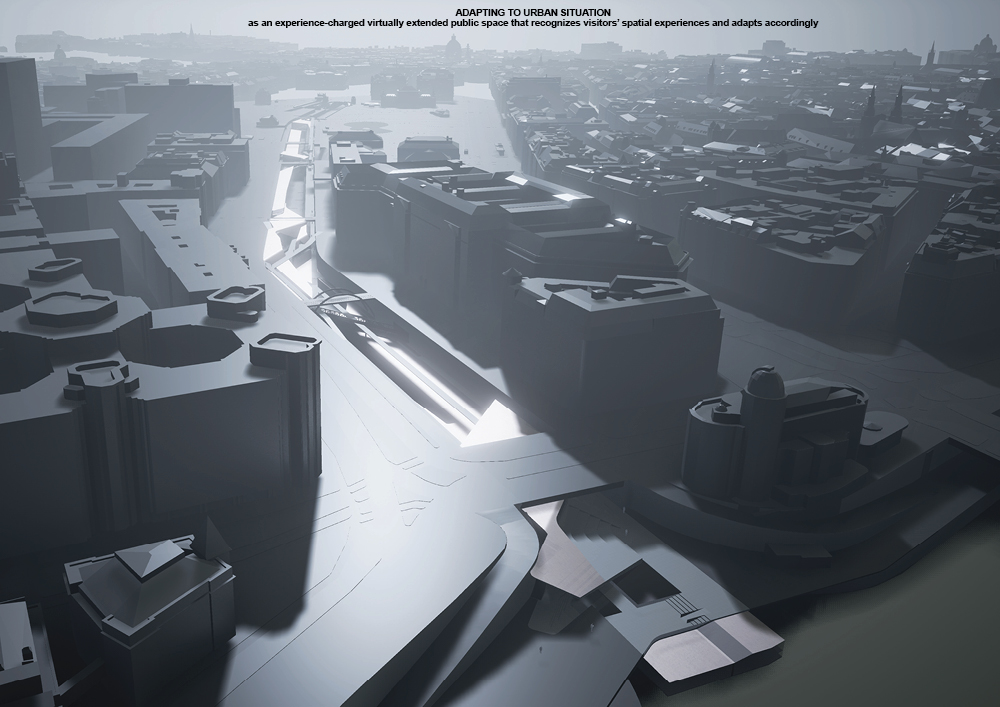
The project examines how the main actors in spatial perception – space, senses, brain – have become definable in terms of data, and how to make use of it while shaping spatial experience. The proposed technique allows to extract users’ experience data from brain-computer interfaces as they visit VR environments, and apply this data in the design process.
While data-based solutions are increasingly improving our everyday lives, in architecture they are related more often to optimized production, environmental sustainability, programmatic functionality, economic applicability and other technical aspects, in case of which no particular attention is devoted to user experience. In its most common present forms data-based approaches devalue spatial quality in architecture. Considering experiential impact the main criterion for spatial quality, “Shaping Space by Experience Data” combines virtual reality and brain tracking techniques to track beholders’ spatial experience in data format and apply this data in an experience-oriented design process.\nThe method was developed in the course of laboratory experiments, where I instructed test subjects to visit various test models in a virtual reality environment, recording their location, direction of sight and bioelectrical brain activity data. The indicators of their emotional states were ascertained by valence-arousal method on the scales of activity-passivity and positivity-negativity. The data was analyzed by post-scientific methods that allow to enter the indicators into spatial models and manipulate their formal properties on the basis of these data, so that users’ experiential responses would be expressed as spatial interactions.\nThis transfer of experiential data to spatial models was a key stage in developing principles governing potential boundary situations for the accompanying architectural project: an innovation centre situated in contemporary public space that is programmed to adjust according to its visitors’ experience data. Its spaces are adjusted by data-based illusion techniques that alter the perceived properties of the spaces by light, optics, reflection and perspective distortions. Physical and non-physical space produce a combined effect. The building’s spatial properties remain physically unchanged, but its ostensible characteristics extend the spaces virtually and make us perceive new dimensions that adapt according to our responses.