-

Biophilic hallways - raw earth, hemp and wood
-
Street facing facade Street facing facade - dry rammed recycled concrete
-
The great hall - to enter an outdoor area
-
Kindergarten playground
-
The sports hall The sports hall - simplicity & soft light
-
Playgrounds in close harmony with nature
-
Site plan
-
Ground floor plans
-
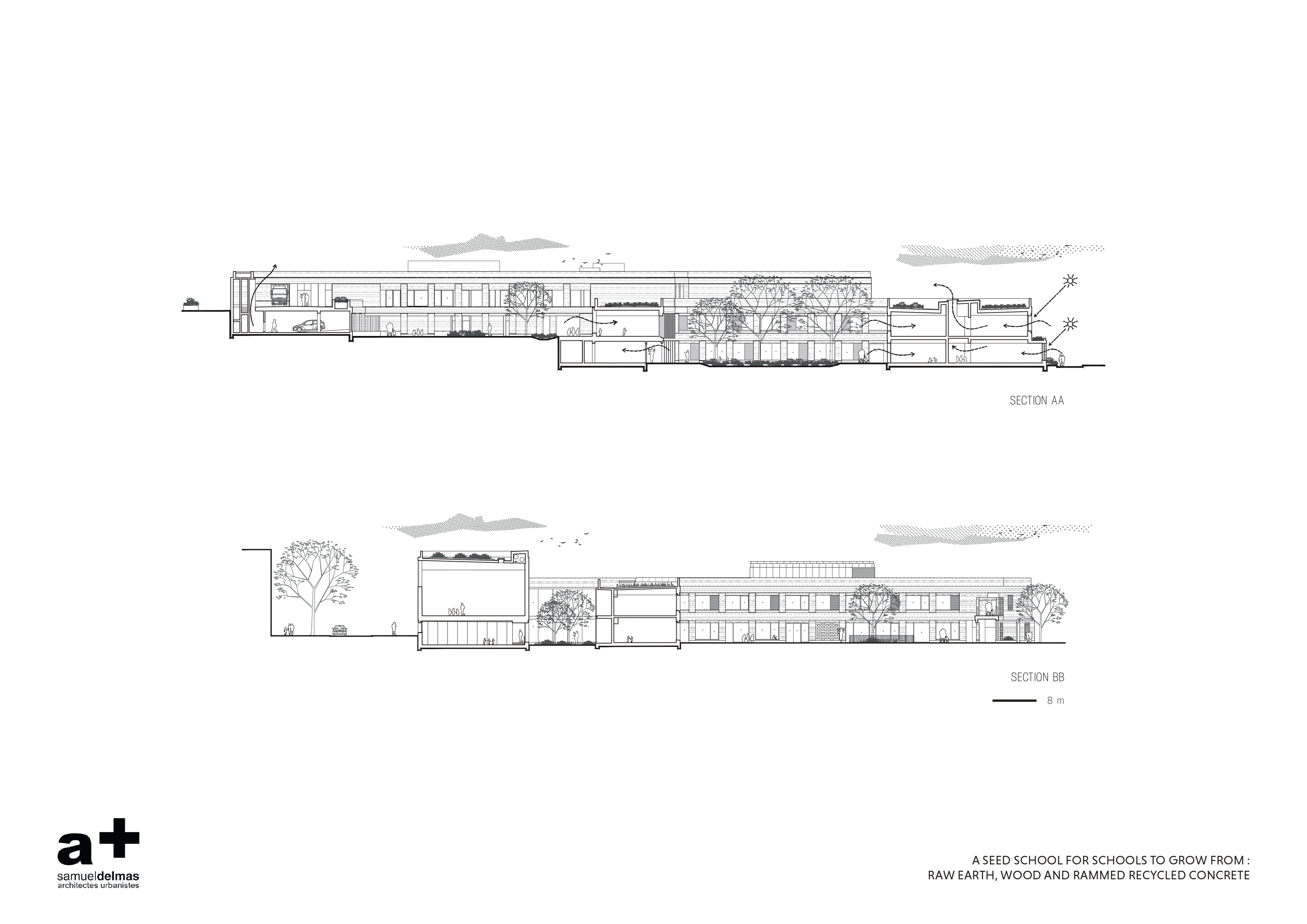
Sections
-
Facade section
Seed School: Growing Schools from Rammed Earth, Wood, and Recycled Concrete
a+ samueldelmas architectes urbanistes. Châtenay-Malabry, France
-
Name of work in English
Seed School: Growing Schools from Rammed Earth, Wood, and Recycled Concrete
-
Name of work in original language
Faire école : terre crue, bois et béton recyclé damé
-
Work Location
Châtenay-Malabry, France
-
Studio
a+ samueldelmas architectes urbanistes
Nominees



The project’s guiding principle was to create an ideal learning and growing environment for children within a building designed with the right amount of the right material in the right place. It prioritized local sourcing, reused materials, bio and geo-based resources, and raw/finished solutions.
Collaborators
Architecture: Marilyne Thévenet - a+ samueldelmas architectes; Architecture: Solène Mondoloni - a+ samueldelmas architectes; Architecture: Nuno Florêncio - a+ samueldelmas architectes; Architecture: Martin Journot - a+ samueldelmas architectes; Structure: Batiserf P. Clément - Batiserf; Structure: Batiserf T. Vialleton - Batiserf; Fluids: Amoes E. Arboleya - AMOES; Acoustics: Meta C. Guerini-Gross - Meta; Economy: Lucigny-Talhoët et associés S. Pineau - Lucigny-Talhoët et associés - LTA; Consulting: Matelow A. Hellouin de Ménibus - Matelow; Control office: BTP Consultants R. Chebib - BTP Consultants; SCMC: BP Consulting G. Romito - BP Consulting; structural works: Donato Construction D. Sampaio - Donato Construction; Wood framework: Les Charpentiers de l'Atlantique J. Minguet - Les Charpentiers de l'Atlantique; External woodwork: Ertcm Industries M. Duverneau - ERTCM Industries; outside woodwork: Diter B. Perrin - Diter S.A; Locksmithing: Sarmates A. Burguière - Sarmates; Inside woodwork: JPV Bâtiment S. Leplanquais - JPV Bâtiment; Raw earth-hemp partitioning: Akta L. Goudet - Akta
Program
Education
-
Labels
Children & Youth · School
Site area
7029 m²
-
Client
Ville de Châtenay-Malabry
Total gross floor
6639 m²
Cost
2952 €/m²
The school, designed for 540 children, is inserted in a mixed-use eco-district of 18 ha previously occupied by an university. It is gently inserted in a slope creating a sequence of three large courtyards open towards the landscape dedicated to : the preschool on the lower floor, the elementary school and sports facilities on the middle floor, and the central kitchen on the top floor. In harmony with its bond to the site, the school was literally built from the ground by reusing the demolition materials of the former builidings, mainly visible its protective outer wall of rammed dry concrete.
The program made by the City of Châtenay-Malabry expressed the ambition to make the primary school a model of innovation and low-carbon construction, promoting the use of an alternative technique known as "cast earth concrete." However, after further investigation, it became clear that this option was not mature and viable for the project and its objectives. In response, our team developed three innovative low carbon construction techniques: dry-rammed concrete façades made from 100% recycled aggregates, hemp-earth partitions, and acoustic ballast floor with recycled sand. These techniques are intended to be publicly shared for further reproduction and the building gives them an prominent role becoming itself literaly a pedagogic tool. Besides, the building's bioclimatic design includes calibrated window openings with solar shading, natural night-time ventilation, and passive strategies that reduce reliance on active systems, ensuring user comfort with minimal energy use.
Wood, earth, and vegetation are omnipresent throughout the project. It thus embodies the principles of biophilia, ensuring an ideal environment for childrens. All loadbearing façades are "dry" rammed concrete made from recycled concrete aggregates from onsite demolitions (4,000 tons). Interior partitions between classrooms and corridors are timber-framed with raw earth and hemp infill (59 tons), finished with straw/raw earth plaster (42 tons). The earth was sourced less than 35 km from unused stockpiles in the Île-de-France region, the hemp and straw were produced within 45km radius from the site. Floor ballasting was carried out using recycled sand recovered entirely from the site’s former buildings. Even food industry by-products—such as peach and apricot kernels—were repurposed to protect underlying roofing materials. The structure is deliberately simple: load-bearing façades and exposed timber frames inside allow for highly flexible layouts and ensure the building’s reversibility.