-

View from Boats
-
Silhouette with 12 Bens in background and boats
-
South facing plaza area
-
Overhang and Canteen Window
-
Entrance canopy
-
Aerial View
-
Site plan
-
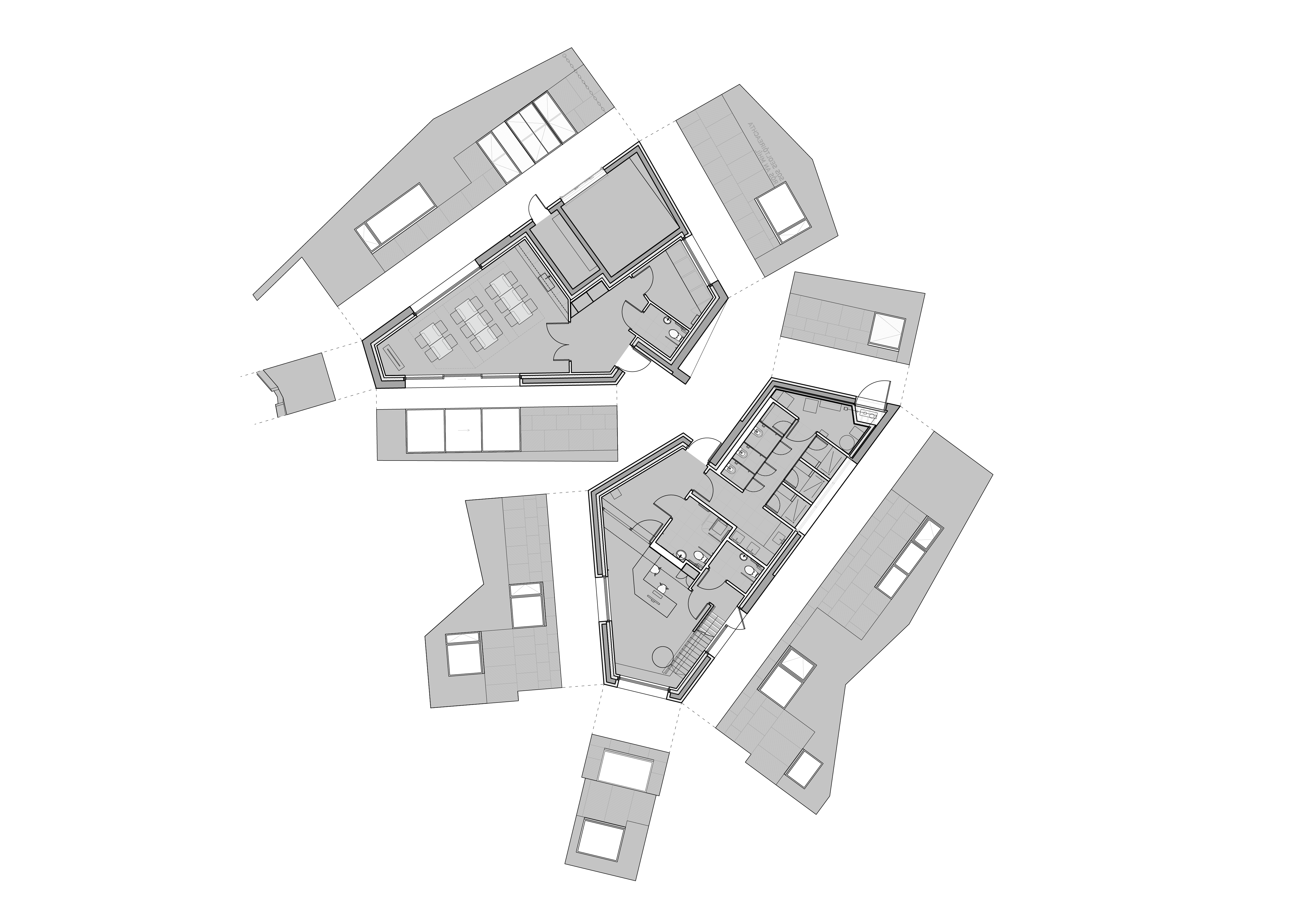
Ground Floor Plan
-
First Floor Plan
-
Sections Elevations
-
Sections Elevations
-
Unfolded Elevations
Rossaveel Small Craft Harbour
Foley, Campus. Galway, Ireland
-
Name of work in English
Rossaveel Small Craft Harbour
Prize year
EUmies Awards 2026
-
Work Location
Galway, Ireland
-
Studio
Foley, Campus
EUmies Awards 2026 Nominees


The building provides welfare facilities for the small craft harbour as well as an electrical substation. It marks the harbour entrance and creates a new focal point and public space for the area. The location is extremely exposed and the project negotiates the threshold between sky, land and sea.
Collaborators
Collaborator (office): Marta Lopez Garcia - Foley Architects
Program
Infrastructure
-
Labels
Facilities · Energy
Site area
1511 m²
-
Client
Department of Agriculture Food and the Marine
Total gross floor
182 m²
Cost
4000 €/m²
Rossaveel Harbour is located in the Gaeltacht village of Ros An Mhil on the Connemara coast and contains an auction hall, ice-plant, piers for fishing, ferries and passenger boats catering for 300,000 visitors each year. The site is a man-made pier at the entrance to the harbour which shelters boats docked at the small craft harbour. The commission was to create a new focal point for the area as well as basic infrastructure such as an ESB substation, showers, toilets, a canteen, small office and a look out for the Harbourmaster for surveillance.
The project interacts with its context. The roof is a simple inverted planar surface which is detailed to create a waterfall feature pouring rainwater back into the sea via a soakaway providing drama for ferry passengers heading to the islands on a rainy day. This rises on the corner to allow the super intendants office to look out over the harbour entrance. The building silhouette of the building is designed to blend into the landscape beyond it. The reinforced concrete “fragile shell” structure spans and cantilevers off the external leaf of the walls which are insulated internally. The roof canopy creates a sheltered entrance for the two distinct parts of the building’s program. One side contains a canteen, laundry and substation while the other a shower block and offices. The building is mostly used in the afternoon when boats arrive to dock for the night and so the canopy follows the angle of the sun to frame the sunset, further anchoring the project within its environment.
The material palette comes the site which is made of reinforced concrete retaining walls and rock armour made of local stone. The new landscape, which is made of natural stone, folds up onto the building and the reinforced concrete roof continues down the façade. Rectangular openings are formed where these two materials meet, giving an undulating materiality reflecting the Connemara landscape beyond the project. In this harsh environment concrete was chosen both as structure and an external finish due to its durability and longevity. This reduces the need for the frequent replacements or repairs, which have affected the surrounding metal clad buildings of the harbour. The building’s thermal mass properties help regulate indoor temperatures, and the material choice also helped fire protect the ESB Substation which is integrated into the building. A ground source heat was installed and the building achieved an A2 rating due to its minimal energy consumption.