-

0 representative document.jpg
-
1 existing building.jpg
-
2-concept.jpg
-
3-ground-floor-plan.jpg
-
4-shelter.jpg
-
5-first-floor-plan.jpg
-
6-knowledge.jpg
-
7-community.jpg
-
8-roof-plan.jpg
-
9-safe-space.jpg
Remodeling. Adaptation of a building
Theresa Emilia Schleinitz. Ybbsitz, Austria
-
Name of work in English
Remodeling. Adaptation of a building
-
Name of work in original language
Ein Umbau. Adaption eines Bestandsgebäudes – feministische Kritik an bestehenden baulichen und gesellschaftlichen Strukturen
Prize year
Young Talent 2025
-
Work Location
Ybbsitz, Austria
-
Author/s
Theresa Emilia Schleinitz
-
School
Faculty of Architecture - Graz University of Technology.
Graz, Austria
Young Talent 2025 YT Nominees


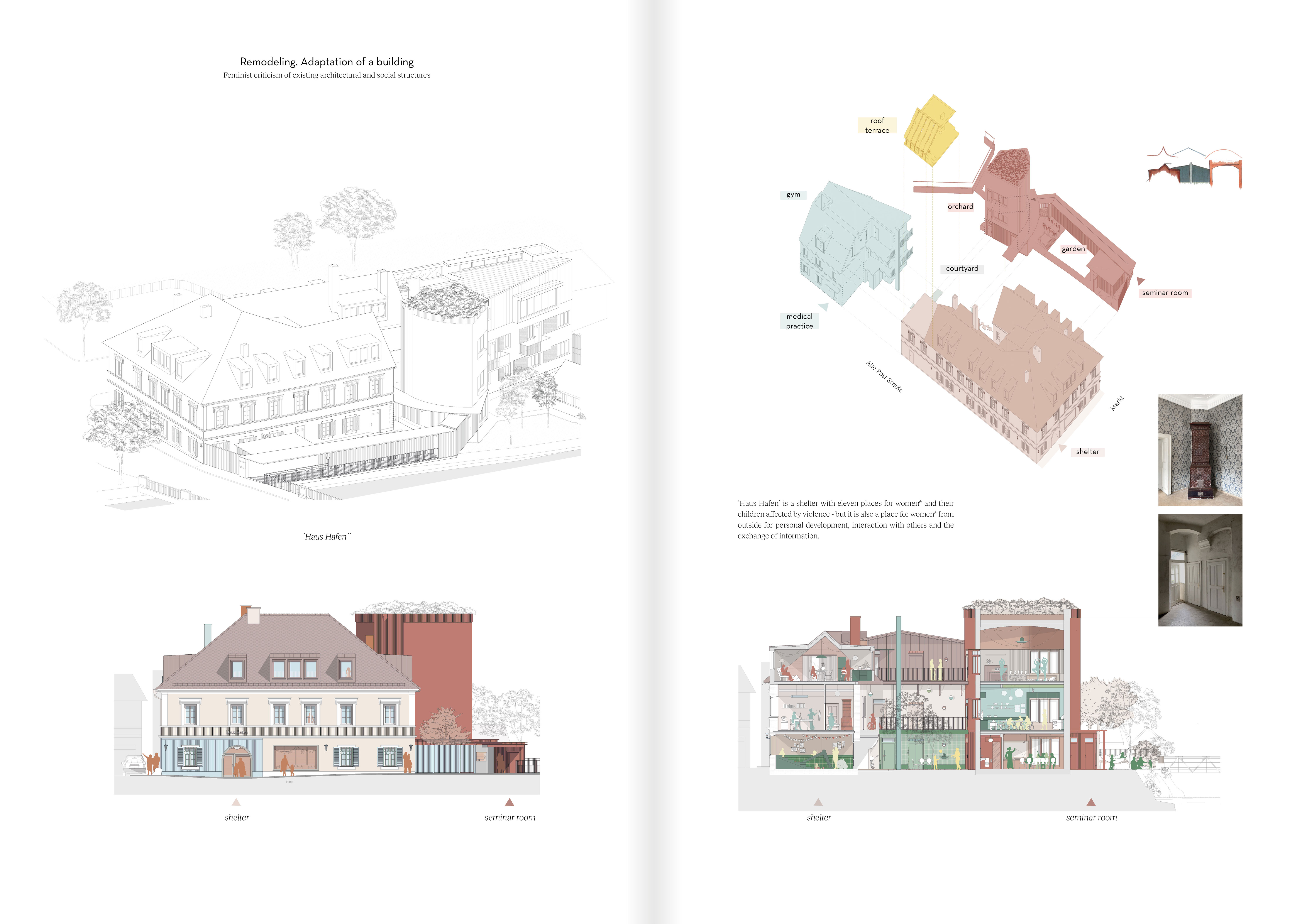


Remodeling. Adaptation of a building
Feminist criticism of existing architectural and social structures
Program
Health
-
Labels
Health Centre · Facilities · Children & Youth
Whilst architecture creates the physical conditions of life, conservative, misogynistic norms have manifested themselves in the built environment. Awareness of gender issues and measures in support of intersectionality are not sufficiently implemented in both the university curricula and in the planning practice of architectural offices. The male* norm of the patriarchy divides the social space into the spheres of paid work and reproductive work, which often leads to the invisibility and isolation of women*. Housing and workplace conditions are still adapted to a patriarchal norm today.
Architecture holds authority over the built environment and determines the physical conditions for the living spaces of our society. This thesis questions its planning practices and its influence on the availability of space, as well as its configuration, which is often standardized towards the needs of men*. An understanding of concepts of feminism and the clarification of historically and socio-politically male*-dominated contexts and their impacts on the disadvantaged position of women* form the basis of this work. Aiming to create a safer, more accessible, and diverse world for all, architecture can intervene in the capitalist system of production and reproduction by overcoming the modernist separation of working and living, and thus promote social change. Remodeling can become a repair practice, when spatial diversity and inclusivity are lacking. As a starting point for breaking down and transforming patriarchally charged structures - and utilizing their inherent social and structural local qualities - architecture must work sustainably with existing buildings, as well as house women*-specific healthcare and protective facilities. Combining the acquired knowledge, this thesis culminates in a design that examines the conversion of a historical, existing building into a Women*´s House in the Austrian countryside. Shelters for women* and their children must be freed from taboos and expanded into rural regions - as a space for exchange, protection and experience in a world whose value system is hostile to women*. As an alternative to monofunctional housing, the design incorporates a women*´s shelter, a common space and workshop room for exchange - and thus contributes to urgent feminist claims on and in architecture.