-

panels.jpg
-
panels2.jpg
-
panels3.jpg
-
panels4.jpg
-
panels5.jpg
-
panels6.jpg
-
panels7.jpg
-
panels8.jpg
Reimagining Urban Vernacular
Pierre Dalais. Sydney, Australia
-
Name of work in English
Reimagining Urban Vernacular
-
Name of work in original language
Reclaiming High-Tech Ruins for Low-Tech Living
Prize year
Young Talent 2025
-
Work Location
Sydney, Australia
-
Author/s
Pierre Dalais
-
School
Sydney School of Architecture, Design and Planning - University of Sydney.
Sydney, Australia
Young Talent 2025 YT Open Finalists
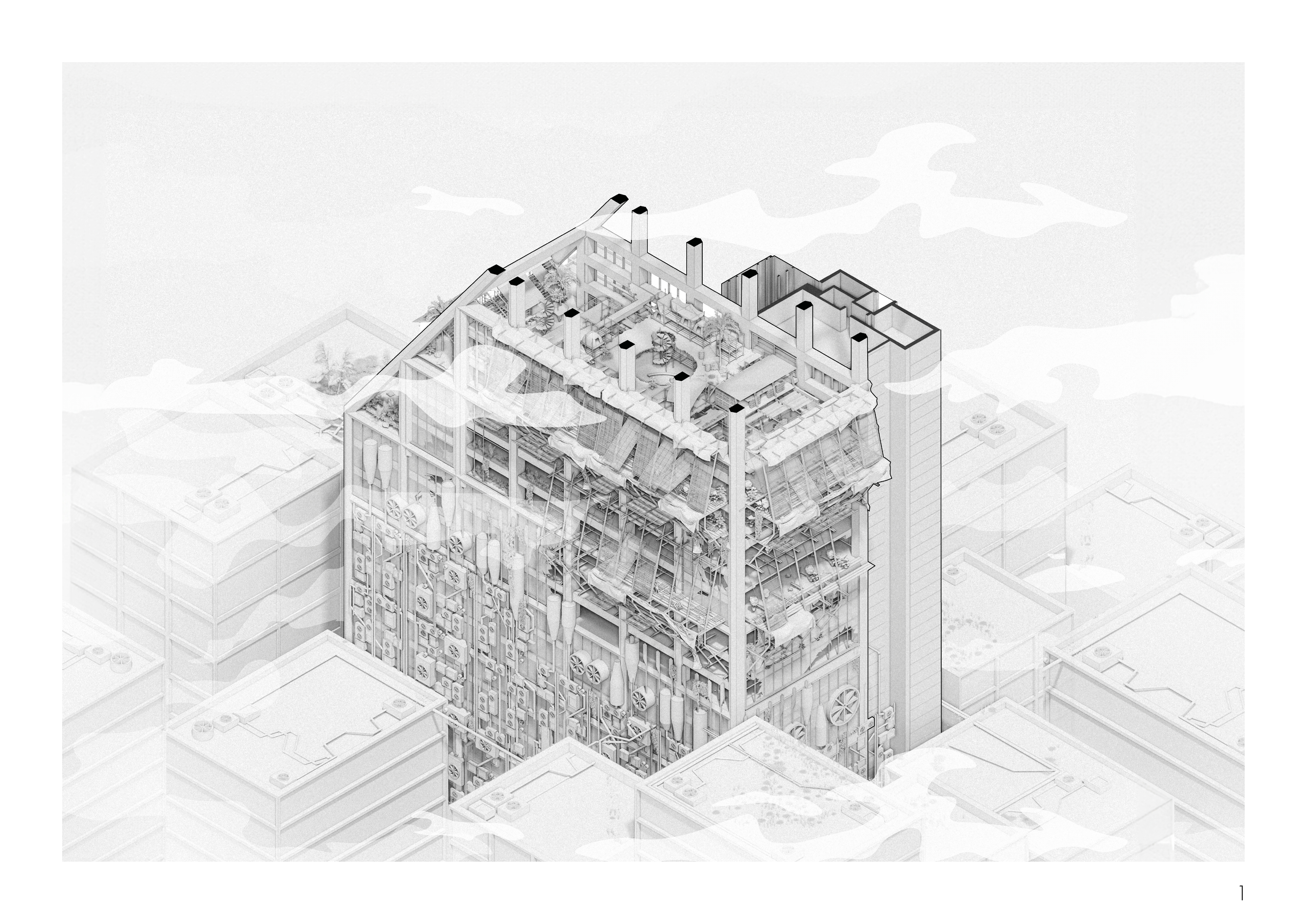


Reimagining Urban Vernacular
Reclaiming High-Tech Ruins for Low-Tech Living
Program
Mixed use - Cultural & Social
-
Labels
Aggregation · Architecture · Community · Collective housing · Research
To emphasis on the current trend of a techno-centric world, this scenario envisions its collapse due to economic failure and resource depletion. Abandoned Skyscrapers stand as remnants of a failed utopia. Amidst this decay, the project reclaims a high-tech tower, transforming it into a low-tech experimentation. Through subtraction, reuse, and adaptation, squatters aim to redefine urban repair, questioning the fundamental role of architecture. As the project explores a fictional future of decay and reclamation, one question remains: What defines an urban vernacular in this transformed world?
Squatters reclaim the abandoned Deutsche Bank Tower in Sydney. The fall of global systems has left architecture and techno-temples in ruins, prompting a return to the core principles of shelter, materiality, and climate adaptation. Navigating the blurred boundary between utopia and dystopia, the project imagines a future of decay and reclamation. Squatters repurpose the structure, transforming rigid corporate spaces into self-sustaining, communal habitats through strategic subtractions, passive ventilation, and adaptable enclosures. Mechanical systems inspired by Renaissance-era machinery—operating without electricity—offer an alternative to high-tech dependence, reframing construction as a tactile, human-driven craft. At its core, this project proposes re-learning architecture by emphasizing shelter as its most fundamental role. Drawing from informal settlements, vernacular design, and adaptive reuse, it introduces urban camping, movable thermal barriers, and layered climatic filters to regulate comfort. Spaces evolve organically, shaped by necessity rather than dictated by preordained design. This exploration questions architecture’s reliance on technology and its impact on local identity. It examines how resourceful, climate-responsive design can naturally foster a regional aesthetic and sense of place, rather than conforming to globalized trends.