-

View from the central passage, a new urban street
-
The public condition of this passage reinforces the idea of opening the centre to the city
-
The organization of the spaces is based on the structural reinforcements of the existing building
-
The closed programs are located in the opaque boxes, which act as great pillars
-
Workshop in one of the main spaces, with a skylight illuminating the centre
-
On the outside, the original holes that had been disfigured are recovered
-
Demolition diagram
-
First floor
-
Ground floor
-
Longitudinal section
-
Cross section
-
Climate section
Rehabilitation of Vapor Cortès - Prodis 1923
H ARQUITECTES. Terrassa, Spain
-
Name of work in English
Rehabilitation of Vapor Cortès - Prodis 1923
-
Name of work in original language
Rehabilitació del Vapor Cortès. Prodis 1923
Prize year
EUmies Awards 2026
-
Work Location
Terrassa, Spain
-
Studio
H ARQUITECTES
EUmies Awards 2026 Architecture finalists
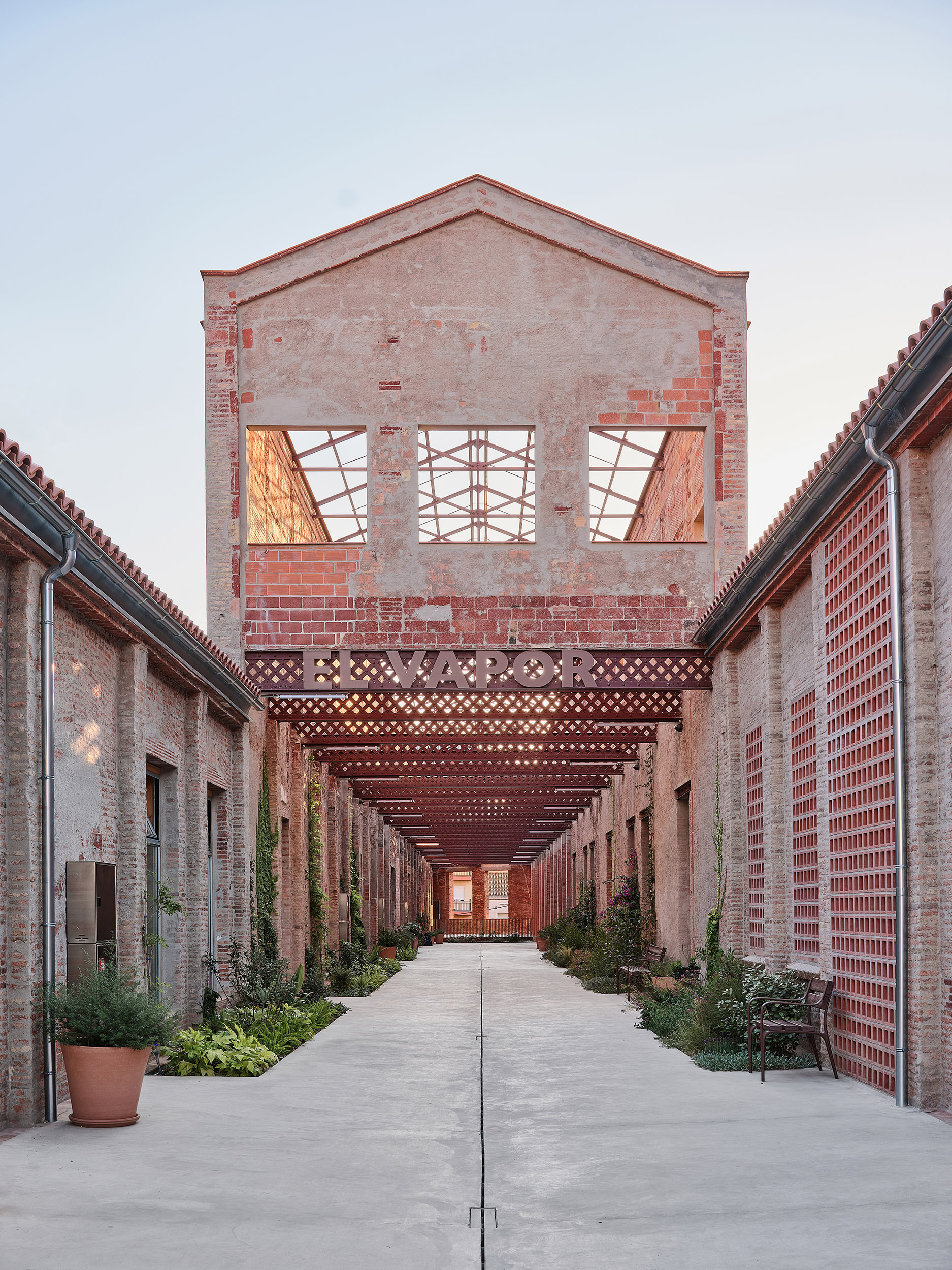


The new Prodis headquarters transforms the old Vapor Marquès warehouses into an inclusive center organized around a recovered passage that becomes a new street for the city. The new intervention introduces wooden structures, skylights, and passive systems while respecting its original character.
Collaborators
Collaborator (office): Maya Torres - HARQUITECTES; Collaborator (office): Miquel Arias - HARQUITECTES; Collaborator (office): Itziar González - HARQUITECTES; Collaborator (office): Albert Ferraz - HARQUITECTES; Collaborator (office): Andrea Arasa - HARQUITECTES; Collaborator (office): Sara Ferran - HARQUITECTES; Collaborator (office): Mariona Dalmau - HARQUITECTES; Collaborator (office): Maria Azcárate - HARQUITECTES; Structure: DSM Arquitectes; Installations: M7 Enginyers; Quantity surveyor: Carles Bou; Environmental: Societat Orgànica; Acoustics: MC Acústica; Planning: Territoris XLM; Topography: GEOMÈTRIC
Program
Social welfare
-
Labels
Community
Site area
3600 m²
-
Client
Prodiscapacitats Fundació Privada Terrassenca (PRODIS)
Total gross floor
3842 m²
The new Prodis headquarters is located in former industrial buildings of the Vapor Marquès. Its value lies in its urban structure (warehouse-street-warehouse) and in its imperfection from the history of its transformations. The first strategy is the recovery of the central street between the buildings, turning it into a passage that will become a new urban street and from where the circulations and activities are organized. On both buildings, the center’s main uses (workshops, classrooms, kitchen) are organized and interconnected with complementary areas (bathrooms, meeting rooms, storage).
The need to subdivide spaces within an enormous space and at the same time the need to reinforce the existing trusses allows an organization of the spaces and their hierarchies based on these structural reinforcements. New beams perpendicular to the existing trusses reduce their span and allow them to be preserved. These intersections create spatial patterns following the same constructive and material logic as the original and that allow us to hierarchize the space. These new superimposed structural orders also help us to locate the most closed programs, and at the same time central skylights in each main space that qualify and characterize them. A sequence of linked spaces is created that allows us to understand the large dimension of the buildings, but at the same time they manage to create more domestic corners and spaces within a whole. The light and the structure establish an intense bond with the environment and transport us to a more emotional situation.
The project attempts to extend the wood-wood work that characterizes the original construction, where the overlap of systems (tread-strap-sheet metal) creates a characteristic texture of wooden slats of different dimensions. The new beams, closed boxes and skylights will follow the same nature of wood-wood overlap as if the same constructive system that configured the roof were extended to also solve the new needs. The rest of the interventions try to be very discreet to preserve the original essence of the building and its transformations. In this sense, all cladding is removed to reveal the structural layers that explain the changes and stages of the building. The good level of thermal insulation, natural ventilation, trombe walls and solar protections guarantee us a very good passive operation. A building that will live half inside and half in the passage where the natural condition of the climate will also be part of this new opening of the institution towards the exterior.