-

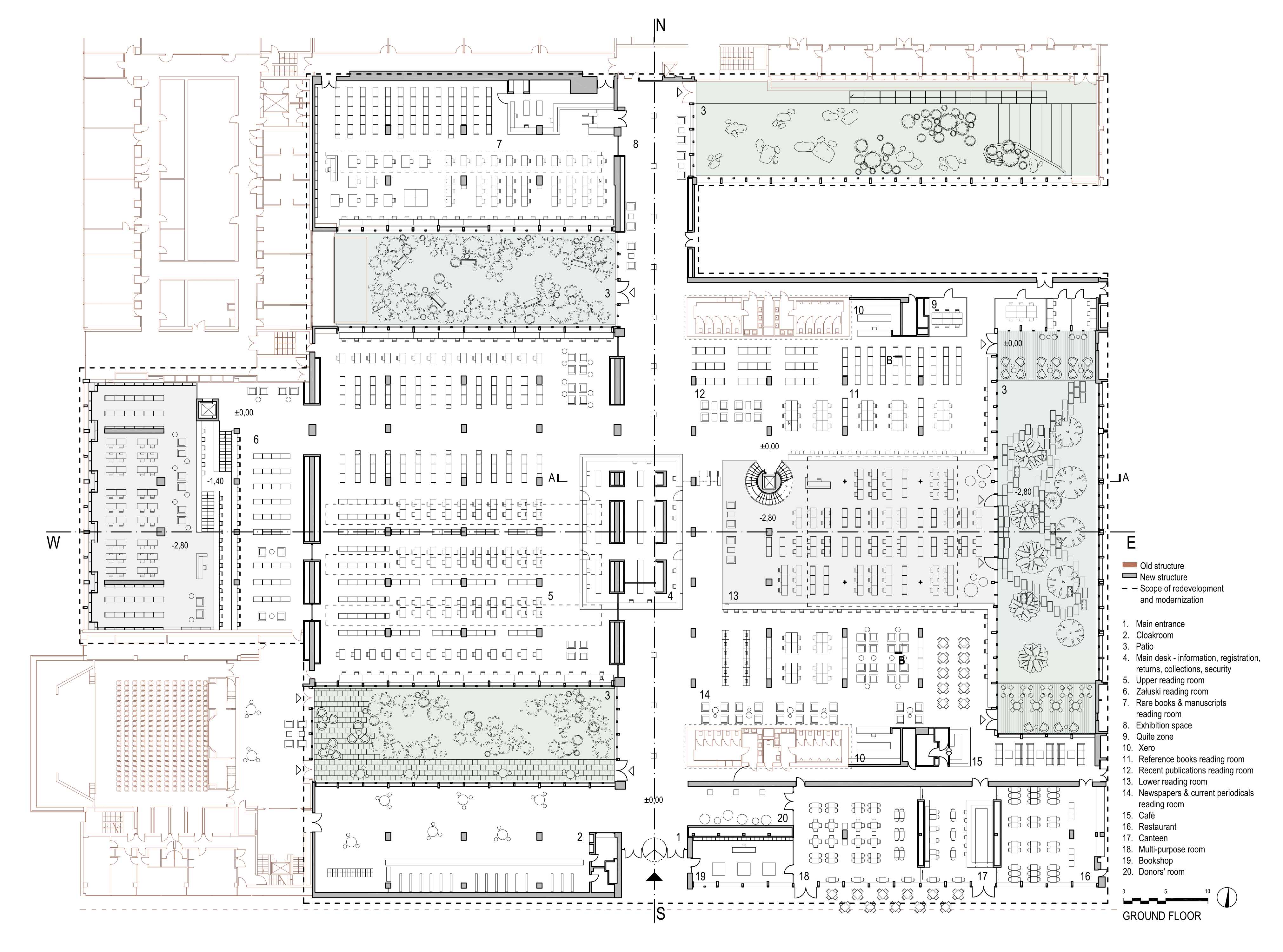
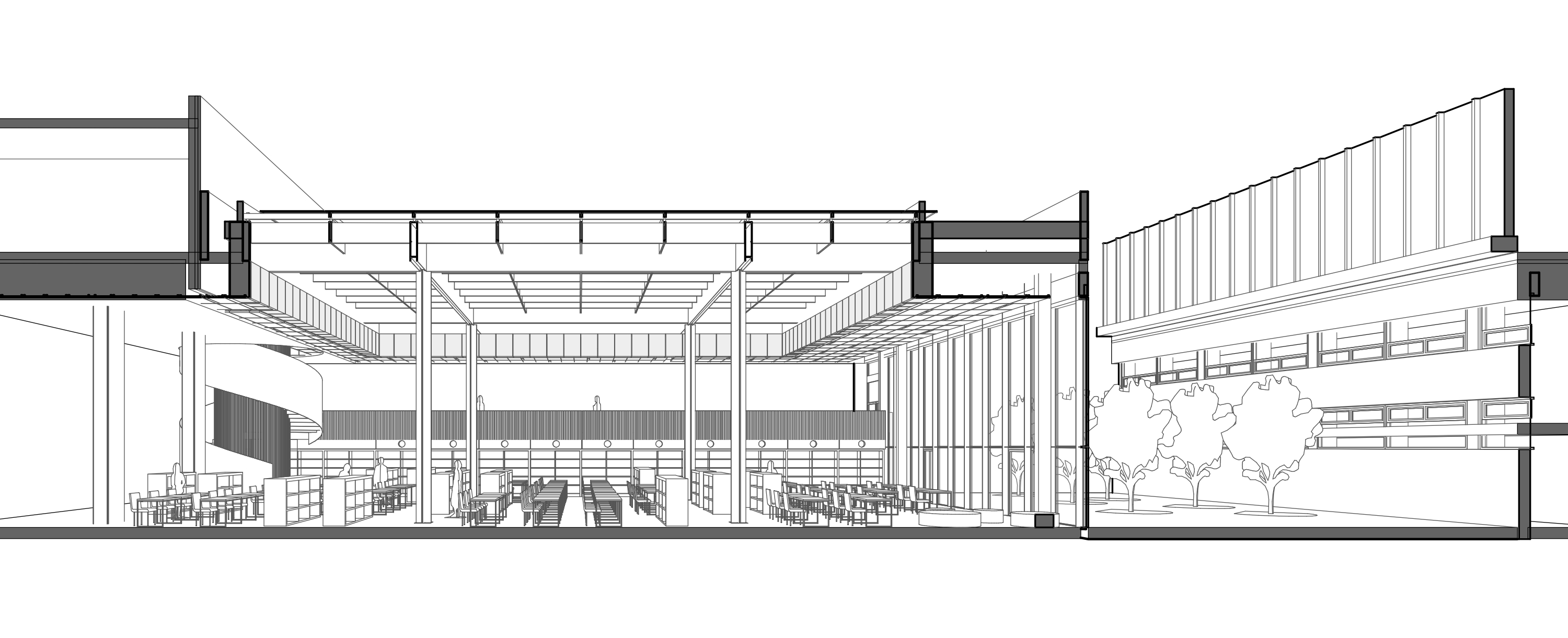
The new two-story lower reading room, is now a central library space adjacent to the main entrance area. It is covered by a large-format skylight and is bordered by a green patio accessible from the reading room space.
-
The National Library after modernization seen from a bird's eye view. The center of Warsaw is visible in the background.
-
The new golden counter of the information desk, which relates in color to the existing window woodwork, is the central reference point for the entire interior space of the library.
-
The new space - tall and finished with cooper, steel, wood and stone.
-
Załuski's two-story reading room, which is the result of dismantling a large section of the ceiling, is a space into "we descend, immersing ourselves in books".
-
SITE PLAN
-
GROUND FLOOR
-
SECTION A-A
-
SECTION B-B
-
STAIRS
-
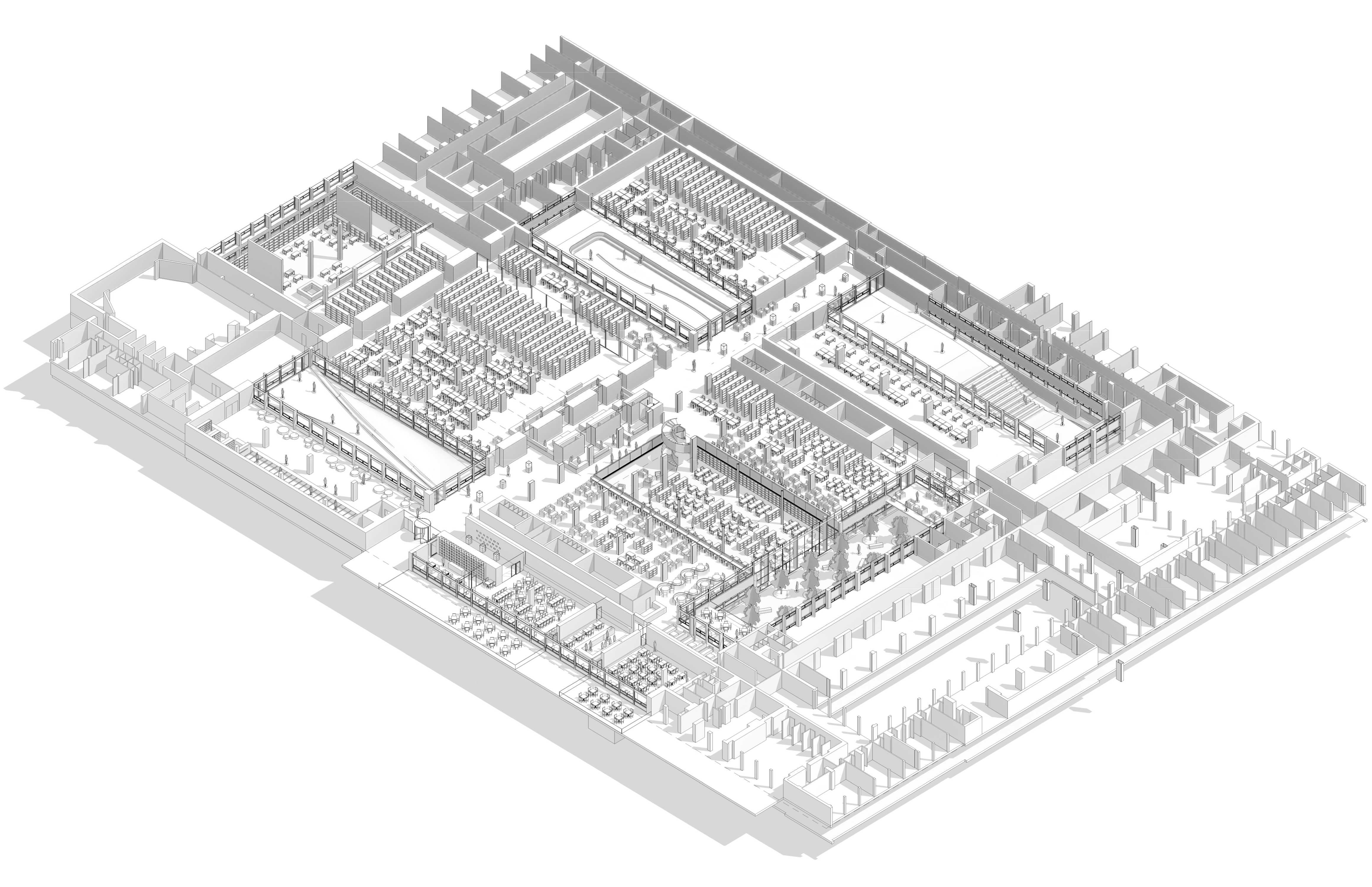
AXONOMETRY OF NEW READING ROOMS
-
SKYLIGHT SECTION
-
-
Redevelopment and modernization of the National Library of Poland in Warsaw
Konior Studio Tomasz Konior, SOKKA. Warsaw, Poland
-
Name of work in English
Redevelopment and modernization of the National Library of Poland in Warsaw
-
Name of work in original language
Przebudowa i modernizacja Biblioteki Narodowej w Warszawie
Prize year
EUmies Awards 2024
-
Work Location
Warsaw, Poland
-
Studio
Konior Studio Tomasz Konior, SOKKA
EUmies Awards 2024 Nominees




Collaborators
Program
Education
-
Labels
Library
-
Client
Biblioteka Narodowa
Total gross floor
9484 m²
Completion
2022
The National Library building was designed in the 1960s by architect Stanislaw Fijalkowski and his team. The changing requirements over the years regarding the storage and accessibility collections as well as the technical conditions of the building itself of the building itself have forced its modernization in terms of reading rooms and public spaces.In 2015, a two-stage competition was held architectural competition, which selected the winning work by KONIOR STUDIO and SOKKA. Already at the competition stage, the analyses conducted analyses showed that the unified language of of modernist architecture carries with it certain limitations. Modularity and repetition introduces orderliness, but without putting the accents in the right place, the uniform space remains incomprehensible and illegible.
The most important place of the New Library is the central space located at the intersection of the main entrance axis main entrance and the axis of the reading rooms with three key elements: the main, brass counter, the skylight and the spiral staircase. The central counter made of brass, which combines the most important functions of reader service becoming the processor of the entire library. Thanks to Its well-thought-out location makes it highly visible both from the main entrance and from the farthest location. It marks the border and is a bridge between the public zone of the building and the zone reading rooms. The most characteristic element of the reconstruction is the skylight-covered lower reading room. The considerable height of the girders and the dark color help counteract excessive overexposure to the Lower Reading Room and diffuse the natural light providing comfortable conditions for working.The next element is a spiral staircase that connects the three levels of the reading rooms. Behind the smoothly climbing circle strip of sheet metal balustrade shipyard concealed five gears cantilevered attached to a reinforced concrete shaft elevator.
The main finishing materials of the existing building are various types of cladding made of natural materials. The project envisaged for the most part their preservation. Only in places of interference with the structure they were supplemented with terazzo consistent with the character space also other noble materials like copper, steel and wood. In addition that National Library is being the treasury of our knowledge and identity is also place where reader with the collections. It has become a priority to to meet the highest parameters acoustic, lighting and ergonomics. A key aspect building a sense of comfort is also new arrangement of four interior patios (one of them is an orchard) and opening them to readers. Specially selected vegetation that changes with the seasons guarantees readers an attractive view and a chance to relax as they work and the opportunity to relax while working in contact with nature.