-

RE-PEAT
-
Peat life and its perception
-
Disappearing peat
-
Climate resilient peat living
-
Typologies for symbiosis with peat
-
Social-ecological peat landscape
-
Human-peat interaction
-
RE-PEAT panel
-
-
Name of work in English
Re-peat
-
Name of work in original language
Different Futures for the Peat Polders as Social-Ecological Landscape in the Netherlands
Prize year
Young Talent 2023
-
Work Location
De Rijp, The Netherlands
-
Author/s
Anastasiia Soshnikova
-
School
Faculty VI, Planning, Building and Environment - Technical University of Berlin.
Berlin, Germany
Young Talent 2023 YT Shortlisted


Re-peat
Different Futures for the Peat Polders as Social-Ecological Landscape in the Netherlands
Program
Landscape
-
Labels
Regeneration · Gardens & Parks
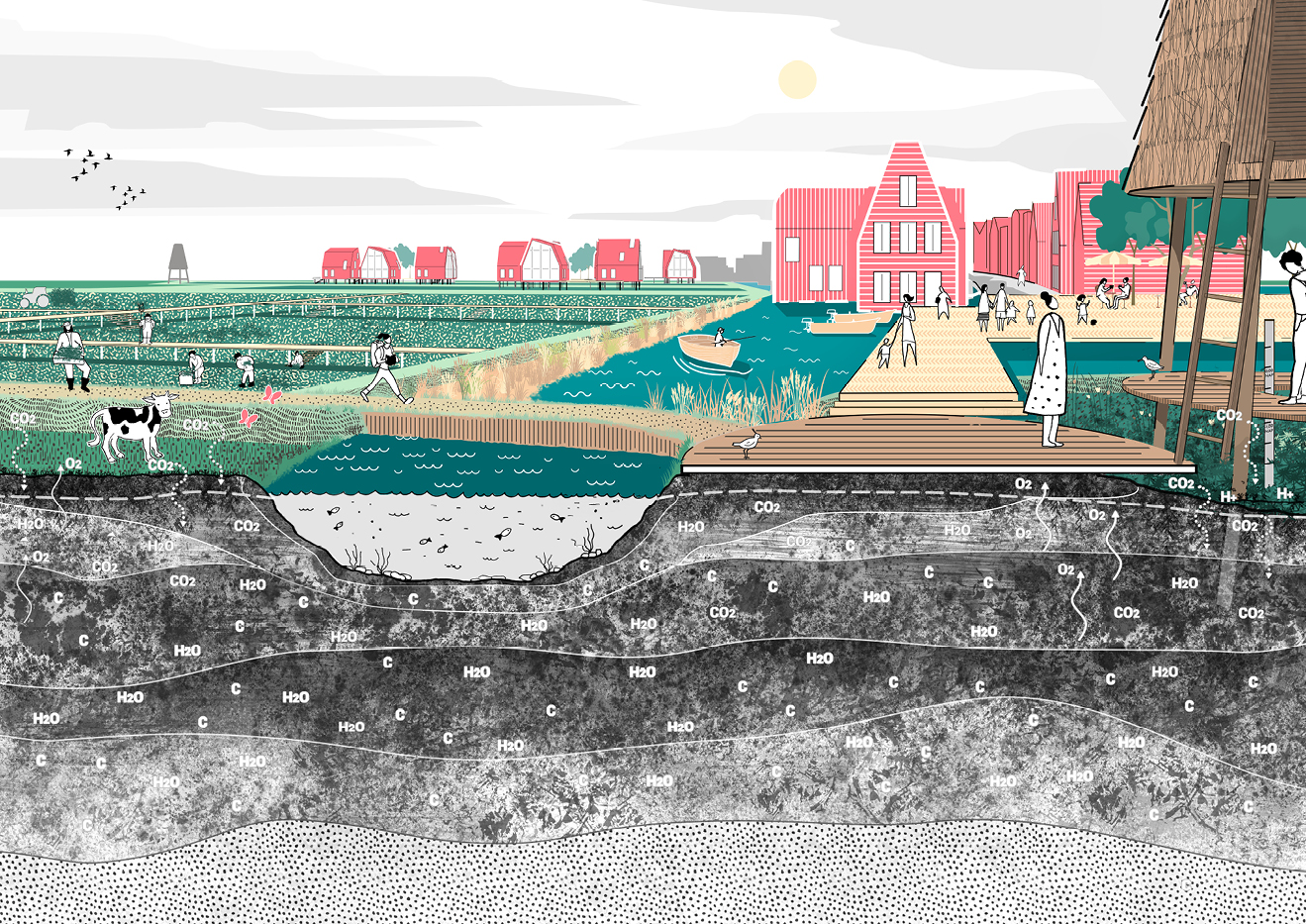
The project showcases design strategies for peat polders, focusing on settlement areas affected by intensive agriculture usage and lowered water level. It offers a broad framework to transform these areas into social-ecological landscapes while mitigating the harmful impacts of peatland drainage.
The social-ecological systems approach was used as a theoretical framework, focusing on the interactions between natural and human processes in order to create a sustainable peat polder landscape. It succeeds in an integrated description of the study area and the synchronous development of design strategies for both, the peatlands and the settlements, and also for the material exchange processes taking place between them. The water system links the social-ecological systems by connecting the water infrastructure of the building and the water system for peat moss development. Peat soil links them as well, providing areas for nature, agriculture, living, and production. In the design face, the social-ecological system components develop an integrated concept for a climate-resilient new neighborhood. Coexistence is enabled by adapted, soil-friendly construction methods (e.g., floating and elevated houses), the establishment of different marsh-tolerant crops (e.g., paludi), and targeted stormwater management. Supplemented by public-relations facilities such as a community center, the ridge walking path, and observation platforms, the proposal takes on the character of a model village. Building houses on peat is perceived as mainly a threat, but it can also be an opportunity. This will have a beneficial impact on social-ecological systems and could become the main economic driver of land use. In general, this results in a design plan with significantly reduced greenhouse gas emissions, increased biodiversity and spatial experiential value, and a high income for farmers. Additionally, renewed peat growth can stop centuries of subsidence caused by agricultural use. A thick peat package retains rainwater, preventing subsidence and effectively sequestering carbon. Through its cross-scale architectural-open space planning treatment and especially the design-integrated material exchange processes, the work provides an innovative and convincing approach for an integrated, climate-sensitive spatial development of the peat polder landscapes.