-

Collage of the Project perspective and Shanghai Numerical Mood
-
Chinese shadows and remembrance of glorious vault
-
Open sky Subway and the 3 platforms layers
-
Global section of the tower and the urban implantation, plus section of confronting the Temple
-
Numerical Green Wall facing the Elevated Road in Jing'an District
-
Conceptual visions
-
Numerical representation of the global skyline in the site and the urban Incent burner park in the center of the project
-
Vertical panels of conceptual background for Random Access Memory
-
-
Random Access Memory
Mickaël GIRAUD. Shanghai, China
-
Name of work in English
Random Access Memory
-
Name of work in original language
A Mnemonic Update of the Metropolis_Shanghai
Prize year
Young Talent 2018
-
Work Location
Shanghai, China
-
Author/s
Mickaël GIRAUD
-
School
Strasbourg School of Architecture - Strasbourg School of Architecture.
Strasbourg, France
Young Talent 2018 YT Nominees


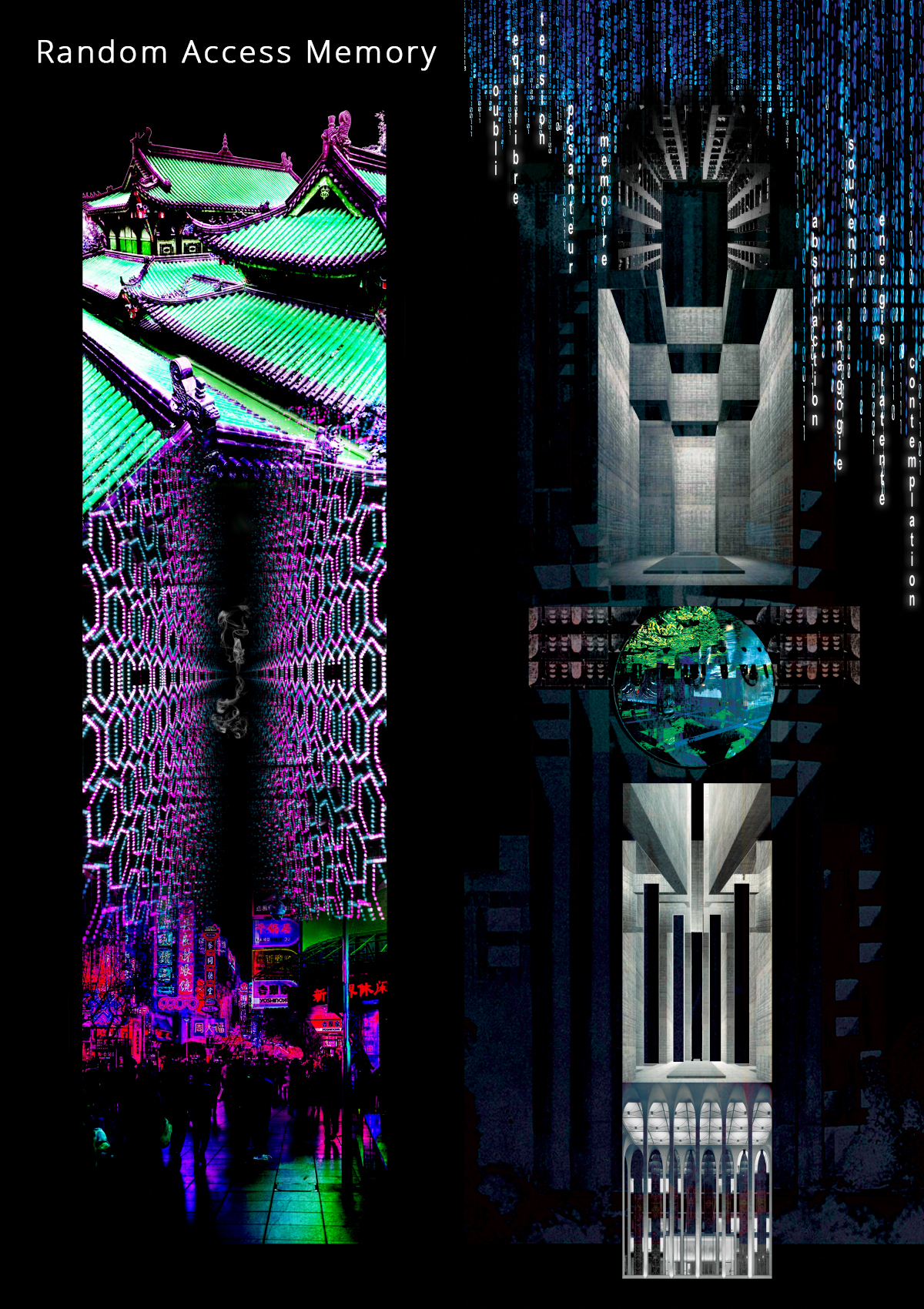
Random Access Memory
A Mnemonic Update of the Metropolis_Shanghai
Program
Funerary
-
Labels
Memorial · Cemetery
How to integrate in today's Chinese mégalopolis, places dedicated to death, spaces of memory and eternal links with the deceased ? The project proposes the creation of a temple of "living memory", where human flows & digital flows blend into timeless spaces, reminiscent of monumental forms of the past between physical realities and invisible energies.
The architectural scale of the project will have just as much meaning since it will be the support for questioning of the body in the funeral. Symbolism will intervene in a process of conceptual and formal theorization, taking its source in the writings of Aldo Rossi, Lao Zi, Fançois Cheng, Can Onaner and Marc Augé. Two symbolic places accompany the path of the pedestrian: the ring brings together and develops flows in the horizontality of the city, and the tower concentrates them in an ascending rhythm. The intention of the project lies in a dialogue process between life and death, memory and oblivion, the formal and the virtual, the intimate and the common, and between latent energy and fixed form. The aim of the project is to create a memory in this process of forgetting, by awakening the senses and putting man in front of the immaterial energy represented by death. Strong dialectics are then at the base of the reflection carried out for the project, between Life/Death, Remembrance/Full/Vacuum, Formal/Virtual, Old/Current, Intimate/Common, Latent Energy/Fixed Form. In vain, the aim of the project is to create a memory in the post funeral process in Shanghai, by creating an urban structure, open to the public, offering a dialogue between the world of the living (the city) and that of the deceased (the project). Marc Augé then describes forgetfulness as "the living force of memory, memory is its product.” Then, forgetfulness is perceived as the negative of memory (therefore making it possible to experience the negative in architecture, between light and shadow, full emptiness... by repeating the above-mentioned dialectics). It is therefore a question of inscribing death within life, not as a fatal component, but as an open-mindedness linking memory and forgetfulness.