-

WEB_ÁP_07_cover image.jpg
-
WEB_ÁP_01.jpg
-
WEB_ÁP_02.jpg
-
WEB_ÁP_03.jpg
-
WEB_ÁP_04.jpg
-
WEB_ÁP_05.jpg
-
WEB_ÁP_06.jpg
-
WEB_ÁP_08.jpg
-
WEB_ÁP_09.jpg
-
WEB_ÁP_10.jpg
-
WEB_ÁP_11.jpg
-
WEB_ÁP_12.jpg
-
WEB_ÁP_13.jpg
-
WEB_ÁP_14.jpg
-
WEB_ÁP_15.jpg
Post-Extractivist Retreat
Álvaro Pozo Pérez. Palazuelo de las Cuevas, Spain
-
Name of work in English
Post-Extractivist Retreat
-
Name of work in original language
Retiro Postextractivista
Prize year
Young Talent 2025
-
Work Location
Palazuelo de las Cuevas, Spain
-
Author/s
Álvaro Pozo Pérez
-
School
Institute of Technology - CEU San Pablo University.
Madrid, Spain
Young Talent 2025 YT Shortlisted


Post-Extractivist Retreat
Thermal leisure centre in Sierra de la Culebra
Program
Sport & Leisure
-
Labels
Bath · Facilities · Nature
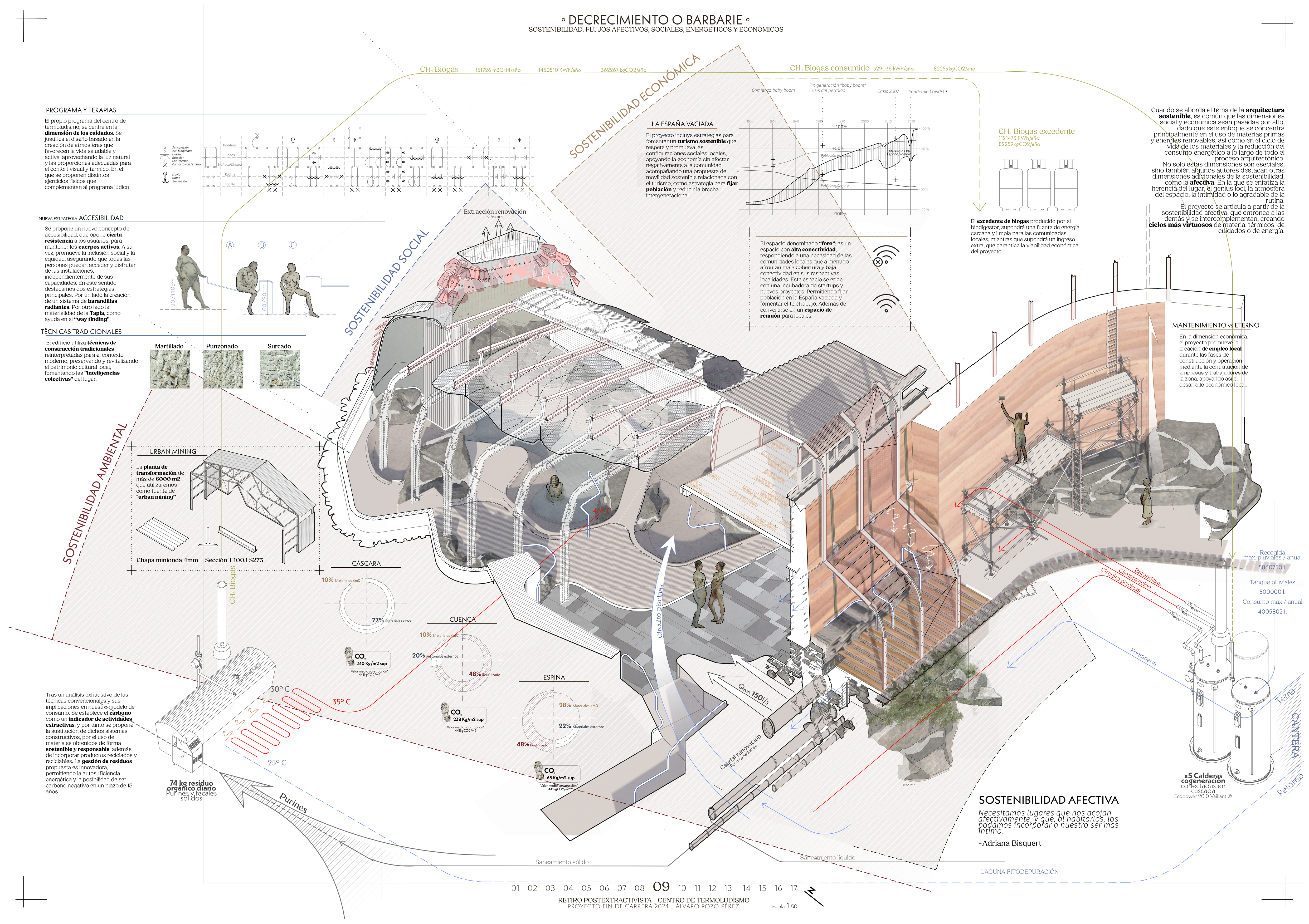
The current consumption model is outdated, and architecture reflects this crisis. This project, driven by degrowth principles, reimagines construction practices to foster healthier, regenerative spaces. Through the case study of a thermal leisure center in an abandoned slate quarry in Sierra de la Culebra, a prototype of degrowth strategy for architecture is developed. After a devastating wildfire in 2022 ravaged the region’s biodiversity, deep-rooted issues were laid bare: depopulation, climate change, and an outdated economic model driven by uncontrolled resource extraction.
The project proposes a shift toward techniques and materials that challenge prevailing practices, guided by thermodynamic materialism that reimagines design and consumption. At its core, it embraces affective sustainability, not merely offering solutions but establishing a preliminary guideline for the profession, proving that a more sensitive, connected way of living is within reach. The design unfolds through three core elements: Spine, Shell, and Basin, which interweave to resolve the project while shaping a sensory journey. The spine arranges the program linearly, along a rammed earth wall emanating warmth, guiding the way. The shells define the program, while the basins, sculpting the slate stratum, foster an intimate connection between water and the body. Cold, warm, and hot zones invite physical engagement by subtly resisting movement, ensuring accessibility remains dynamic and promotes vitality, not just convenience. Architecture is reimagined as a dynamic system, where each element harmonizes with the environment. It becomes a living entity: breathing, adapting, attuned to its surroundings. Committed to carbon responsibility, it rejects cement and virgin extractive materials, experimenting with alternative construction methods that redefine foundations and envelopes. Beyond function, the project optimizes resources through self-sustaining water management and harnesses the energy potential of waste via a biodigester, transforming what was once discarded into a valuable resource. Despite CO2 release during construction and lifecycle, it achieves carbon negativity within 15 years, proving architecture can restore rather than deplete. More than a proposal, it is a manifesto. An urgent call to redefine design as a catalyst for social and ecological transformation.