-

-
Analysis of Area
-
Design stages of Pavilon
-
model + historical analysis
-
model + section + people view
-
plan + section + interior
-
Visualisation of pavilon
-
Summary
-
-
Polish Pavilion at the EXPO 2020 in Dubai
Miko?aj Przygrodzki. Dubai, Saudi Arabia
-
Name of work in English
Polish Pavilion at the EXPO 2020 in Dubai
-
Name of work in original language
Representation of Polish
Prize year
Young Talent 2018
-
Work Location
Dubai, Saudi Arabia
-
Author/s
Miko?aj Przygrodzki
-
School
Faculty of Civil Engineering and Architecture - Lublin University of Technology.
Lublin, Poland
Young Talent 2018 YT Nominees


Polish Pavilion at the EXPO 2020 in Dubai
Representation of Polish
Program
Mixed use - Commercial & Offices
-
Labels
Compact · Heritage · Pavilion · Showroom · Visitors Centre
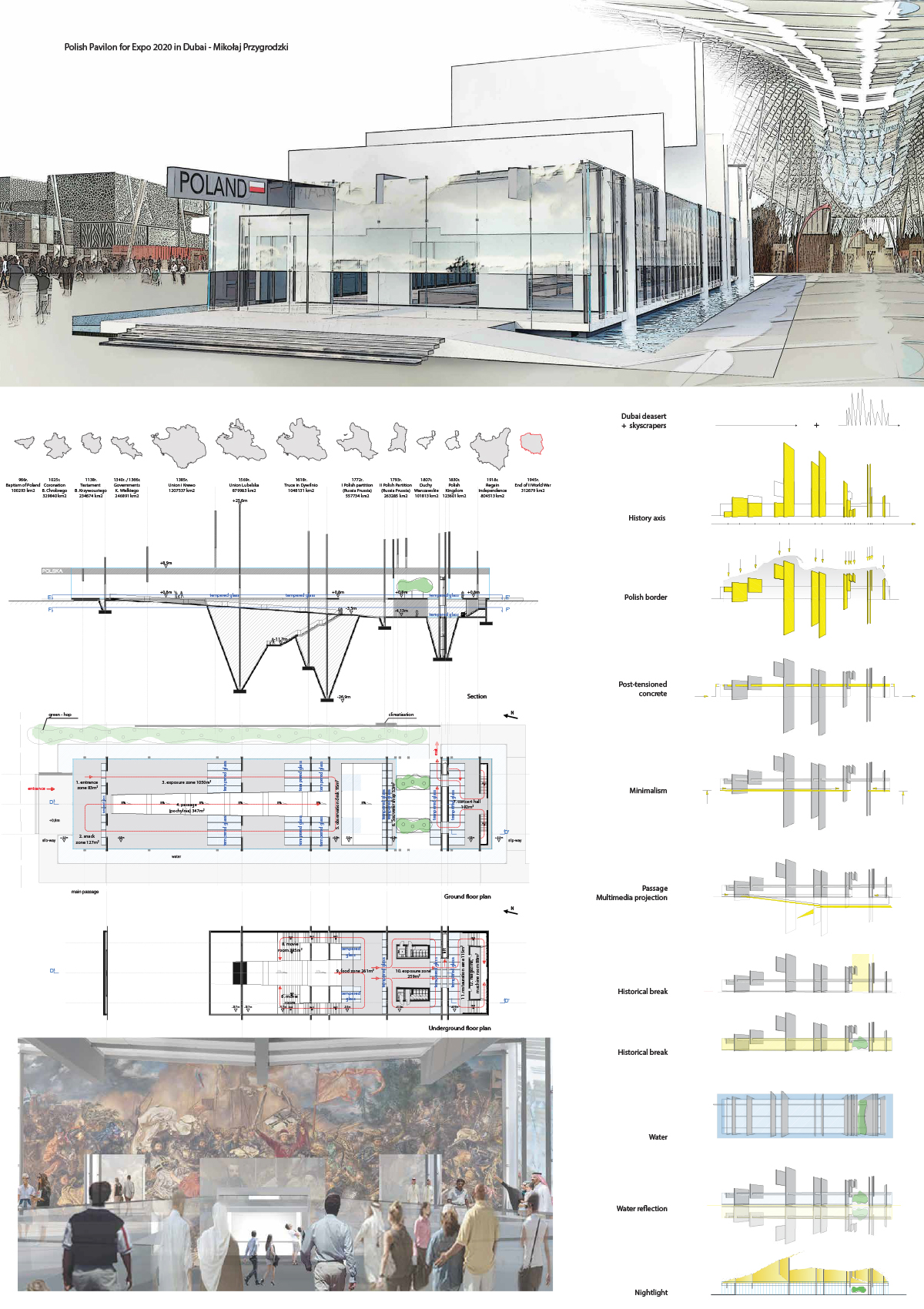
The exhibition pavilion at Expo is not just a usable area - it is an issue that includes cultural, economic and economic achievements, development of technical and technological ideas. Designing the pavilion as a representation of individual pages of history is a kind of message that is supposed to exert on the viewer a feeling of the wind of history.
The main idea of ??the pavilion is the historical background. The architectural layout is a system of walls symbolizing the individual history of Poland and the Polish nation. In the project, I tried to present Poland in all its beauty and splendor, show the cultural richness of over a thousand years of history. You can not take up such a topic without a history that has shaped Polishness. I think architecture is closely related to the history of each country. I wanted to show the story in an innovative way, not through directions or trends, but in an innovative way to capture the subject. Modern technologies give great design possibilities. The use of the BIPV solar panel will solve the problem of high demand for electricity, which will significantly reduce operating costs. The pavilion will be made in the technology of compressed concrete. Simple cuts and proportions of the composition segments combine modernity and minimalism, creating a functional and structurally contemporary body. The main building level is located at an altitude of 80 cm, giving the lightness of the form detached from the ground. The inter-floor ceiling was largely glazed in order to show the whole walls. Designed along the pavilion, the passage enables disabled people and mothers with children to move around the building. The visitor has the impression of overcoming the road, distance, time ... The conscious operation is the lack of glazing in the fragment of the pavilion block, which refers to the more than a hundred-year period when the Polish state did not exist on the maps. This space will be filled with greenery. The water around the pavilion refers to the natural riches of the country, which are the Baltic Sea and the Masurian Lakes (UNESCO). A mirror reflection of the pavilion in the water surface will create a suggestive effect of continuing the walls deep into the earth.