-

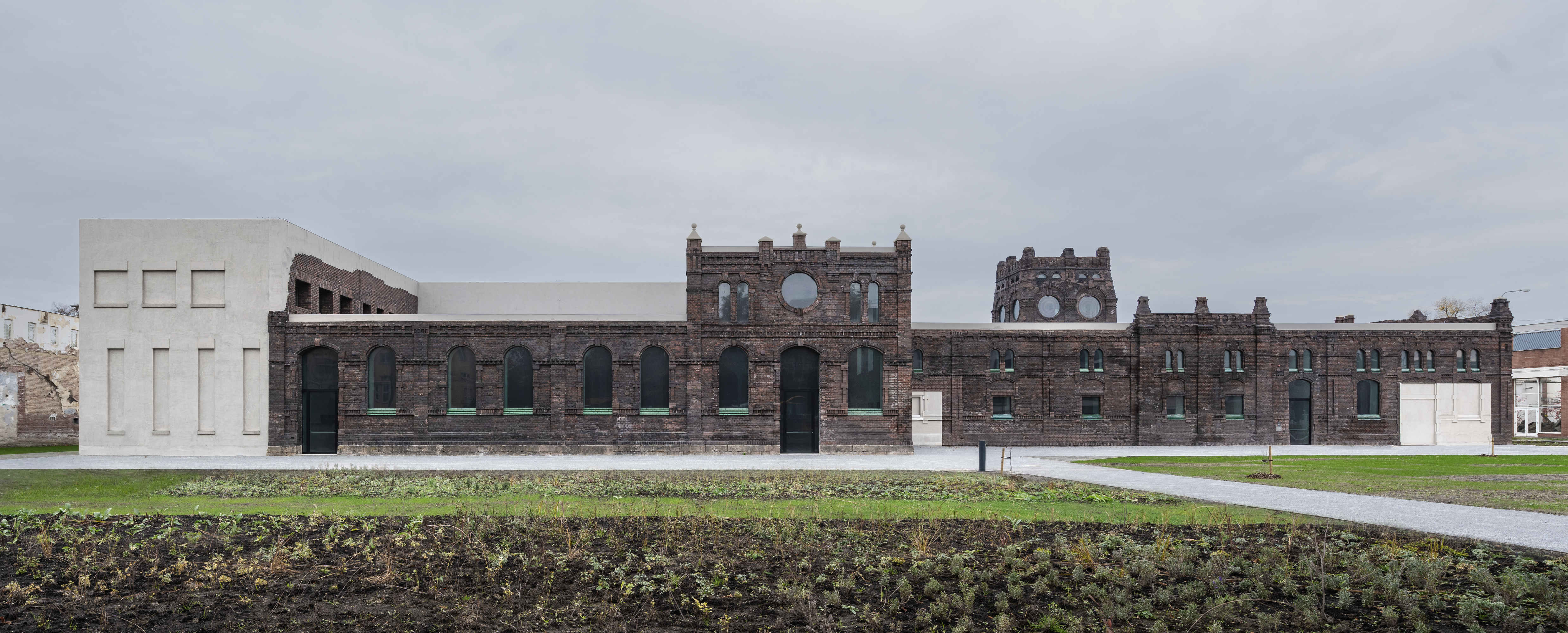
The slaughterhouse building was erected in the 19th century. After the war, it was chaotically modified by successive owners and eventually fell into disrepair. It ultimately became a contemporary art gallery.
-
The walls of the former slaughterhouse were battered in many places by huge holes. The sooty blackened brickwork bore witness to the city's industrial history. We took these shortcomings at face value.
-
The main idea of the project is based on preserving the functionality of the openings as shortcuts connecting the building to the city, providing entirely new exhibition opportunities for artists and curators.
-
We filled the openings in the walls with contemporary material while retaining the old ornamentation. The new infills can rotate and open the exhibition rooms directly to the outside.
-
The former atrium is now the link between the exhibition halls. The soiled brick is contrasted with the micro-concrete with which the new and reconstructed parts of the building have been finished.
-
The situation. We decided to transform the degraded space around the building into the only bio-diverse art park in this part of the city, which was immediately appreciated by the residents.
-
Ground floor
-
First floor
-
Section 1-1 (top), west elevation (bottom)
-
Section 2-2 (top), north elevation (bottom), detail of revolving walls (right)
-
A general sketch explaining the genesis and main premise of the project, which aims to make art and wider culture more accessible to new audiences.
-
An old photograph and axonometry showing that the green fields in the park are traces of the former buildings that once surrounded the slaughterhouses.
-
Old photo and visualisation. The walls of the former slaughterhouse were whitewashed with lime for hygienic purposes. The finish of the exhibition space refers to this.
-
-
Plato Contemporary Art Gallery
KWK Promes. Ostrava, Czechia
-
Name of work in English
Plato Contemporary Art Gallery
-
Name of work in original language
PLATO, Městská Galerie Současného Umění
Prize year
EUmies Awards 2024
-
Work Location
Ostrava, Czechia
-
Studio
KWK Promes
EUmies Awards 2024 Architecture finalists


Program
Culture
-
Labels
Art Gallery · Heritage
Site area
11417.5 m²
-
Client
City of Ostrava
Total gross floor
3601 m²
Completion
2022
Cost
2610 €/m²
The realisation is the result of an international competition to transform a dilapidated old slaughterhouse in the Czech city of Ostrava into the PLATO Gallery of Contemporary Art. The walls of the slaughterhouse were dilapidated and battered in many places by huge holes. The soot-reddened brickwork bore witness to the city's industrial history. We took these deficiencies at face value and added another layer to the history of the building, which is under conservation protection. We were allowed to preserve the character of the soiled brick and the windows, and to fill in the openings in the walls with contemporary material while retaining the old ornamentation of the brick walls. We also used the adopted principle of recreating all non-existent elements of the building from micro-concrete to rebuild the collapsed section of the slaughterhouse.
The main idea of the project is based on maintaining the functionality of the openings as shortcuts connecting the building to the city. Hence the idea that their new infills could rotate and open the exhibition rooms directly to the outside. This has provided artists and curators with entirely new exhibition possibilities and allows art to literally 'go out' into the space around the building. Mobility has meant that culture, in the broadest sense, has the potential to become more democratic, as well as accessible to new audiences. We were involved not only in saving the former slaughterhouse building, but also in the design of the outdoor areas even though this was not our task. We convinced the authorities to abandon the concrete paving. The contaminated soil there was rehabilitated and replaced by a biodiverse park with water-permeable floors, flower meadows and with retention basins. The layout of the greenery refers to the location of the buildings that once supported the slaughterhouse, and edible crops, also inside the gallery, complete the transformation of the site. The result is an inclusive space that sensitises not only to art but also to environmental issues.
The original dominant material of the building is brick. The destroyed bricks have been mostly replenished with those salvaged from a collapsed section of the building. The new glazing has a ceramic screen print, making it appear dark and dull, attenuating the light in the galleries. The interiors were whitewashed for hygienic purposes, so the exhibition rooms are finished with white lime plaster laid over mineral board insulation. The building's soiled brickwork appears in the former atrium, now covered. The partially collapsed wooden roofs covered with dark felt have been replaced with steel structures and covered with a light-coloured membrane. This allows the roofs to heat up less, without creating a heat island effect around them. The colour refers to the micro-concrete from which all the new and reconstructed elements are made. The most important of these are the revolving walls, of which there are six. Two are the entrances to the building, while the others connect the galleries to the outside. Despite their considerable size, they give a complete seal when closed, and the maintenance of the mechanisms hidden under the floor is simple and required once a year.