-

3D printed school in Pk3 Refugee Camp in Bria, Central African Republic
-
Humanitarian Aid Architecture Research Panel
-
3d print and recycle for building Laboratory research phase
-
Real scale 3d printed prototype
-
Refugee camp and school project plans
-
Self suficient school top plan sections and climatic
-
3D printed school in Pk3 Refugee Camp in Bria, Central African Republic
-
PHASER 3D Printed Humanitarian Aid Settlements for Emergencies Response
-
PHASER 3D Printed Humanitarian Aid Settlements for Emergencies Response
Víctor Martínez Pacheco. Bria, Central African Republic
-
Name of work in English
PHASER 3D Printed Humanitarian Aid Settlements for Emergencies Response
-
Name of work in original language
Investigation about architecture in catastrophes, characterization of the structural behaviour in 3D printed pieces, development of a constructive system and application in the design of a refugee camp PK3 and school in Bria (Central African Republic).
Prize year
Young Talent 2020
-
Work Location
Bria, Central African Republic
-
Author/s
Víctor Martínez Pacheco
-
School
School of Architecture and Building Engineering - Technical University of Cartagena.
Cartagena, Spain
Young Talent 2020 YT Nominees

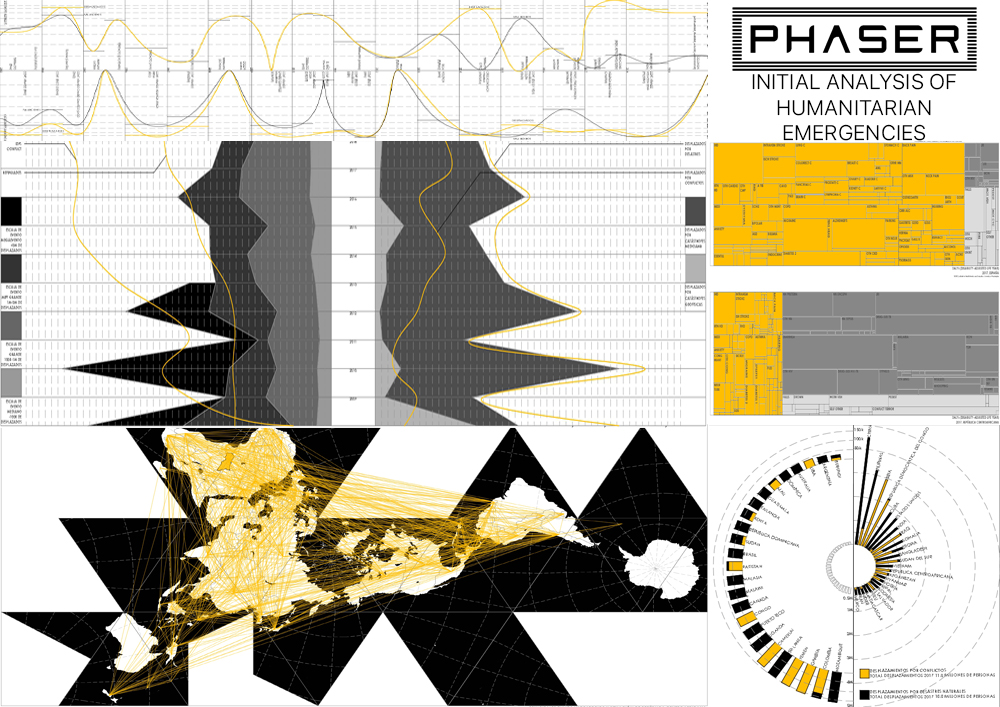


PHASER 3D Printed Humanitarian Aid Settlements for Emergencies Response
Investigation about architecture in catastrophes, characterization of the structural behaviour in 3D printed pieces, development of a constructive system and application in the design of a refugee camp PK3 and school in Bria (Central African Republic).
Program
Education
-
Labels
School · Kindergarten
PHASER reviews emergency architecture and investigates new structural forms, presents a new construction system for humanitarian aid with open source 3D printing to promote different building models in humanitarian crises and takes advantage of the recycling of PET plastics to build a school in the refugee camp.
An investigation is carried out into disasters and their human consequences and it is discovered that school is one of the most urgent needs. To develop the project, it is thought to use components that combine rapid response and that provide solid, functional and cheap solutions. To achieve a sturdy structure that meets the imposed requirements, prototyped material is used, made with open source domestic 3D printers The severity of the contamination of plastics in the environment is analyzed and it is decided to use Polyethylene Terephthalate, PET, from recycled bottles as material. In the first test phase, ISO 3167 A ”specimens were manufactured and analyzed to specify the influence of the printing orientation, the internal filling pattern and its density on the structural behavior in 3D printing. Standard tests of tensile strength, flexural strength, Charpy impact resistance, HDT / Vicat (High Deflection Temperature) of flexure under thermal load and Rockwell hardness are carried out together with microscopic analyzes and the forms of rupture produced to determine the influence of the fill density, orientation, coefficient of adhesion between layers and print pattern on 3D printed parts. The material used in the tests was white polylactic acid since it is biodegradable. The following phase is tested with PET plastics: collection, cleaning, crushing, sieving, pellet and filament to extrude it. The procedures are repeated and the results are compared. Then, the dimensions and geometry of the architectural model are determined according to the previous requirements, results and observations. 27 possible structural systems are designed, analyzed and tested. Phaser system allows any basic building to be erected in a context of humanitarian crisis. The structure is resistant and habitable with only 4 pieces: a knot, a dodecahedron with 12 connection holes to connect the bars by pressure; two bars (coupler and extender) that are coupled to each other and to the knot by the spherical tongue and groove system and a cotton canvas that serves as packaging for its transport and as a building enclosure.