-

0_Main illustration.jpg
-
1_Project_6000px.jpg
-
2_Site.jpg
-
3_Rehabilitation in society.jpg
-
4_Site.jpg
-
5_Plan.jpg
-
6. Facade.jpg
-
7. Sections.jpg
-
8. Materials and details.jpg
People and Outlaws
Karla Hvidsten. Tananger, Norway
-
Name of work in English
People and Outlaws
-
Name of work in original language
Folk og Røvere
Prize year
Young Talent 2025
-
Work Location
Tananger, Norway
-
Author/s
Karla Hvidsten
-
School
Faculty of Architecture and Design - Norwegian University of Science and Technology.
Trondheim, Norway
Young Talent 2025 YT Finalists


People and Outlaws
Freedom within incarceration
Program
Government & Civic
-
Labels
Prison
The core principle of the Norwegian correctional system is that inmates will eventually leave prison and lead a crime-free life. Prisons aim for rehabilitation, as transitioning to society is easier when prison conditions reflect life outside the walls. However, prisons are designed after 19th-century models. Among the inmates are vulnerable offenders starting at 18, who require treatment in appropriate facilities. With youth crime rising in Norway, preventing recidivism is both socially and economically beneficial. How can high-security prisons be designed to rehabilitate young offenders?
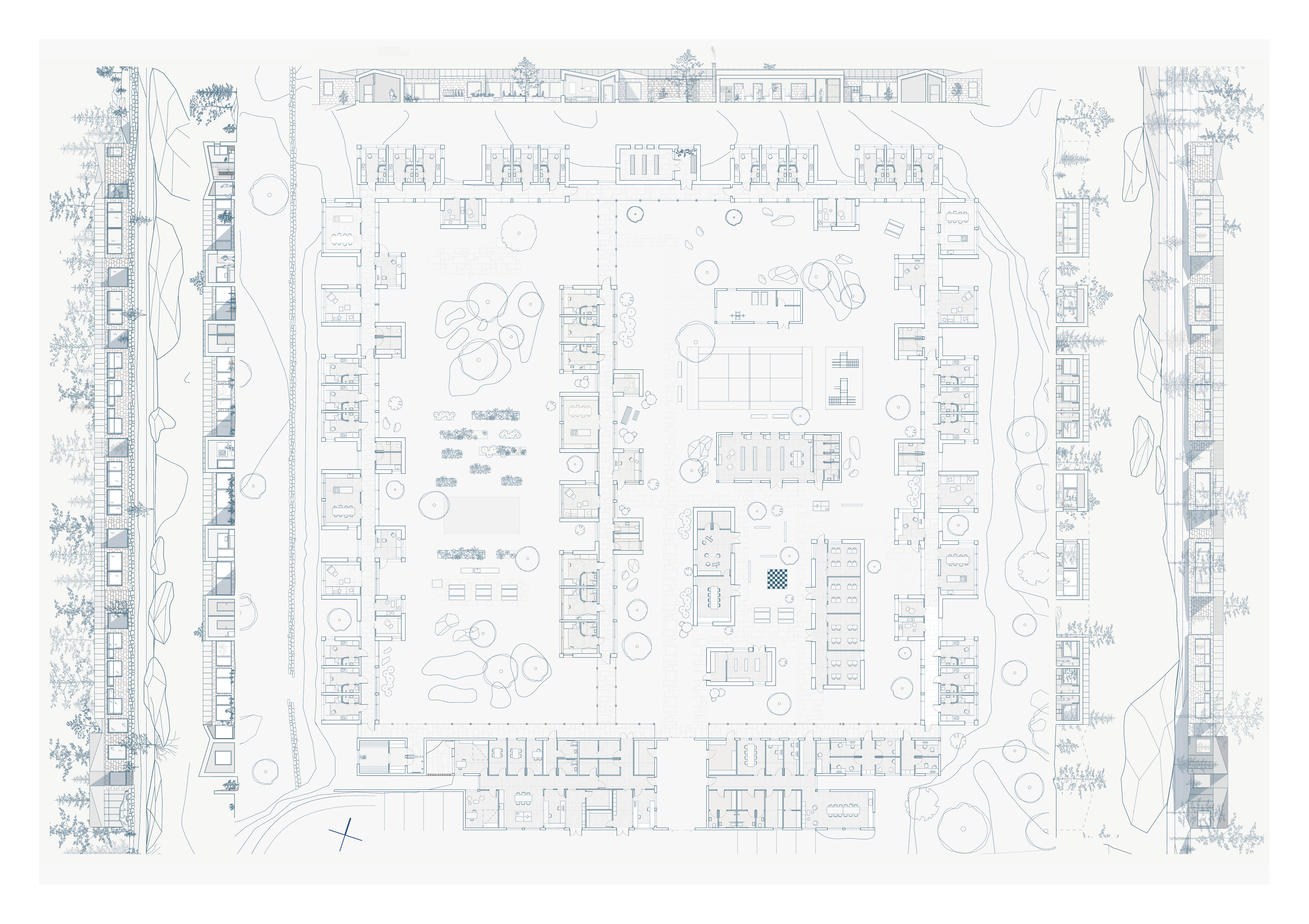
The proposal offers 30 young offenders aged 18-24 the opportunity to become responsible citizens during their time in prison while engaging with society and nature. The design features a high-security prison with few cells, contrasting today’s facilities. Located in Tananger, a village on Norway’s west coast with great job opportunities, the design fosters synergistic effects—offenders gain trust and role models, while the community benefits from additional helpers. The design evolved from analyzing prisons and deconstructing M2015, a cross-shaped module with 100+ cells. This led to the creation of smaller buildings and a more normalized environment. Smaller prisons have shown better results in terms of well-being and are easier to integrate into a community. To minimize square footage and overuse of resources, essential prison functions are systematized in corridors, activity spaces, common areas, learning spaces, and administration. This approach reduces the footprint and ensures spaces that can evolve. In Norway, deprivation of liberty is the punishment, not harsh surroundings. The outer wall, often seen as a necessary evil, is therefore integrated into the building to soften its impact. The new stone structure mimics traditional stone fences. It functions as a barrier and a walkway, offering inmates a connection to nature through windows, and time perspective. The architecture emphasizes the power of nature as a part of rehabilitation. Situated in Jæren’s landscape, known for its plains and archipelagos, the prison uses locally sourced, durable materials rooted in tradition, to reduce stigma. Inspired by ancient longhouses, the building’s materials, stone, straw, clay, and wood, shelter from coastal weather and promote well-being, all while reducing CO2 emissions.