-

situation
-
process
-
situation
-
façade
-
interior
-
skylight
-
floorplan
-
elevation
-
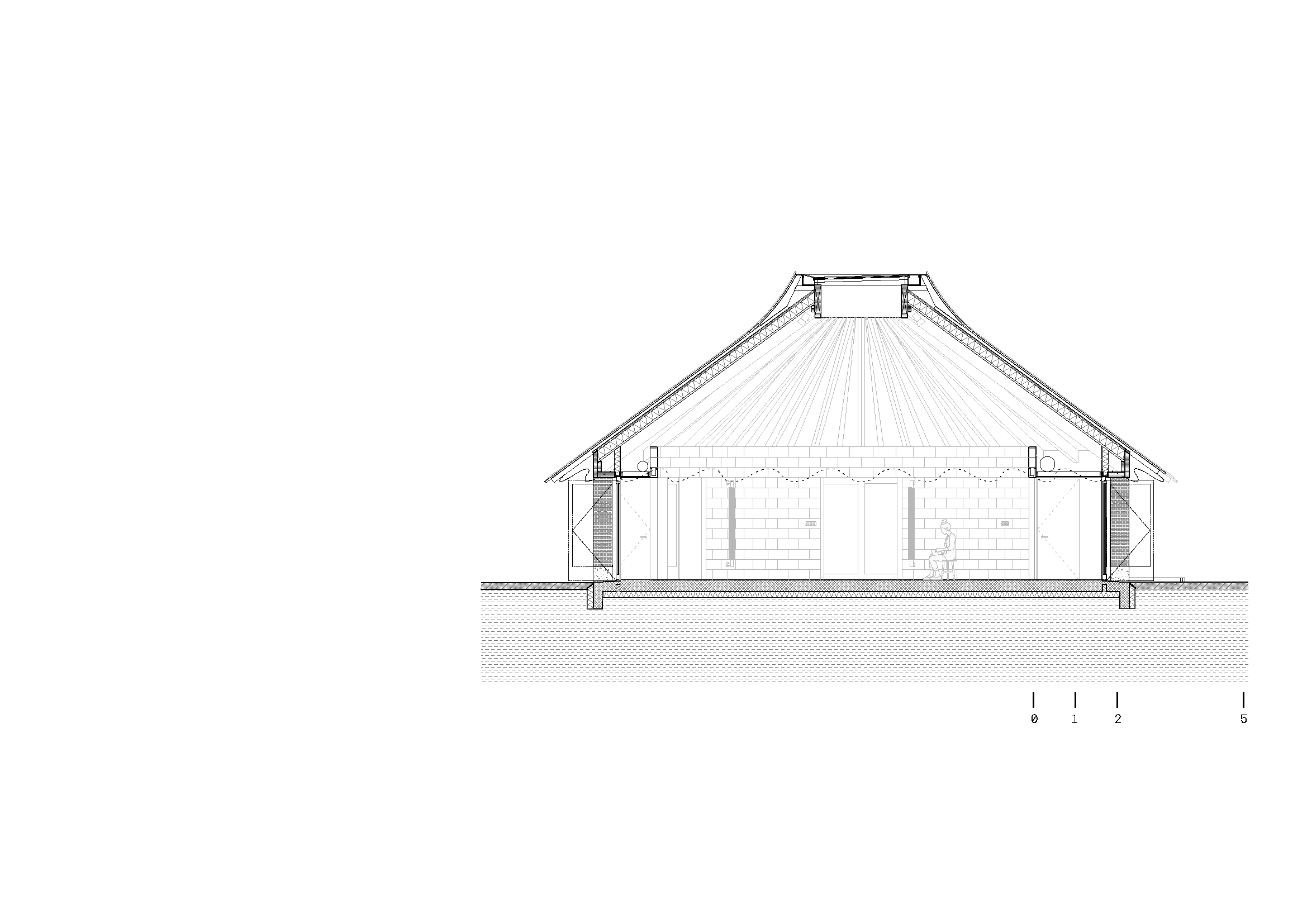
section
-
detail
-
axonometric roof
-
detail
Pavillon Le Vau
L'Atelier Senzu. Paris, France
-
Name of work in English
Pavillon Le Vau
Prize year
EUmies Awards 2026
-
Work Location
Paris, France
-
Studio
L'Atelier Senzu
EUmies Awards 2026 Nominees




Our project features a circular classroom that deliberately contrasts with the rectangular classrooms that pupils are used to. With its circular shape, the layout consists of a fluid circle. This idea was developed with the teaching team to reimagine uses related to the transmission of knowledge.
Collaborators
Structure: Antoine Baugé - sylva conseil; Environmental: thema verde; Building physics: James Cointe - wor
Program
Education
-
Labels
School · Children & Youth
-
Client
SLA 20, Mairie de Paris
Total gross floor
100 m²
Cost
3600 €/m²
The Le Vau Educational Pavilion is a project made of wood and raw earth, built in a school complex in the 20th arrondissement of Paris. The project required combining three challenges: designing architecture that could accommodate both hospitality and education; creating a place of connection between the school and its neighbourhood; and contributing to the decarbonisation of construction. We chose a circular room, as the circle allows for numerous layouts that are collective, collaborative and more egalitarian between everyone.
This project is the result of institutional initiatives as well as observations made by the teaching staff at Le Vau School, who consistently note the difficulty of convincing parents to walk through the school gates and stay there. They observe a form of inhibition, even mistrust, towards the school as an institution. Within different programmes, newly created green spaces and uses have enabled parents and teachers to find new places for interaction, and this gave rise to the idea of considering, within the framework of the participatory budget, the creation of a reception and teaching area in the school playground. Our role as architects was therefore to develop a concept that combined different challenges: architecture capable of accommodating two different uses; the connection between the school and its neighbourhood; and the decarbonisation of the building. The geometry combines these three challenges and creates this unique space.
First, the concrete foundations provide stability on the ground that was once the site of Paris's old quarries. Next, the six rammed earth walls are supported by tinted concrete heel blocks to prevent water from rising through capillary action. The six walls of rammed earth accommodate a circular wooden frame with a glass oculus at the top. The whole structure is insulated and then covered with a material commonly used for Parisian roofs: pre-patinated zinc. Earth is used here for its structural and thermal properties, but also for its aesthetic qualities. The project is built using geo-sourced, bio-based, local and carbon-free materials. It is the first load-bearing rammed earth building in Paris. The rammed earth walls were built during the summer to take advantage of low humidity. They were constructed using a single wooden mould modelled in 3D and then built in the workshop. The six walls took a month to dry before the roof structure could be installed on top.