-

Winter view from the bridge
-
Summer view with the forest in the background
-
Interior view of the chapel
-
Chapel in the main core and the relation with the inner cloister
-
The main core and the spiralic inner cloister around it
-
Detail of the facade, pigmented concrete poured layer by layer
-
Site Plan 1/5000
-
Site Plan 1/500
-
Ground floor plan
-
Plan story 1
-
Section 1
-
Axonometric sections
Pauline Monastery
MOSSFERN Architecture. Miercurea Ciuc, Romania
-
Name of work in English
Pauline Monastery
-
Name of work in original language
Pálos Monostor
Prize year
EUmies Awards 2026
-
Work Location
Miercurea Ciuc, Romania
-
Studio
MOSSFERN Architecture
EUmies Awards 2026 Nominees


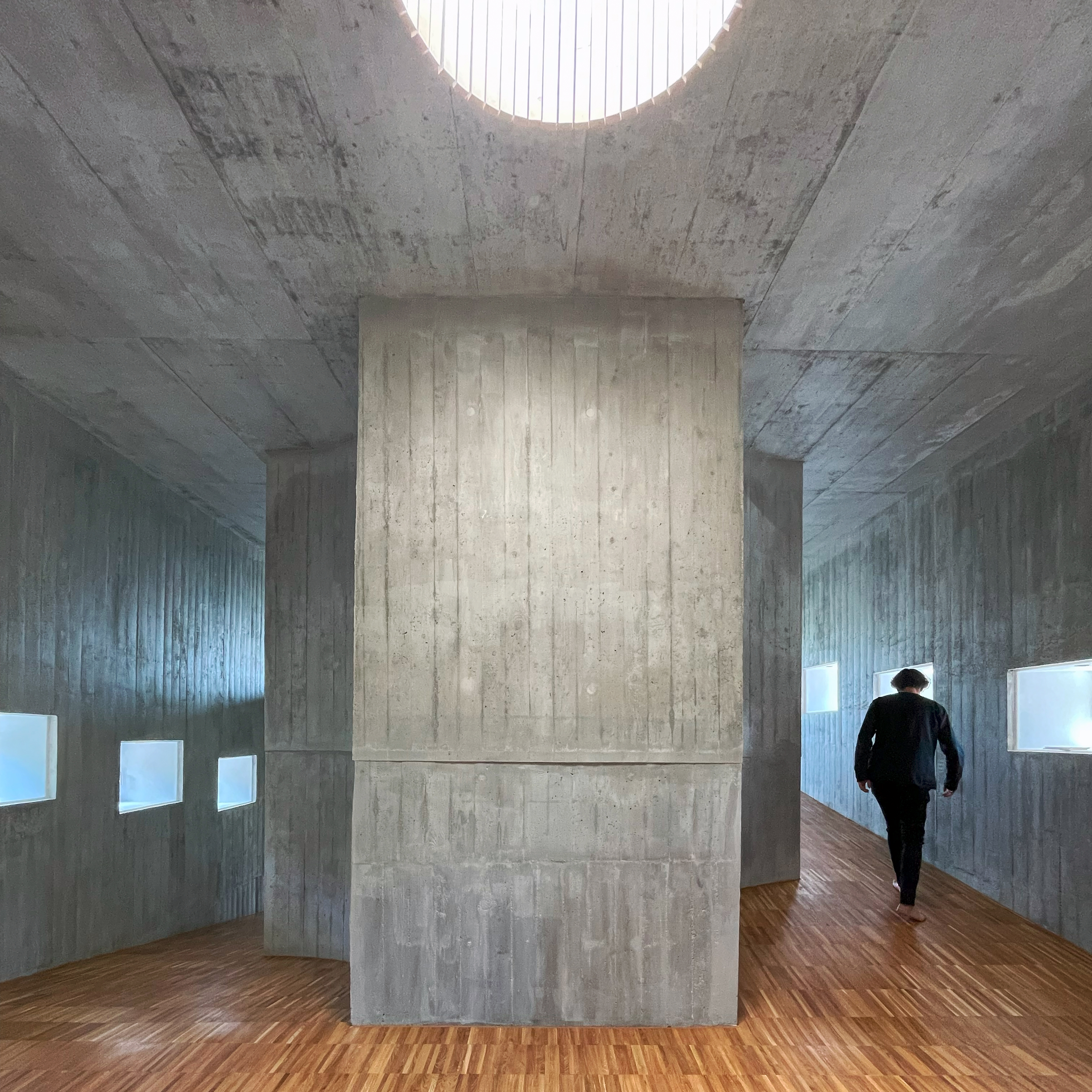


The house is the home of a tight hermit community in the high hills. The core of the building is the chapel. This is the essence of the house. The monastic life pulsates and circulates in the spaces around it. Thus the house is not only a space for dwelling, but in some way transcends itself.
Collaborators
Project management: Botond Bátor - Order of Saint Paul the First Hermit in Transylvania; Construction management: Károly Elekes - Impex Aurora; Structure: Jácint Virág - Lamina; Installations: Ciprian Georgiu - Qmeck Works; Installations: Kristian Kiss - Qmeck Works; Structure: Lajos Bencze - Lamina; Construction management: Attila Csiby - Impex Aurora; Project management: Péter Szántó - Impex Aurora
Program
Religion
-
Labels
Monastery
Site area
6600 m²
-
Client
Order of Saint Paul the First Hermit
Total gross floor
808 m²
Cost
789 €/m²
In a former mining settlement, within a post-volcanic topography, the monastery is placed on a steep, forested site with several mineral water springs. The new building bridges two levels through a row of pulsating spaces: the existing ensemble of the wooden chapel and the parish house on the upper part and the new access from below. Inside the tower-like volume, communal, liturgical, and dwelling functions are stacked in a simple, vertical order. The inner cloister circulation responds to the cold mountain climate, offering a sheltered, continuous connection between prayer and daily life.
A house is just a house. In the absence of aestheticization it simply exists. The project embraces this modest truth while confronting the challenge of creating spiritual gravity on a marginal, post-industrial mountain site. The program is organized along a central vertical axis — chapel, library, kitchen, and heating room — as both structural and spiritual backbone. Around it, the monastic cells unfold on split levels, connected by a continuous inner ramp replacing stairs with a slow, meditative ascent. The geometry of the inner core generates a pulsating sequence of spaces, alternating between contraction and expansion, turning movement into prayer. The haptic reality of the space is paired with an uniquely human scale. The curving opaion of the chapel breaks the scale and looks up to the sky through a huge inverted shingle paraboloid, evoking the multifaceted mystical convergence of divine and human optics. At the entrance a bridge marks the threshold between different worlds.
The monastery's outer shell is made of pigmented concrete poured layer by layer using sliding formwork. It recalls the stratification of the local mountain soil and gives the tower a geological presence. Inside, the raw concrete structure remains visible, its plank-imprinted surfaces revealing the logic of construction. Non-structural roughly whitewashed brick partitions are used to separate the cells from the cloister, softening the austerity and bringing a domestic atmosphere to the private spaces. Their surfaces contrast with the coldness of the concrete, enhancing tactile warmth. The building works with these contrasts: warm in its coldness, imposing in its nest-like human scale, carefully manufactured in its industrial appearance, ancient and timeless in its contemporarity. Local craftsmanship, durable materials and minimal detailing ensure long life and low maintenance in the alpine climate. Its unified, distinctive vibration and its acoustics weave together the hermit community.