-

Updated utopia
-
-
-
-
-
-
-
-
-
Name of work in English
Parasites
-
Name of work in original language
A Plan to Reactivate the Spanish Rural Landscape
Prize year
Young Talent 2023
-
Work Location
Cuenca, Spain
-
Author/s
Lourdes López Vílchez
-
School
Higher Technical School of Architecture - Polytechnic University of Valencia.
Valencia, Spain
Young Talent 2023 YT Nominees




Parasites
A Plan to Reactivate the Spanish Rural Landscape
Program
Ephemeral - Cultural & Social
-
Labels
Installation
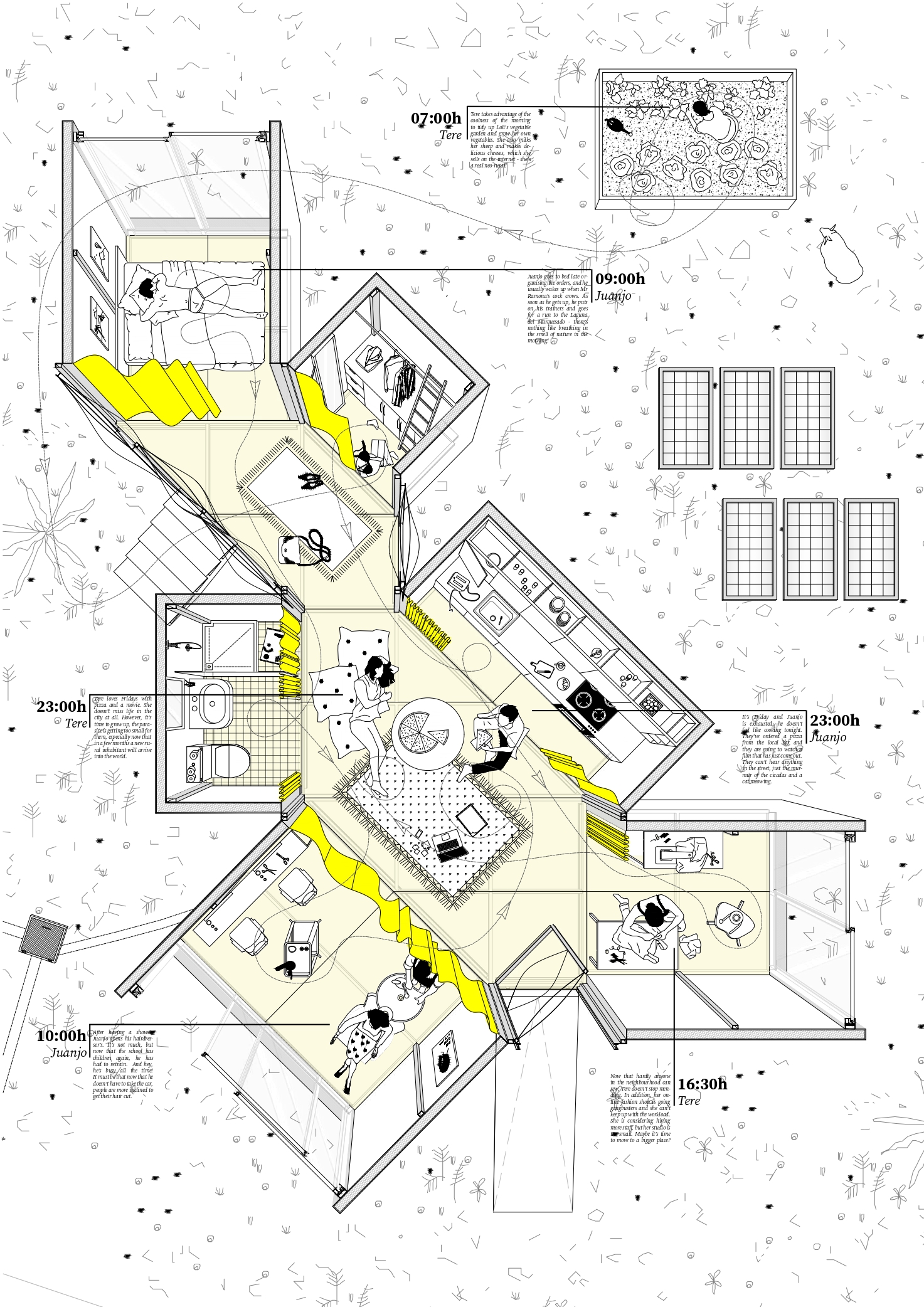
This project reflects on the term "inhabit" and proposes a model of nomadic and growing housing that serves as an injection into the territories of rural Spain attacked by the phenomenon of depopulation. It is an experimental housing project that accompanies the inhabitant aspiring to neo-rurality in their process of adapting to the environment.
The proposed repopulation process is based on several utopian projects from the 1960s and transposes the catastrophic vision that several authors had of the world to today's image of the rural environment. Just as the iconic project The Walking City proposes the injection of a nomadic city in a sick territory, here it is the "medicine-individuals" who disperse throughout the territory and generate small variations in the environment that will provoke the so-called "butterfly effect". The settlement in the environment would be carried out by means of minimal structures that satisfy the basic needs of habitation, as proposed in the “Chica nómada” project, and ephemeral structures that, like Prada Poole's projects, can be quickly implanted and, when they explode, leave the development generated during their period of implantation as an inheritance. An architectural piece is proposed that, like Fuller's domes, arrives and is implanted, solving the problem of shelter immediately. A light, low-cost, growing and nomadic piece is formulated to be placed on the plot of a second home in an attempt to provide a solution to the country's deficient rental market. This piece, therefore, uses both the physical and social terrain, as a relationship of mutual help is woven between the neo-rural individual and the host individual. PARASITA comes together as the juxtaposition of two architectures: a central space and a catalogue of partially pieces that need to be attached to it in order to provide them with functionality. Conceived as an evolving structure, the different elements are ready to build different configurations and habitats. This project celebrates the structures of ephemerality, which from the outset accept a finite lifespan and lend themselves to experimental innovation. The aim is to apply architecture and urban planning as a support structure to a process of reversing the demographic emptying of our small villages, to serve as a guide and to reach out to both the individual and the environment, in a delicate process that manages to restore the splendour still latent in the Spanish rural landscape.