-

VEGA IT Radnicki - panorama
-
VEGA IT Radnicki - street view
-
VEGA IT Radnicki - entrance plateau
-
VEGA IT Radnicki - main entrance
-
VEGA IT Radnicki - frame
-
VEGA IT Radnicki - south facade
-
Site plan
-
Groun floor plan
-
First floor plan
-
Typical floor plan
-
Facade and section
-
Axonometric view
Palace Vega IT Radnicki
Kuzmanov and Partners. Novi Sad, Serbia
-
Name of work in English
Palace Vega IT Radnicki
-
Name of work in original language
Palata Vega IT Radnički
Prize year
EUmies Awards 2026
-
Work Location
Novi Sad, Serbia
-
Studio
Kuzmanov and Partners
EUmies Awards 2026 Nominees


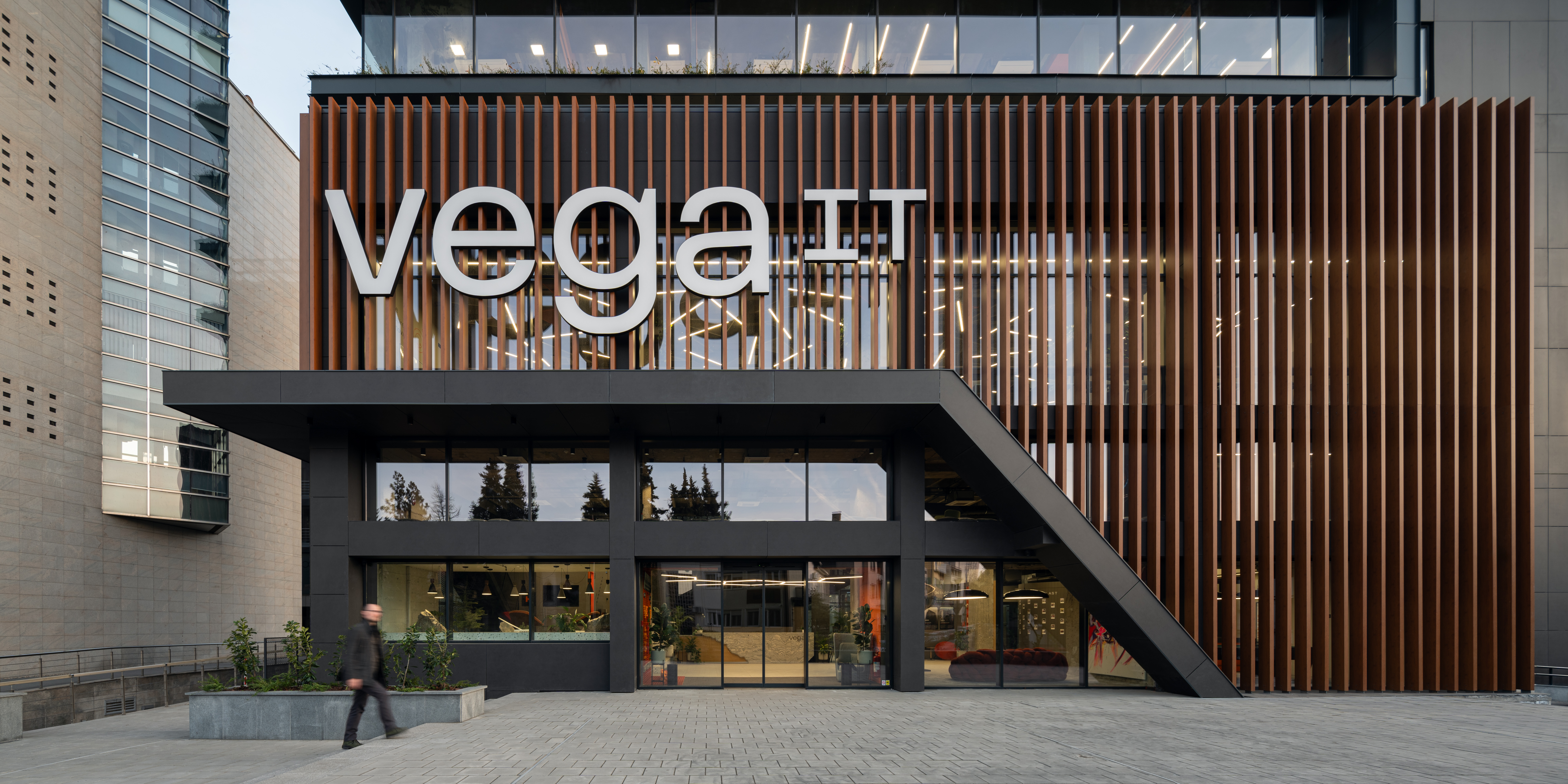


The conceptual design for the revival of the abandoned Radnicki university building, which was a mere structural skeleton after a fire in 2000, was to preserve the building's identity while incorporating contemporary design recognition and using new materials and modern claddings.
Collaborators
Collaborator (office): Aleksandar Kovjanić - TIM Inženjering Sistem
Program
Office
-
Labels
Corporative Building · Office
Site area
854 m²
-
Client
Vega IT
Total gross floor
6100 m²
Cost
3400 €/m²
The building of the former Radnicki university, built in 1966, was always a symbol of Novi Sad. It was a significant center of the city's social and cultural life, where generations of people were educated. A key principle in forming the conceptual design was to preserve the building's verticality. The introduction of a frame that encompasses the building had both a functional and aesthetic purpose. The building's main envelope is a glass "curtain wall" façade. The vertical division on the façade is contrasted by strong horizontal lines, thereby allowing the necessary dynamism.
The reconstruction of the Radnicki university building was a demanding, complicated, and major construction undertaking, given that the building had been, for all practical purposes, "clinically dead" since the fire about twenty years ago. Considering the existing elements of the building, including its structural system and the functional layout of the spaces, a solution was proposed that was technically the most feasible while respecting all volumetric constraints. The idea was to bring the access segment of the building closer to future users in the best possible way. The transparency of the glass surfaces, the airiness of the lobby, and the recognizable volume of the first two floors, which also act as the building's plinth, were the basic ideas for the gradation of this part of the building. The access staircase and the canopy form a unique element that provides an aesthetically pleasing solution for the entrance area.
The main skin of the building is a semi-structural glass curtain wall façade made of aluminum profiles. They form a self-supporting aluminum structure that is connected to the building by special anchors. The quality of the installed glass reduces UV rays, allowing the penetration of clean light for better light comfort in the workspace. The vertical division of the aluminum mullions on the façade is contrasted by strong horizontal lines. These strong horizontal elements are steel, with supports and cladding designed to also satisfy fire protection requirements for preventing fire spread from floor to floor. These elements are also designed to serve as supports for planters with vegetation. The translucent glass surfaces of the façade allow the atmosphere of the interior to be experienced in the exterior, making it visible from street perspectives. With this comprehensive approach to the building's design, a unity of aesthetic and functional architectural expression has been achieved.