-

The seven Sorrows converge above – a single point where earth and heaven meet in light
-
Seen from a distance, the chapel appears as a simple, elemental mass – view from Těšany.
-
The approach to the chapel along the gravel path is lined with an lane of apple trees.
-
Light pierces the sanctuary, finding a path of its own toward the hearts below
-
The old millstone is the central element of the sanctuary – it forms the tabernacle.
-
View toward the great gates and the future organ loft framed by slender fir lamellas
-
site plan - the chapel and orchard conclude the back paths at the southern edge of the village
-
concept scheme
-
groundfloor plan
-
section A–A'
-
detail – diagonal lamella drawing
-
lamella structure axonometry
Our Lady of Sorrows Chapel
RCNKSK. Nesvačilka, Czechia
-
Name of work in English
Our Lady of Sorrows Chapel
-
Name of work in original language
Kaple Panny Marie Bolestné
Prize year
EUmies Awards 2026
-
Work Location
Nesvačilka, Czechia
-
Studio
RCNKSK
EUmies Awards 2026 Nominees


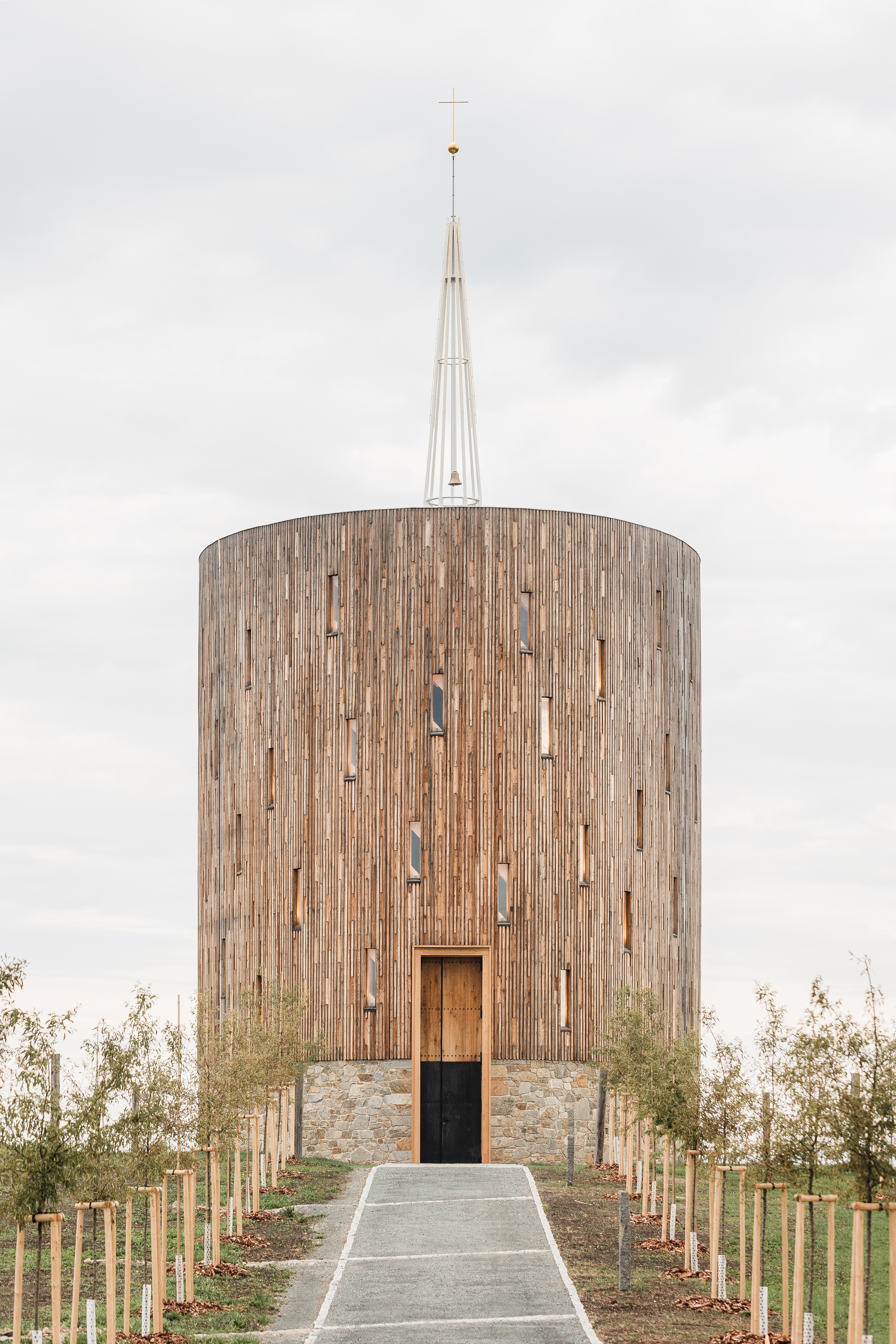


The central circular sacred structure, inspired by medieval construction methods, connects tradition with modern technology. The construction is made of hand-hewn beams and an innovative wooden lamellar structure produced using CNC machining. It rises from a stone plinth and an earthen floor.
Collaborators
Structure: Vít Mlázovský; Structure: Filip Chmel; Consulting: Michal Říčný - Atelier Tišnovka, s.r.o.; Landscape: Eva Wagnerová; Carpentry, Stonework: David Šebesta; CNC production: Karel Hrdlička; Metalwork and Steel Tower Construction: Tomáš Fiala; Substructure/Foundation: Miroslav Klein; Design and Production of the Chancel Elements: Dominik Fiala; realisation of rammed earth floor construction: Hanno Burtscher - Earthman Consulting; realisation of rammed earth floor construction: Matěj Janský; Furniture: Pavel Abrahámek; oak gates carpentry and steelwork: Daniel Golík; oak gates carpentry and steelwork: Jakub Jarcovják; Lighting: ETNA spol. s r.o.; quarry stone supplier: HUTIRA s.r.o.; lansdcape installation: Jiří Dohnálek; Installations: ELSTAR PLUS, s.r.o.,; heating, water supply and sewarage: František Ryšavý; photovoltaicsystem installation: Svoboda a syn, s.r.o.; security systems (EZS): MAXPROGRES, s.r.o.,
Program
Religion
-
Labels
Chapel
Site area
3750000 m²
-
Client
The Roman Catholic parish of Moutnice
Total gross floor
150 m²
Cost
6600 €/m²
The vision was to create a building that would shape the landscape and leave a lasting mark on local culture. For over a century, the people of Nesvačilka longed for a chapel — a place of silence and faith where the community could gather. Dedicated to Our Lady of Sorrows, it rises from the soil. The gneiss stones of its foundation symbolize us — stubborn, unyielding, difficult to shape. From them, seven beams ascend, recalling her Sorrows. The timber structure, interwoven with windows, lets light pierce the heart of the chapel and reach you. The entire construction was funded by donations.
A central structure is standing on a hilltop as a beacon — a point of orientation in both space and spirit. The use of natural materials, rare in this region — stone and wood — is symbolic: to bring faith into a parched landscape. Mary's story and emotions are reflected in the architecture itself. Upon the dust and soil of this place, which form the floor, we build a temple. The lower section, made of gneiss stones, represents us — stubborn, disobedient, and difficult to mould. From these stones, seven beams rise toward the heavens, symbolising the Seven Sorrows of Mary and our connection to God. From the sky descends a veil of Mary’s tears, weeping over us. The delicate wooden structure, interwoven with slender windows, allows sunlight to reach the heart of the chapel throughout the day. The building is encircled by a ring of the Stations of the Cross, complemented by apple trees forming an avenue leading to the chapel, with an orchard behind connecting to the surrounding fields.
The structure blends tradition with modernity. The construction is inspired by medieval building techniques, in dialogue with modern technologies. The floor is made of compacted, rammed earth, while the walls are made of quarried stone. The supporting lamellar structure, made from a thousand wooden elements, traditionally joined with pegs and wedges, was crafted using CNC milling. The fifteen-meter-long beams are hand-carved, freely traversing the space, crowned by a steel spire on the roof. Upon entry, you are greeted by five-meter-high doors, opening into a dynamic space. The perspective of the beams and surrounding structure draws you upward. The chapel transcends time. What you experience is its expression, the play of light, acoustics, and scent. The materials are natural, tactile, and imbued with craftsmanship, aiming to lift you beyond the everyday. A key factor in material choice was the ability to age beautifully, enhancing rather than diminishing their quality over time.